
McDonald’s ended 2025 with nearly 210 million 90-day active loyalty users across 70 markets, and systemwide sales to loyalty members reached nearly $37 billion for the year.
Those numbers are definitely impressive, but the more interesting question is how McDonald’s makes the program work across countries with different menus, currencies, regulations, franchisees, and marketing teams.
In McDonald’s five leading markets (the United States, Canada, Germany, Australia, and the United Kingdom), a big part of the answer is SessionM, now a Capillary Technologies company, which has powered MyMcDonald’s Rewards since 2021. The rest comes down to a repeatable rollout process and enough freedom for local teams to run their own markets.
In this article, we’ll see how this works and how you can apply it to your business.
One loyalty program, different local experiences
McDonald’s expanded MyMcDonald’s Rewards across five major markets, including the United States, Canada, Germany, Australia, and the United Kingdom. Those five markets launched MyMcDonald’s Rewards between July 2021 and July 2022, and SessionM supported every launch.
Across all five markets, the basic model was the same. Customers earn points, see rewards in the app, and use them on future purchases. That’s it.
However, these basics changed slightly by market, including how points work locally and what customers can redeem them for.
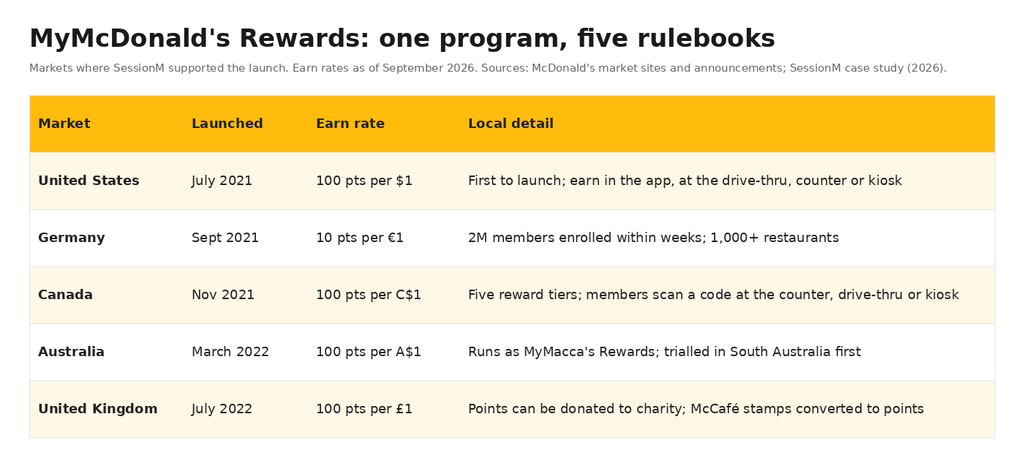
Five-market comparison of MyMcDonald’s Rewards rules (as of September 2026)
For instance, look at the earn rate first. In the US, customers earn 100 points for every dollar spent on qualifying purchases.
Canada, Australia, and the United Kingdom use the same 100-points approach in their own currencies. Each sets its own reward menu and point thresholds, as the rewards page for McDonald’s Australia shows.
The United Kingdom takes a similar approach to the US, but its current program applies rewards and charity options differently. Of the five, only Germany differs almost entirely because of variations in currency and points allocation, though it follows the same principles as the others.
So “one program” does not mean identical rules. It means one earning logic, one member identity, one set of channels, and local control over everything the customer actually sees on the redemption screen.
SessionM, a key part of McDonald’s loyalty infrastructure
SessionM, now a Capillary Technologies company, has powered MyMcDonald’s Rewards since 2021, following a partnership with McDonald’s that began in 2018.
McDonald’s own team calls SessionM “the backbone of our loyalty program” in the case study. MyMcDonald’s Rewards still runs on a mix of vendors that varies by region, so SessionM is one important layer of a larger stack.
SessionM homepage
Three parts of SessionM’s role help explain how McDonald’s scaled loyalty across markets.
- Customer data stays connected
SessionM keeps a single real-time profile for each customer and updates it with information from their purchases and other interactions. The loyalty program can then use that information as the customer moves between different channels.
At the drive-thru, for example, SessionM’s POS APIs can look up a customer’s loyalty information and available offers during the transaction. This real-time sync speeds up responses and improves the customer experience.
- New markets start from an existing setup
McDonald’s does not have to build a completely different loyalty system every time it enters another market.
SessionM uses a templated implementation approach for multi-country organizations. A new market can build on an established structure and adapt only the parts that need to be local.
That makes the rollout more repeatable.
- Franchise rules stay behind the scenes
McDonald’s also has to deal with different restaurant ownership structures.
SessionM solved that by developing custom logic that allows corporate-owned and franchisee-owned restaurants to manage points separately while customers still see one loyalty balance.
This drastically reduces the financial complexity of loyalty rewards and keeps the customer experience simple.
The rollout method and where local teams come in
The way McDonald’s rolled out the program is just as useful as the technology behind it.
In the early markets, SessionM’s team designed and managed campaigns directly with local McDonald’s marketing teams.
As teams became more familiar with the platform, they took over campaign management through training and documentation, while SessionM remained available for strategic support and subject-matter expertise.
This ultimately creates a simple setup. The global team looks after the platform, customer identity, and guardrails. Local teams handle the campaign calendar, creative, and rewards for their market. So the same loyalty program can feel different from one market to another without losing its core structure.
It is similar to how agencies build local SEO for clients expanding into new cities. You keep the main strategy consistent, then adapt the execution to each location.
Loyalty should work across channels
For McDonald’s program to work, it had to be implemented across all of its channels, including the mobile app, kiosks, front counter, drive-thru, and McDelivery, rather than limiting loyalty to the app.
Customers could earn points through these channels, although the process differed by market. In the UK, for example, customers use a one-time code from the app when ordering at the counter or drive-thru. Canada uses QR code scanning, while Australia built loyalty directly into the MyMacca’s app.
Delivery has some differences too. Australia added McDelivery to the loyalty program in February 2023 after initially leaving it out. In the UK, customers earned points on McDelivery when they order through the McDonald’s app, but not through Uber Eats or Just Eat.
Bringing these channels into the same loyalty program gave customers one familiar way to earn and redeem rewards.
SessionM enabled McDonald’s campaigns at scale
With a real-time customer profile in place, McDonald’s ran larger and more complex loyalty campaigns across its markets.
The clearest example is a record-breaking Free McNugget Day, which drove more than 1 million mobile orders in a single day.
SessionM also supported McDonald’s multi-visit campaigns with channel restrictions, where members complete a set number of visits through a specific channel before receiving a bonus.
Across McDonald’s global loyalty program, the case study reports 52% growth in loyalty members, 47% growth in loyalty sales, and 44% growth in loyalty transactions from 2023 to 2024.
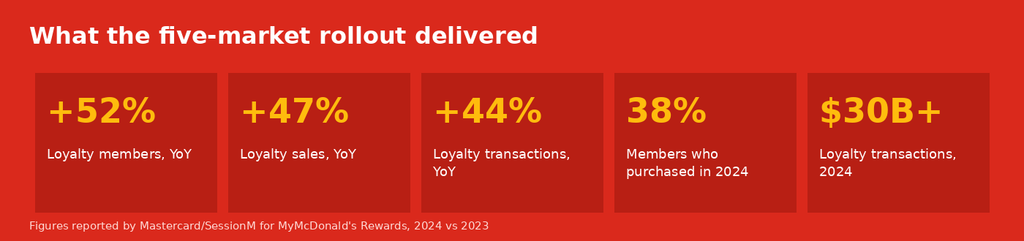
MyMcDonald’s Rewards global results, 2023 vs 2024
What you can take from McDonald’s loyalty strategy
You do not need tens of thousands of restaurants to apply the same thinking. Start with the parts that make the program easier to manage as you add locations.
- Keep the earning mechanic consistent. Pick one simple way for customers to earn points and use it across locations. You can still let each location or region set its own earn rate and decide what those points can buy.
- Agree on reward funding before launch. When several locations or franchisees are involved, decide who pays for each reward before the program goes live. Build those rules into the setup rather than sorting them out later.
- Make every important sales channel part of the program. Customers should be able to earn wherever they normally buy. Leaving out a major channel makes the loyalty experience feel incomplete.
- Use the first market as your template. When you open another location or market, reuse the core setup and adapt the campaigns, rewards, and other local details.
Frequently asked questions
What loyalty platform does McDonald’s use?
SessionM, now a Capillary Technologies company, has powered MyMcDonald’s Rewards since 2021 and supported its launches in the United States, Canada, Germany, Australia, and the United Kingdom. McDonald’s also works with other vendors, and its loyalty technology stack varies by region.
Is MyMcDonald’s Rewards the same in every country?
The model is the same everywhere: members earn points on purchases and redeem them for menu items. Earn rates, reward menus, and point thresholds are set locally. Most of the five markets award 100 points per unit of local currency, while Germany awards 10 points per euro.
How big is McDonald’s loyalty program?
At the end of 2025, McDonald’s reported nearly 210 million 90-day active loyalty users across 70 markets, and systemwide sales to loyalty members of nearly $37 billion for the year.
How does MyMcDonald’s Rewards work across franchised restaurants?
SessionM built custom logic so corporate-owned and franchisee-owned restaurants manage points separately, while customers get the same experience no matter who owns the restaurant.
Wrapping up
McDonald’s shows what becomes possible when your loyalty program is built to grow with the business. You can keep the core experience consistent across markets while still giving local teams room to run campaigns that fit their customers.
SessionM has supported that model since 2021 and continues to support McDonald’s as the program grows.
Want to see how SessionM can help scale your loyalty program across markets?