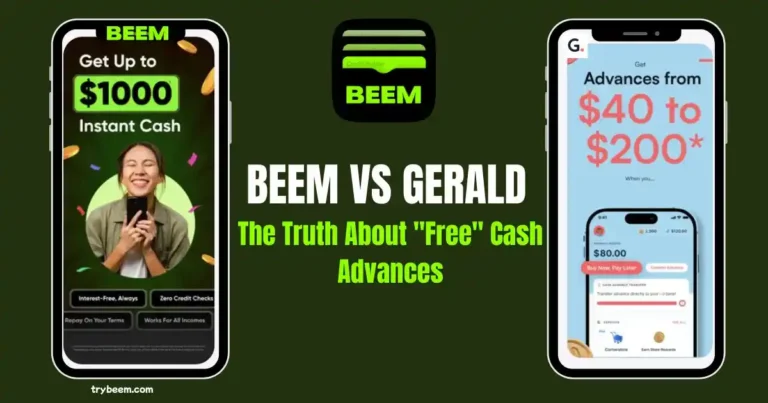

Compare Beem Vs Gerald in 2026
If you have been searching for a cash advance app that actually delivers when your bank account is running on empty, you have probably come across both Beem and Gerald.
On the surface, both platforms promise fee-free, interest-free cash advances – a tempting offer for Americans living paycheck to paycheck. But when you look under the hood, the differences between these two apps are significant, and for many users, the wrong choice could leave them more frustrated than financially relieved.
This in-depth Beem vs Gerald comparison cuts through the marketing language to show you what each app really offers, what the catch is, and which one gives you the most genuine financial support when it matters most.
Quick Verdict: Beem offers up to $1,000 in cash advances with no strings attached and a full suite of financial tools. Gerald’s “free” advance comes with a catch – you must spend a portion of your advance in their in-app store first.
What We Cover in This Guide
- What is Beem and how does Everdraft™ work?
- What is Gerald and how does its cash advance model actually work?
- Side-by-side feature comparison table for Beem vs Gerald
- The hidden strings behind Gerald’s “free” advance
- Which app is better for gig workers and irregular income earners?
- Real user experiences and BBB ratings
- Final verdict: Beem vs Gerald
What Is Beem? America’s AI-Powered Smart Wallet
Beem is an AI-powered Smart Wallet app built specifically for everyday Americans who need real financial flexibility – not just a temporary band-aid.
Whether you are dealing with an unexpected car repair, a medical bill, or just need to bridge a gap before your next paycheck arrives, Beem’s Everdraft™ feature gives you immediate access to cash without the traditional barriers that make financial emergencies even worse.
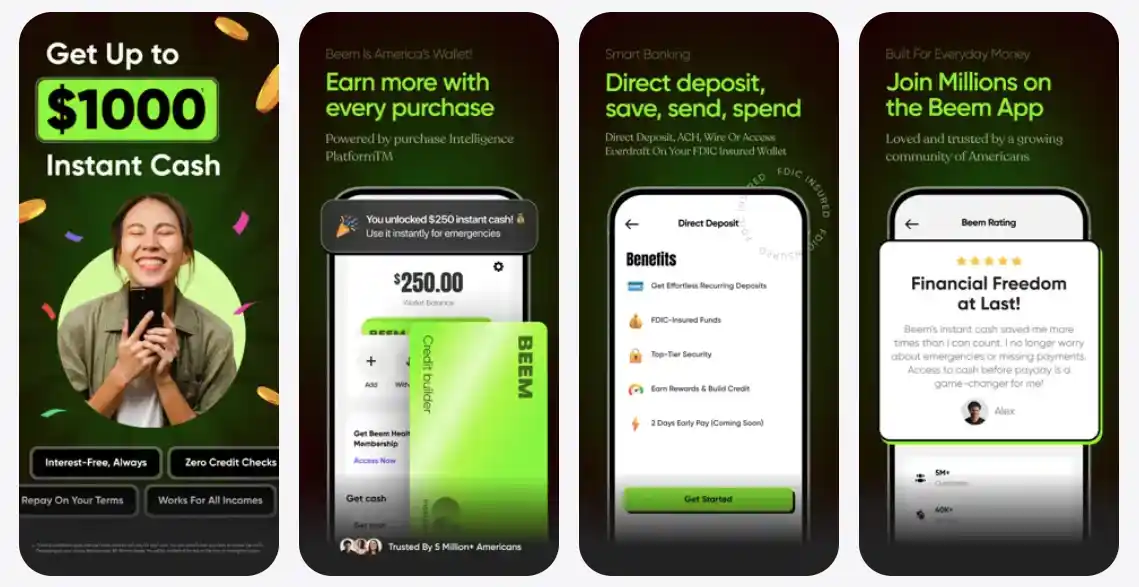
How Beem’s Everdraft™ Cash Advance Works
Everdraft™ is Beem’s flagship cash advance feature. Here is how the process works:
- Download the Beem app and create your account
- Connect your bank account – Beem’s AI analyzes your transaction history, income patterns, and spending behavior
- Check your eligible cash advance amount (between $5 and $1,000)
- Request the funds – no credit check, no income restrictions, no hidden fees
- Receive money via standard transfer (free) or instant transfer in minutes
- Repay at a pace that works for you – no hard due dates
What makes Everdraft™ unique is that the money goes directly into your bank account. There is no mandatory shopping requirement, no store purchase threshold to unlock your cash, and no subscription required to understand your eligibility.
Beem’s proprietary algorithm evaluates your financial profile holistically, which means gig workers, freelancers, and people with irregular income can still qualify.
Beem’s Pricing Plans
Beem offers a Basic (free) plan that includes budget planning (trial) and exclusive insurance offers. For full access to Everdraft™, credit monitoring, identity theft protection, and more, paid plans start at just $1.97/month – less than a cup of coffee. That transparency upfront is a hallmark of how Beem operates.
Beem’s Full Feature Set
Beem is not just a cash advance app – it is a comprehensive financial platform. Here is what subscribers get access to:
- Everdraft™ – instant cash advances up to $1,000 with no interest
- AI-powered budget planner with real-time financial alerts
- Credit monitoring and credit score improvement tools
- Identity theft protection
- Beem Companion Card – automatically builds your credit score with every purchase, reporting to all three major credit bureaus
- Peer-to-peer money transfers to anyone in the US and abroad
- Personal loan comparisons from $500 to $100,000
For someone who is trying to move from financial survival to financial stability, Beem is built to grow with you.
What Is Gerald? A Closer Look at the “Free” Cash Advance App

Gerald (joingerald.com) is a financial app that markets itself as a completely fee-free cash advance and Buy Now, Pay Later (BNPL) platform.
Founded in 2018 and backed by Y Combinator, Gerald has built an audience by promising zero interest, zero fees, and zero subscriptions. On paper, this sounds ideal.
But here is where it gets complicated.
How Gerald’s Cash Advance Actually Works
Gerald’s cash advance model is fundamentally different from what most people expect when they hear the word “advance.” Here is the process you are actually signing up for:
- Download Gerald and create an account
- Connect your bank account and verify your employment
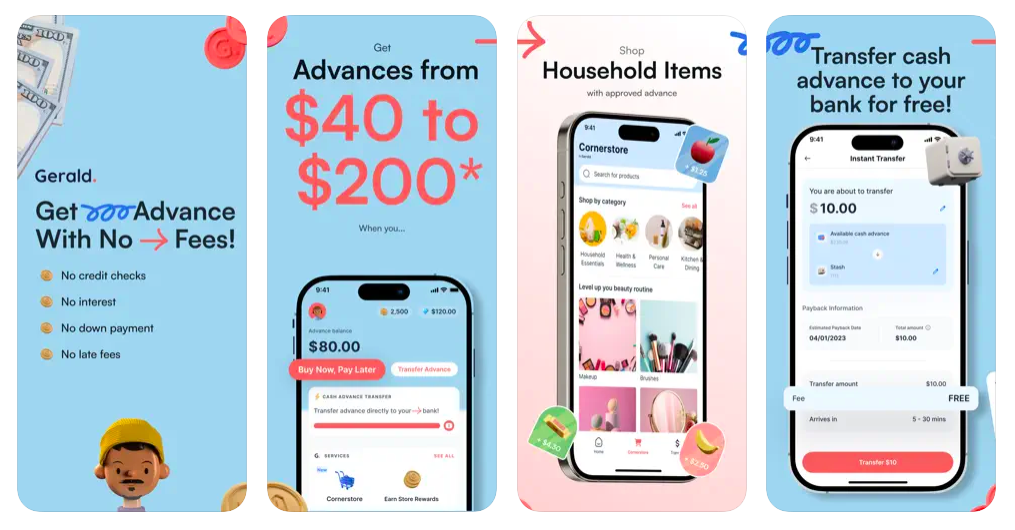
- Get approved for a cash advance – typically between $40 and $200
- REQUIRED: Spend a portion of that advance on Gerald’s in-app store, Cornerstore, or put it toward the Cranberry™ mobile phone plan
- THEN transfer whatever is left to your bank account
Let that sink in for a moment. If you are approved for a $100 advance, you may be required to spend $58 or more at Cornerstore before any cash is released to your bank. One verified App Store review described receiving a $100 advance, being forced to spend $58 in the store, and then only being able to transfer the remaining $35 to their bank – with additional fees noted. That is not a cash advance. That is a shopping mandate with a small payout.
Read the Fine Print: Gerald’s own App Store listing states in bold: “CASH ADVANCE TRANSFER IS ONLY AVAILABLE TO CUSTOMERS WHO PURCHASE ITEMS USING A PORTION OF THEIR ADVANCE FROM GERALD’S CORNERSTORE AND MEET THE REQUIRED MINIMUM ADVANCE SPEND THRESHOLD.”
Gerald’s Advance Limits
Gerald’s effective cash advance range is $10 to $200, though some platforms still cite the older $80 maximum. Either way, when you factor in the mandatory Cornerstore spending requirement, the actual liquid cash you receive in your bank account is significantly lower than whatever advance amount you are approved for. This is a critical distinction that many users only discover after signing up.
Gerald’s Revenue Model
Gerald earns money through merchant partnerships and retail sales via Cornerstore – which is precisely why they require you to make a purchase before unlocking a cash transfer.
The “free” advance is subsidized by your shopping behavior. There is nothing inherently wrong with this model, but it should be understood for what it is: a retail platform that offers limited cash access as an incentive to shop.
Beem vs Gerald: Side-by-Side Feature Comparison
| Feature | Beem (Everdraft™) | Gerald |
| Cash Advance Range | $5 – $1,000 | $40 – $200 |
| Monthly Subscription | From $1.97/month (Basic is free) | $0 – no subscription |
| Forced In-App Spending | ❌ None – get cash directly | ✅ Required (Cornerstore BNPL first) |
| Interest / APR | 0% – No interest ever | 0% APR – No interest |
| Credit Check Required | ❌ None | ❌ None |
| Transfer Speed | Instant (free) or standard | Instant (eligible banks) after BNPL spend |
| Income Restrictions | ❌ None | Requires employment verification |
| Credit Building | ✅ Yes – Companion Card reports to all 3 bureaus | ❌ No |
| Budget Planner | ✅ AI-powered | ❌ No |
| Free Tax Filing | ✅ Yes | ❌ No |
| Identity Theft Protection | ✅ Yes | ❌ No |
| BBB Rating | Accredited / Positive | F Rating – 63+ complaints |
| Money Transfers (P2P) | ✅ US & international | ❌ No |
| Gig/Freelancer Friendly | ✅ No income restrictions | Limited – payroll deposit preferred |
The Truth Behind Gerald’s “Free” Promise
Let’s be direct: Gerald is not lying when it says there are no fees or interest. Those statements are technically accurate. But the omission of the mandatory Cornerstore spending requirement in most of its headline marketing creates a gap between expectation and reality that has frustrated thousands of users.
What Gerald Users Are Actually Saying
The Better Business Bureau (BBB) tells a revealing story about Gerald’s customer experience. Gerald has received an F rating from the BBB, with over 63 official complaints filed over the past three years. The most common complaints include:
- Being required to buy overpriced products from Cornerstore as a condition of receiving cash
- High shipping fees on Cornerstore purchases eating into advance funds
- Not receiving approved advances at all, despite completing purchases
- Transfers delayed well beyond the promised timeframe
- Difficulty reaching customer service to resolve issues
- Repayment being initiated before the advance cash even arrived in users’ bank accounts
One particularly telling App Store review stated: “You have to use part of it on their store in the app before you can even transfer a small amount of the advance to your bank… The kicker is that I would have to repay the advance before I even received it according to their repayment schedule.”
These are not edge cases. They are patterns that have emerged from a model that, however well-intentioned, creates structural frustration for users who need straightforward financial relief.
What Beem Users Are Saying
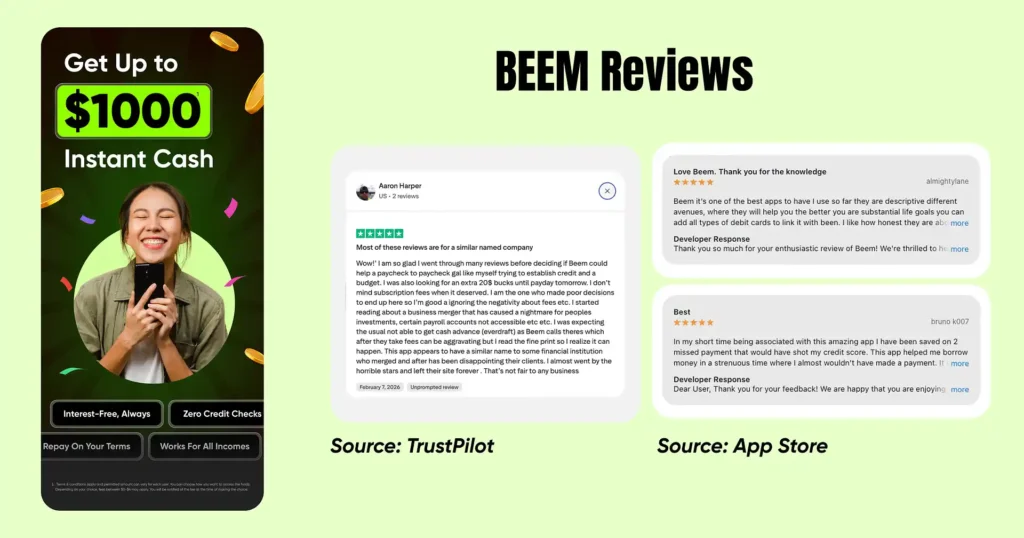
Beem users describe genuinely positive experiences with the app, especially when it comes to short-term financial relief during urgent situations. A common theme in favorable reviews is the ability to access small cash advances quickly when money is tight.
Users who found themselves short before payday often say that even modest amounts made a meaningful difference, whether it was covering groceries, gas, utility bills, or unexpected small expenses. For people living paycheck to paycheck, that quick access to funds created a sense of breathing room and reduced immediate financial stress.
Several users mention that once their account was set up and verified, the process of requesting an advance felt straightforward and relatively fast, which added to their overall satisfaction.
Another aspect that receives praise is the app’s convenience. Users appreciate being able to manage everything directly from their phone without visiting a physical location or filling out lengthy paperwork.
The digital setup, bank linking process, and dashboard tools are described by some reviewers as simple and easy to navigate. Positive feedback often highlights the clean interface and the clarity of the main features, noting that it doesn’t feel overly complicated for someone who just wants a quick solution.
For individuals who are not particularly tech-savvy, ease of use can make a significant difference, and some users state that they were able to understand how the system worked without confusion.
On the Apple App Store, Beem is described as the “#1 Cash Advance and Banking App” with automatic credit building. Common positive themes include the straightforward eligibility check, instant delivery speed, and the honesty about what users need to do to reach their financial goals.
Beem is FDIC insured and backed by established investors including Techstars and Goodwater Capital, providing a layer of institutional confidence that matters when you are trusting an app with your bank account.
Beem vs Gerald for Gig Workers and Freelancers
One of the most underreported differences between these two apps is how they treat users with non-traditional income. Millions of Americans work as rideshare drivers, freelancers, delivery workers, or side-hustlers – and most financial apps are built around the assumption of regular, direct-deposit paychecks.
Beem’s Approach to Irregular Income
Beem explicitly removes income restrictions from its eligibility criteria. The AI evaluates your bank account balance, transaction patterns, and spending behavior – not just whether you receive a biweekly paycheck from a single employer. This makes Beem one of the most accessible cash advance options available for the gig economy.
There are no requirements around minimum income thresholds or employer verification. If your financial history in your bank account demonstrates responsible activity, you can qualify for Everdraft™.
Gerald’s Approach to Irregular Income
Gerald requires employment verification as part of its eligibility process. While it states that eligibility is based on banking activity, the employment validation step creates a structural barrier for freelancers and gig workers whose income comes from multiple sources rather than a single employer.
For these users, Gerald may simply reject their application or approve them for the lowest available amount.
If you drive for Uber, work through Fiverr, or manage your own small business, Beem is the clearer choice.
Beem vs Gerald: Which App Builds Your Financial Future?
This is where the gap between Beem and Gerald becomes most apparent. Gerald is designed for one thing: small, short-term cash gaps. The company itself acknowledges that it does not offer budgeting tools, credit building, or larger loans. It is a one-feature product with a limited use case.
Beem, on the other hand, is built around the idea that financial wellness is a journey – and every user deserves tools that help them move forward, not just tread water.
Credit Building with Beem
The Beem Companion Card is one of the app’s most compelling differentiators. Every time you make a purchase with your Companion Card, Beem automatically reports positive payment history to all three major credit bureaus – Equifax, Experian, and TransUnion.
There is no separate credit builder loan to manage, no additional fees, and no waiting period. You simply spend money you were already going to spend, and your credit score improves over time.
For Americans living paycheck to paycheck who want to access better interest rates on loans, qualify for apartments, or eventually get a mortgage, this feature is genuinely transformative.
Tax Filing with Beem
Beem also offers free federal and state tax filing – a feature that can save users anywhere from $50 to $200 per year compared to paid services like TurboTax or H&R Block. For a household already stretched thin financially, that is a meaningful saving.
Identity Theft Protection with Beem
With financial fraud on the rise, Beem includes identity theft protection as part of its subscription plans. This kind of coverage typically costs $10 to $15 per month through standalone services. Bundled into Beem’s subscription starting at $1.97/month, it represents exceptional value.
When Would Gerald Be a Better Choice?
In the spirit of fairness, there are specific scenarios where Gerald might be the right choice for a user:
- You only need a very small advance ($20 to $50) and you were planning to buy household essentials from an online store anyway
- You want to pay for your Cranberry™ mobile phone plan using a portion of your advance
- You have absolutely no tolerance for any monthly subscription cost and your need is minimal and infrequent
- You are not a gig worker and receive consistent direct deposits from a single employer
Even in these cases, the Cornerstore spending requirement means you are not getting straight cash – you are getting retail credit first. If you go in with that expectation, Gerald is a legitimate (if limited) option.
But for anyone who needs real money in their bank account, fast, without conditions – Beem is the stronger choice by a significant margin.
Beem Alternatives and Gerald Alternatives: The Bigger Picture
When evaluating beem alternatives or gerald alternatives, it helps to understand what you are actually prioritizing. The cash advance space includes a range of apps – Dave ($500 max), Earnin ($750 max), Brigit ($250 max), MoneyLion ($500 max), and more – but few of them combine the advance limit ceiling, financial tool suite, and credit-building capability that Beem offers in one platform.
Gerald, while technically a competitor to both Beem and these other apps, operates on a fundamentally different business model that creates real friction for anyone who needs liquid cash without strings.
If you are looking at gerald competitors, you are essentially looking for apps that give you cash without requiring a purchase first – and that list includes virtually every other major player in the space.
What sets Beem apart from beem competitors is not just the advance limit (up to $1,000, higher than Dave, Earnin, or Brigit) but the full financial ecosystem it provides around that advance. You are not just patching a hole in your budget – you are building a more stable financial foundation.
Final Verdict: Beem vs Gerald
The tagline for this comparison says it all: the truth about “free” cash advances. Gerald has built its brand on the word free, but free is only meaningful when you get what you actually need.
Requiring users to spend money in an in-app store as a condition of accessing their own advance is not a financial service – it is a retail strategy with a financial wrapper around it.
Beem, by contrast, does charge a modest subscription fee for its premium features. But what you get for that fee – up to $1,000 in cash with no conditions, AI-powered financial management, credit building, free tax filing, identity protection, and peer-to-peer money transfers – is a complete financial solution designed for real American life.
If you are living paycheck to paycheck and you need an app that is on your side without fine print, mandatory shopping, or structural friction, the choice is clear.
Bottom Line: Beem gives you real cash, real tools, and real long-term value. Gerald gives you a shopping mandate dressed up as a cash advance. For everyday Americans who need genuine financial support, Beem wins – and it is not close.
Ready to Experience the Difference? Download Beem today and check your Everdraft™ eligibility in minutes – no credit check required.
Frequently Asked Questions: Beem vs Gerald
Is Beem or Gerald better for bad credit?
Both apps skip the traditional credit check. However, Beem goes further by not requiring income verification or employment confirmation, making it more accessible to a wider range of users, including those with no credit history. Beem also actively helps you build credit through its Companion Card feature, which Gerald does not offer.
What is the maximum cash advance I can get from Beem vs Gerald?
Beem’s Everdraft™ allows users to access between $5 and $1,000 – the highest ceiling among the major cash advance apps. Gerald offers between $10 and $200 in approved advances, but the actual cash deposited to your bank is always less, because a portion must be spent at Cornerstore first.
Does Gerald really have no fees?
Gerald does not charge subscription fees, interest, or transfer fees. However, the mandatory requirement to spend a portion of your advance at their Cornerstore creates an indirect cost – you are required to make a retail purchase to access your cash. Whether this counts as a “fee” depends on how you define the term, but it is definitely a condition that limits your flexibility.
Can gig workers and freelancers use Beem?
Yes. Beem has no income restrictions and does not require employment verification. The app evaluates your eligibility based on your actual banking activity, making it ideal for rideshare drivers, freelancers, delivery workers, and others with irregular income. Gerald, by contrast, requires employment verification, which can be a barrier for non-traditional workers.
Is Beem safe and legitimate?
Yes. Beem is FDIC insured, backed by institutional investors including Techstars and Goodwater Capital, and has a growing base of positive user reviews on both the Apple App Store and Google Play. The company is transparent about its fees, eligibility process, and data usage. It is a fully legitimate financial technology company.
What are the best Gerald alternatives?
If you are looking for gerald alternatives that offer straight cash advances without a mandatory shopping requirement, the top options include Beem (up to $1,000), Dave (up to $500), Earnin (up to $750), MoneyLion (up to $500), and Brigit (up to $250). Among these, Beem offers the highest advance limit and the most comprehensive set of financial tools alongside the advance.
Disclaimer: This article is for informational purposes only. Beem does not provide financial, legal, or accounting advice. Features, limits, and pricing are subject to change. Always review the latest terms and conditions on the respective app before making a financial decision.