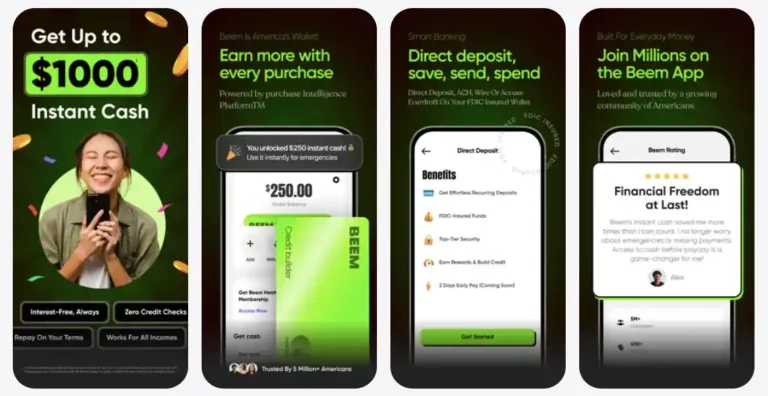

Beem and EarnIn are two of the most popular cash advance apps in the United States, but they take very different approaches to helping users bridge the gap between paychecks.
Beem offers Everdraft, a cash advance up to $1,000 with no interest and no credit check, alongside AI-powered budgeting tools, cashback rewards, and credit-building services.
EarnIn provides earned wage access (EWA), letting users withdraw money they have already earned before payday. This guide compares both apps across features, fees, accessibility, and overall value so you can decide which one fits your financial life.
How Does Beem Work?
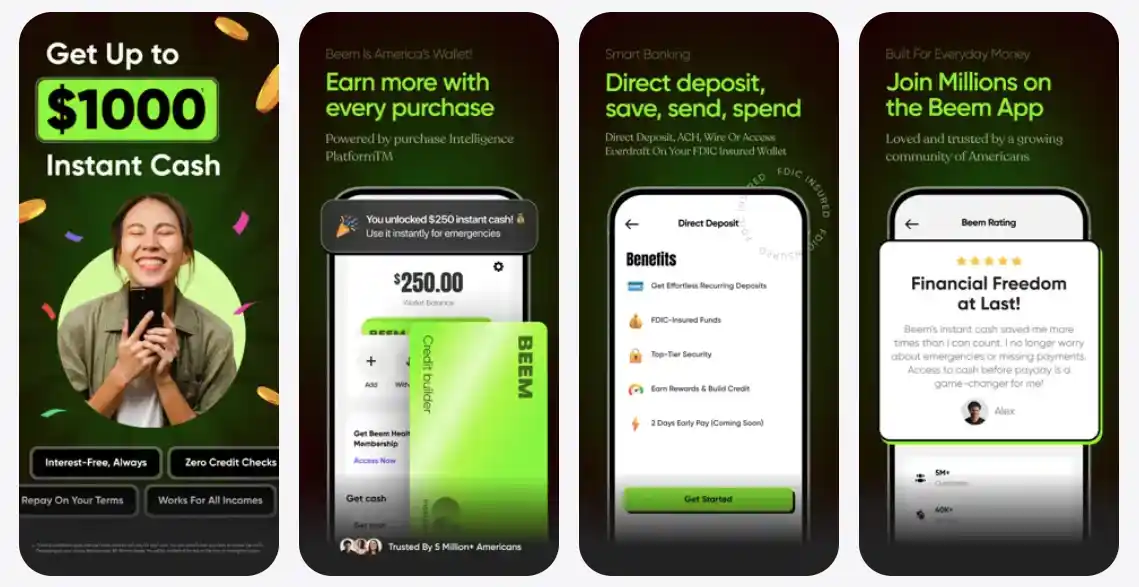
Beem is an all-in-one financial wellness platform built around its signature feature, Everdraft. Users can access cash advances up to $1,000 without a credit check and without paying interest.
The app does not require employer verification, which means freelancers, gig workers, and self-employed individuals can use it just as easily as salaried employees.
Beyond cash advances, Beem provides a full suite of financial tools. BudgetGPT uses AI to analyze spending patterns and offer personalized budgeting recommendations. PriceGPT helps users compare prices before making purchases.
DealsGPT surfaces cashback offers and discounts across thousands of brands. Users also get access to credit-building features, and even Will and Trust services, all within a single app.
Beem operates on a subscription model with different tiers that unlock higher Everdraft limits and additional features.
All financial services on the platform are FDIC-backed, adding an extra layer of security for users who are cautious about fintech apps.
How Does EarnIn Work?
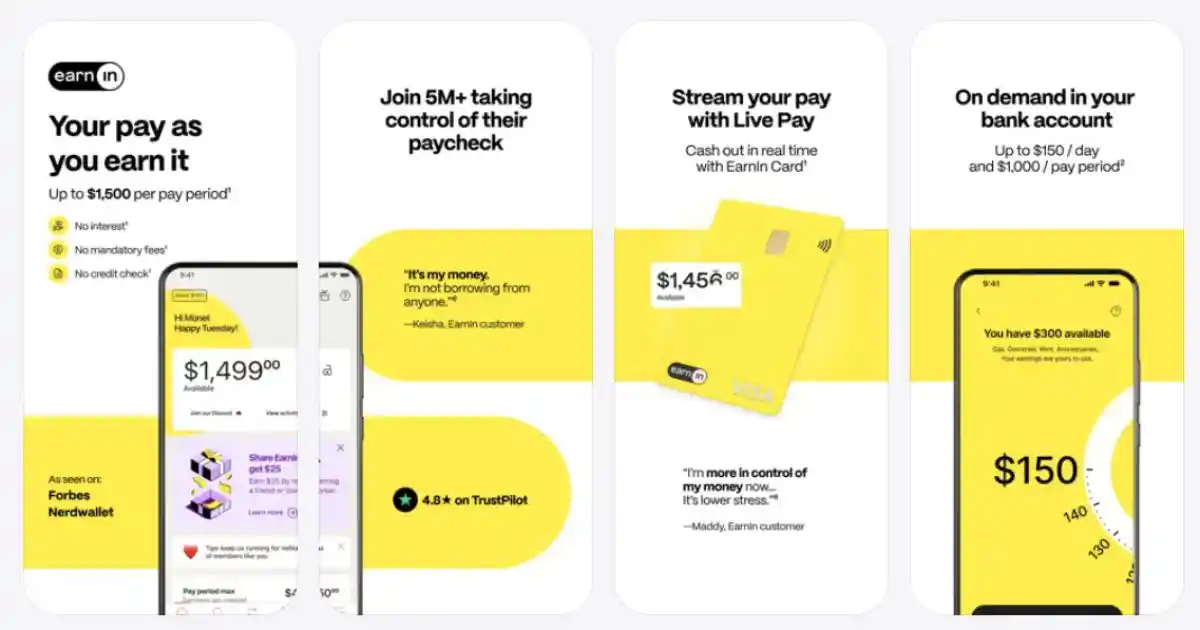
EarnIn uses a model called earned wage access. It connects to your employer’s timekeeping system or your bank account to verify the hours you have already worked. Based on that data, you can withdraw a portion of your earned but unpaid wages before your official payday.
EarnIn does not charge traditional interest or fees. Instead, it operates on a voluntary tip model. Users can choose to tip any amount (or nothing) when they receive an advance.
The app also offers features like Balance Shield, which sends alerts when your bank balance drops below a set threshold, and Lightning Speed, which delivers funds faster for an optional fee.
One important distinction is that EarnIn’s core advance feature depends on employer integration or verifiable direct deposit.
If your employer does not work with EarnIn’s system, or if you are a freelancer or gig worker without a consistent pay schedule, your access may be limited or unavailable.
Beem vs EarnIn: Feature-by-Feature Comparison
| Feature | Beem | EarnIn |
| Cash Advance Limit | Up to $1,000 (Everdraft) | Up to $100 per day / $750 per pay period |
| Interest Charges | None | None (tip-based model) |
| Credit Check Required | No | No |
| Employer Verification Needed | No | Yes (or verifiable direct deposit) |
| Freelancer/Gig Worker Friendly | Yes | Limited |
| Speed of Funds | Minutes | Standard: 1-3 business days; Lightning Speed: minutes (fee applies) |
| AI Budgeting Tools | Yes (BudgetGPT, PriceGPT, DealsGPT) | No |
| Cashback & Rewards | Yes | No |
| Credit Building | Yes | No |
| Shared Access (Family/Friends) | Yes (Beem Pass) | No |
| Tax Filing Tools | Yes | No |
| Will & Trust Services | Yes | No |
| FDIC-Backed | Yes | No |
| Pricing Model | Monthly subscription | Free (optional tips + Lightning Speed fees) |
| App Store Rating (iOS) | 4.8 | 4.6 |
Which App Gives You More Cash When You Need It?
Beem offers significantly higher cash advance limits compared to EarnIn. With Everdraft, users can access up to $1,000 depending on their subscription tier and usage history. Beem Boost allows responsible users to unlock even higher limits over time.
EarnIn caps daily withdrawals at $100 and limits total advances to $750 per pay period. These limits depend on your verified earnings, so if you have not worked enough hours in a given cycle, your available advance may be lower.
For users facing a larger unexpected expense, such as a car repair or medical bill, Beem’s higher ceiling provides more breathing room. EarnIn works well for smaller, day-to-day shortfalls but may fall short when bigger emergencies arise.
Which App Is More Accessible to All Americans?
Beem serves a broader range of Americans because it does not require employer verification. Whether you are a salaried employee, a gig worker driving for a rideshare company, a freelance designer, or a small business owner, you can access Everdraft based on your income history rather than your employer’s participation.
EarnIn’s earned wage access model is built around employer integration. If your workplace uses compatible timekeeping software, the process is smooth. But if you work for a small business that does not use digital timekeeping, or if you are self-employed, EarnIn may not be able to verify your earnings.
This limits its reach for the millions of Americans working in the gig economy, freelancing, or operating small businesses.
According to the Bureau of Labor Statistics, over 57 million Americans participate in gig or freelance work. For this growing segment of the workforce, employer-dependent models create a barrier that apps like Beem have eliminated.
What Are the True Costs of Each App?
Understanding the real cost of using each app is essential for making a smart decision.
Beem’s Cost Structure
Beem does not charge many common fees found in traditional or some cash advance apps:
- No interest on cash advances
- No late fees
- No overdraft fees
- No credit check fees
There is no interest on cash advances. No hidden fees. What you borrow is what you repay. The subscription model creates predictable, transparent costs.
EarnIn’s Cost Structure
EarnIn markets itself as free, but there are costs to consider. The voluntary tip model means users are encouraged (though not required) to leave a tip each time they take an advance.
While tipping is optional, the app uses behavioral nudges to suggest amounts, and research has shown that many users feel social pressure to tip. Lightning Speed, which delivers funds in minutes instead of days, costs an additional fee per transaction.
The Consumer Financial Protection Bureau (CFPB) has examined earned wage access products and noted that tips and fees associated with these services can function similarly to traditional borrowing costs when calculated on an annualized basis.
Does Beem or EarnIn Offer Better Financial Tools?
Beem offers a significantly broader set of financial tools compared to EarnIn, which is primarily focused on wage access.
Beem’s Financial Ecosystem
Beem takes an all-in-one approach to financial wellness. Beyond Everdraft, the platform includes BudgetGPT, an AI-powered budgeting assistant that analyzes your income and spending patterns and provides personalized recommendations. PriceGPT compares prices across retailers before you buy. DealsGPT finds cashback opportunities and coupon deals at thousands of brands.
Users also get access to credit-building tools that help improve their credit score over time, tax filing guidance, and even estate planning through Will and Trust services. Beem Pass lets you share access with friends or family, which is particularly useful for households managing shared finances or creative teams dealing with irregular income.
EarnIn’s Feature Set
EarnIn focuses on its core product: earned wage access. It also offers Balance Shield (low-balance alerts), a savings feature called Tip Yourself, and Credit Monitoring. While these are helpful, they are relatively limited compared to Beem’s integrated ecosystem of AI tools, rewards, credit building, and financial planning services.
Is Beem Safer Than EarnIn?
Both apps prioritize user security, but their safety profiles differ in meaningful ways.
Beem’s financial services are FDIC-backed, which means your funds are insured up to the standard $250,000 limit by the Federal Deposit Insurance Corporation. This is the same protection you get with traditional banks, providing a strong safety net for your money.
Beem also uses bank-level encryption to protect personal and financial data. The platform is transparent about its fee structure, with no hidden charges or surprise costs.
EarnIn also uses encryption and follows standard security practices. However, EarnIn does not carry FDIC-backed protection on its core service. Users should be aware that the tip-based model, while positioned as optional, has drawn scrutiny from consumer advocacy groups regarding transparency.
For users who prioritize institutional-grade security and clear, upfront pricing, Beem’s FDIC backing and subscription model offer a more traditional safety framework.
Which App Has Better User Reviews?
User reviews provide valuable real-world insight into how each app performs.
Beem holds a 4.8-star rating on the iOS App Store, with users frequently praising the speed of Everdraft advances, the range of financial tools, and the transparency of the subscription model.
Common positive themes include the ease of getting cash without credit checks and the value of AI budgeting features.
EarnIn holds a 4.6-star rating on the iOS App Store. Users appreciate the simplicity of the earned wage access model and the ability to get cash before payday.
However, some reviews mention frustration with the employer verification requirement, daily withdrawal limits, and the pressure to tip.
Both apps maintain strong ratings, but Beem’s higher score and broader feature set tend to resonate with users looking for more than just a cash advance.
Who Should Choose Beem?
Beem is the better choice if you are looking for a comprehensive financial platform, not just a cash advance app. It is particularly well suited for:
- Gig workers and freelancers who do not have a traditional employer to verify earnings
- Users who need higher advance limits (up to $1,000 vs EarnIn’s $100/day cap)
- People who want AI-powered budgeting and spending insights to build healthier financial habits
- Families or groups who want to share access through Beem Pass
- Anyone building or rebuilding credit who wants integrated credit-building tools
- Users who value FDIC-backed security and transparent, predictable pricing
Who Should Choose EarnIn?
EarnIn may be a good fit if you are a salaried employee with a compatible employer and your needs are primarily limited to small, frequent advances. Consider EarnIn if:
- Your employer integrates with EarnIn’s system and you have verifiable direct deposit
- You only need small amounts ($100 or less per day) to cover minor gaps
- You prefer not to pay a subscription fee and are comfortable with the tip-based model
- You do not need additional financial tools like budgeting, rewards, or credit building
The Verdict: Which App Serves More Americans?
When it comes to serving the broadest range of Americans, Beem has a clear advantage. Its lack of employer verification requirements means it is accessible to salaried workers, gig workers, freelancers, and self-employed individuals alike. Higher cash advance limits through Everdraft give users more flexibility during financial emergencies. And its integrated ecosystem of AI tools, cashback rewards, credit building, tax services, and estate planning makes it far more than a simple cash advance app.
EarnIn is a solid option for traditional employees who need quick access to small amounts of earned wages. But its employer-dependent model and limited feature set mean it serves a narrower segment of the population.
For Americans looking for a single app that combines emergency cash access with long-term financial wellness tools, Beem delivers more value across more situations.
People Also Ask About BEEM vs EarnIn
Is BEEM better than EarnIn for cash advances?
Beem offers cash advances up to $1,000 through Everdraft with no interest and no credit check, while EarnIn caps advances at $100 per day and $750 per pay period. For users who need higher limits and do not want to rely on employer verification, Beem provides a more flexible option.
Does EarnIn charge fees?
EarnIn does not charge mandatory fees but uses a voluntary tip model that encourages users to tip after each advance. Lightning Speed, which delivers funds in minutes, carries an additional fee. While tips are optional, the CFPB has noted that such costs can resemble traditional borrowing fees when annualized.
Can gig workers use EarnIn?
EarnIn requires employer verification or verifiable direct deposit, which limits access for gig workers, freelancers, and self-employed individuals. Beem does not require employer verification, making it accessible to all types of workers regardless of employment structure.
Is Beem safe to use?
Beem is FDIC-backed, meaning user funds are insured up to $250,000 by the Federal Deposit Insurance Corporation. The platform uses bank-level encryption and offers transparent pricing with no hidden fees. These protections align with the same standards used by traditional banks.
Which app has better financial tools?
Beem offers a significantly broader range of financial tools, including BudgetGPT, PriceGPT, DealsGPT, cashback rewards, credit building, tax filing guidance, and Will and Trust services. EarnIn focuses primarily on earned wage access with limited additional features like Balance Shield and basic credit monitoring.
Can I share my Beem account with family?
Yes. Beem Pass allows users to share access to Everdraft and other financial tools with friends or family members under one subscription. This feature is especially helpful for households managing shared finances or groups dealing with irregular income.
How fast can I get cash from Beem vs EarnIn?
Beem delivers Everdraft funds within minutes of approval. EarnIn’s standard delivery takes one to three business days, with an optional Lightning Speed upgrade for faster (but not free) delivery. For users who need cash immediately, Beem’s standard speed matches EarnIn’s premium tier.
Disclaimer: This article is for informational purposes only and does not constitute financial advice. Cash advance features, limits, and terms may vary based on eligibility, subscription tier, and account history. Always review the latest terms on each app’s official website before making financial decisions.