
Both payday loans and cash advances promise the same thing: money before your next paycheck. Both target the same people: workers living paycheck to paycheck who need $200 or $500 to cover a bill, a repair, or an emergency that cannot wait until Friday.
And both exist because the traditional banking system has failed to serve the 60% of Americans who could not cover an unexpected $1,000 expense without borrowing.
But that is where the similarities end. The difference between payday loans and cash advances is not a technicality.
It is the difference between a financial tool that helps you bridge a gap and a financial trap that makes the gap wider. In 2026, understanding payday loans vs cash advances is not just a money question. It is a safety question.
This guide breaks down exactly how each works, what they cost, how they affect your credit, and which one you should actually use when you need cash fast.
What Is a Payday Loan?
A payday loan is a short-term, high-interest loan typically ranging from $100 to $1,000. You borrow a fixed amount, the lender charges a fee (usually $15 to $30 per $100 borrowed), and you repay the full amount plus fees on your next payday, typically within two to four weeks.
Most payday lenders do not run a traditional credit check, which is part of their appeal for borrowers with poor credit.
Here is what payday loans actually cost in annual terms: a $15 fee on a $100 two-week loan equals a 391% APR. A $25 fee equals a 652% APR.
For context, the average credit card APR in 2026 is roughly 22% to 28%. Payday loans cost 15 to 30 times more than credit card debt.
The repayment structure creates a second problem. Because the full balance plus fees is due on your next payday, borrowers frequently cannot afford the lump-sum repayment and roll the loan over into a new loan, paying another round of fees on the same principal.
According to the CFPB, the average payday borrower takes out eight loans per year and spends more on fees than on the original amount borrowed. This rollover cycle is the core of the payday lending business model and the primary reason the cash advance vs payday loan debate matters so much.
What Is a Cash Advance App?
A cash advance app is a mobile platform that provides small, short-term advances (typically $50 to $1,000) against your next paycheck or expected income.
The key distinction in the payday loans vs cash advances comparison: most cash advance apps charge zero interest and instead operate on subscription fees, optional tips, or express delivery charges that are dramatically cheaper than payday loan fees.
Cash advance apps connect to your bank account, analyze your income and spending patterns, and determine how much you can safely borrow and repay from your next deposit.
When your paycheck arrives, the advance is automatically deducted. There is no rollover, no compounding fees, and no debt spiral.
Popular cash advance apps in 2026 include Beem, Dave, Brigit, EarnIn, and Cleo. Each operates slightly differently, but the model is the same: advance money at low or zero cost, repay automatically, and move on.
The cash advance app model exists because technology made it possible to verify income and deliver funds at a fraction of payday lending’s cost.
Payday Loans vs Cash Advances: Side-by-Side Comparison
| Feature | Payday Loans | Cash Advance Apps |
| Typical Amount | $100 to $1,000 | $20 to $1,000 |
| Interest/Fees | $15-$30 per $100 (391-780% APR) | Zero interest; optional tips or small subscription fees |
| Repayment Term | Lump sum on next payday (2-4 weeks) | Automatic deduction from next deposit |
| Credit Check | Usually none (some soft checks) | None (bank activity verified instead) |
| Credit Impact | No positive reporting; collections if defaulted | No hard inquiry; some apps offer credit building |
| Rollover Risk | High (average borrower takes 8 loans/year) | None (automatic repayment, no rollover option) |
| Delivery Speed | Same day or next day | Same day to 1-3 business days |
| Regulation | Varies by state; banned in some states | Federally and state regulated as fintech products |
| Access Method | Storefront, online, or tribal lender | Mobile app |
| Debt Trap Risk | Very high | Very low |
The comparison table makes the difference between payday loans and cash advances stark. On virtually every metric that matters to borrowers, cash advance apps outperform payday loans. The cost is lower. The repayment is safer. The credit impact is neutral or positive. The debt trap risk is nearly eliminated.
The Real Cost Comparison
Numbers tell the story. Here is what borrowing $500 actually costs under each model.
Payday Loan: $500 borrowed. Fee: $75 to $150 upfront. If rolled over once: $150 to $300 in total fees. If rolled over four times (average cycle): $300 to $600 in fees on a $500 loan.
Cash Advance App: $500 borrowed. Interest: $0. Subscription: $0 to $9.99/month. Express delivery (optional): $0 to $5.99. Total cost: $0 to $15.98.
The difference between payday loans and cash advances on a single $500 transaction can exceed $500 in savings. Over a year of periodic borrowing, a borrower taking four payday loans at $500 each could spend $1,200 to $2,400 in fees alone.
The same borrower using a cash advance app pays under $200 annually, mostly optional. When people ask “are cash advances better than payday loans,” the math answers unambiguously.
Why Payday Loans Still Exist
If cash advance apps are cheaper, safer, and more accessible, why do payday loans still exist in 2026?
Not everyone knows the alternative. Many payday loan borrowers, particularly older adults and those in rural areas, are unaware that cash advance apps exist. The payday industry maintains physical storefronts in low-income neighborhoods where visibility is high.
Immediate physical cash. Storefront lenders hand you cash within minutes. Cash advance apps deliver funds digitally, which requires a bank account. For borrowers who need physical currency immediately, storefront lenders offer something apps cannot.
State regulation gaps and tribal lending. Some states allow payday lending with minimal regulation, and tribal lenders operating under tribal sovereignty can offer loans in states where payday lending is otherwise banned, often at even higher rates.
None of these reasons make payday loans a good choice. They explain why the industry persists despite being objectively worse for consumers. Understanding payday loans vs cash advances means understanding that the better option exists but has not yet reached every borrower who needs it.
Which Cash Advance App Should You Use Instead?
If you are reading this article, you have likely already decided that a cash advance app is the smarter path. The question is which one. Here is a quick framework.
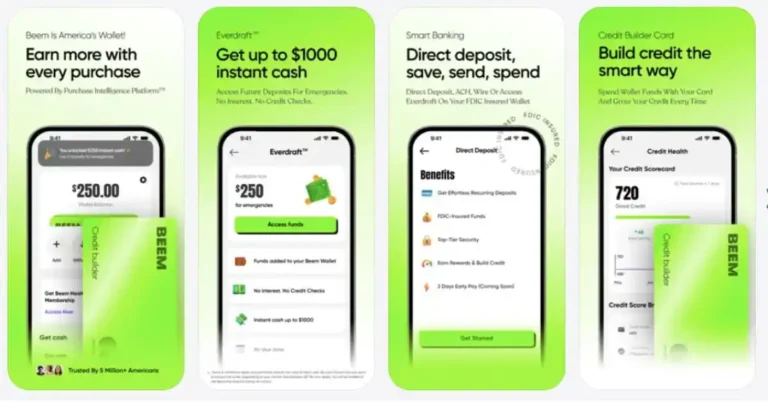
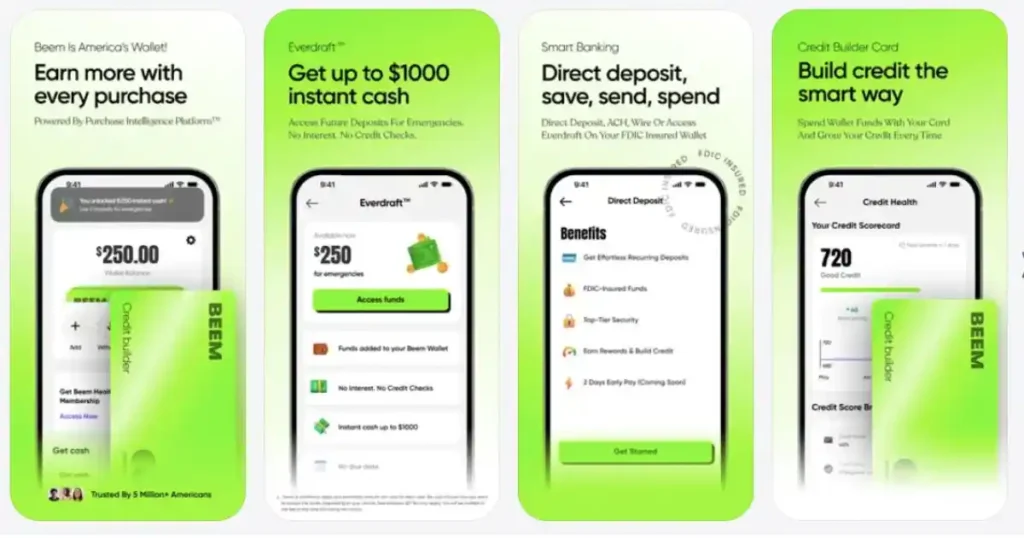
If you need the highest possible advance with zero interest: Beem’s Everdraft™ provides up to $1,000 with no interest and no credit check. That matches or exceeds most payday loan amounts while costing a fraction of the price.
Beem also includes BudgetGPT for AI-powered budgeting, DealsGPT for automatic cashback, PriceGPT for price comparison, and JobsGPT for income opportunities. For anyone comparing a payday loan vs cash advance app, Beem is the strongest argument that you never need the payday loan.
If you want banking plus advances: Dave offers up to $500 with no interest, a full checking account, early direct deposit, and gig work connections through its Side Hustle feature. Clean, simple, $1/month.
If you want automatic protection: Brigit monitors your balance and sends up to $250 automatically before you overdraft. No manual request, no credit check, no interest.
If you want daily access to earned wages: EarnIn lets you access up to $150/day ($750/pay period) of money you have already earned. Tip-based model, zero mandatory fees.
If you want AI budgeting with personality: Cleo offers up to $250 in advances plus an AI assistant that tracks your spending and actually keeps you engaged with your finances. Available from $5.99/month.
Every one of these options is cheaper, safer, and more transparent than a payday loan. The cash advance vs payday loan decision in 2026 should not be close.
How to Break the Payday Loan Cycle
If you are currently trapped in a payday loan rollover cycle, here is the exit plan.
Stop rolling over. Every rollover adds another round of fees to the same principal. Even if it means cutting expenses drastically for one pay cycle, breaking the rollover is the single most important step.
Replace the payday loan with a cash advance app. Download Beem, Dave, or any app above. Use the zero-interest advance to cover the gap the payday loan was filling. You are replacing a $75 to $150 fee with a $0 to $10 cost.
Build a one-week buffer. Once the payday loan is paid off, use your advance app’s budgeting tools to save one week’s expenses. This eliminates most emergencies that send people to payday lenders. Beem’s BudgetGPT can build this plan automatically based on your income and spending.
People Also Ask For Payday Loans vs Cash Advances
What is the difference between a payday loan and a cash advance?
The core difference between payday loans and cash advances is cost and structure. Payday loans charge $15 to $30 per $100 borrowed (391-780% APR) with lump-sum repayment on your next payday, creating high rollover risk. Cash advance apps charge zero interest and repay automatically from your next deposit with no rollover option. Both provide short-term funds, but cash advances are dramatically cheaper and structurally safer.
Are cash advances better than payday loans?
Yes. On every measurable financial metric, cash advance apps outperform payday loans in 2026. Zero interest vs 391%+ APR. Automatic repayment vs lump-sum due dates. No debt trap vs an average of eight rollovers per year. No credit impact vs potential collections reporting. The payday loans vs cash advances comparison is not close. Cash advance apps are the safer, cheaper option.
Can I get a cash advance with no credit check?
Yes. All major cash advance apps (Beem, Dave, Brigit, EarnIn, Cleo) approve users based on bank account activity rather than credit scores. No hard inquiry is pulled, which means no impact on your credit report. Beem offers up to $1,000 with no credit check and zero interest through Everdraft™.
How much can I borrow from a cash advance app?
Cash advance app limits range from $20 to $1,000 depending on the platform and your deposit history. Beem offers the highest limit at up to $1,000. Dave offers up to $500. EarnIn provides up to $750 per pay period. Brigit and Cleo each offer up to $250. All charge zero interest, making even the maximum amounts far cheaper than equivalent payday loans.
Are payday loans illegal?
Payday loans are banned or heavily restricted in 18 states plus Washington D.C. as of 2025. In states where they are legal, regulations vary widely. Some states cap fees, require cooling-off periods between loans, or limit the number of rollovers. However, tribal lenders operating under tribal sovereignty may offer payday loans in states where they are otherwise banned. Cash advance apps operate legally nationwide as regulated fintech products.
How do I switch from payday loans to a cash advance app?
Pay off your current payday loan balance to stop the rollover cycle. Download a cash advance app (Beem, Dave, Brigit, or EarnIn), link your bank account, and set up direct deposit. Use the zero-interest advance to cover future gaps instead of returning to the payday lender.
Then use budgeting tools like Beem’s BudgetGPT to build a savings buffer that reduces your need for any borrowing over time.
Disclaimer: This article is for informational purposes only and does not constitute financial or legal advice. Payday loan regulations vary by state. Always verify current terms and legality in your jurisdiction. Cash advance app features, fees, and limits are subject to change. Beem is not a bank. Banking services are provided by FDIC-insured partner institutions.