
Nobody argues about whether you should have an emergency fund. That debate ended decades ago. Every financial advisor, every budgeting blog, every money podcast says the same thing: save three to six months of expenses and do not touch it unless something goes seriously wrong.
The problem is not the advice. The problem is reality. According to Bankrate’s 2024 survey, 56% of Americans cannot cover an unexpected $1,000 expense from savings.
More than half the country is one flat tire, one ER visit, or one broken furnace away from a financial crisis with no savings to absorb the blow.
So what happens when the advice says “use your emergency fund” and you do not have one? Or when you have $800 saved and a $200 grocery shortfall hits three days before payday? Do you drain the savings you fought to build, or do you use a cash advance app and let the fund keep growing?
The emergency fund vs instant advance question is not theoretical for most people. It is a real decision that happens on a random Wednesday when something breaks and you have to choose in the next ten minutes.
This guide gives you the framework to make that decision correctly every time, whether your savings account has $50,000 or $50 in it.
Emergency Funds vs Instant Cash Advances: Key Differences
Before diving into when to use each, here is how emergency funds and instant cash advances compare on the fundamentals.
| Feature | Emergency Fund | Instant Cash Advance |
| What It Is | Your own money saved in a dedicated account | A short-term advance on your next paycheck via a mobile app |
| Source of Funds | Personal savings built over time | Advance against expected future income |
| Typical Amount Available | $500 to $18,000+ (depends on how much you have saved) | $20 to $1,000 (depends on app and deposit history) |
| Cost to Access | $0 (it is your money) | $0 to $9.99/month subscription; $0 to $5.99 express delivery |
| Interest | None (you are withdrawing your own savings) | None (most apps charge zero interest) |
| Repayment | You replenish the fund over time from future income | Automatic deduction from your next paycheck or deposit |
| Speed of Access | Same day (transfer from savings to checking) | Same day (express) to 1-3 business days (standard) |
| Credit Check | Not applicable | None |
| Credit Score Impact | None | None |
| Impact on Future Finances | Reduces your safety net until replenished | No impact on savings; repaid from next deposit |
| Best For | Large, unpredictable expenses; income loss; breaking debt cycles | Small, short-term timing gaps; protecting savings during the building phase |
| Risk | Depleting savings that took months to build | Becoming dependent on advances every pay cycle |
| Earning Potential | Earns 4-5% APY in a high-yield savings account | Earns nothing (it is borrowed money) |
| Psychological Effect | Watching savings drop can discourage future saving | No savings impact, but can mask budgeting problems if overused |
The table reveals something important about the emergency fund vs instant advance comparison. These are not competing tools.
They operate at different scales, serve different types of problems, and carry different risks. An emergency fund is a reservoir. A cash advance is a faucet. You need both, and knowing when to turn on the faucet versus when to drain the reservoir is the entire skill.
What Is an Emergency Fund (And What It Is Not)

An emergency fund is money set aside specifically for unexpected, necessary expenses. Medical bills. Car repairs that keep you employed. Emergency travel for a family crisis. A gap between jobs. Urgent home repairs that affect safety or habitability.
It is not a vacation fund, a “treat yourself” account, or a down payment savings pool. The moment you start making exceptions for non-emergencies, the fund stops functioning as a safety net and starts functioning as a second checking account that slowly empties.
How Much Do You Need?
The standard recommendation is three to six months of essential living expenses. If your rent, food, utilities, transportation, insurance, and minimum debt payments total $3,500 per month, you are targeting $10,500 to $21,000.
That number is intimidating when you are starting from nothing. But the first $1,000 matters more than the last $1,000 in any emergency fund. According to Federal Reserve data, the most common financial emergencies cost under $1,000. Hitting that first milestone covers roughly 80% of the surprises life throws at you.
Where to Keep It
A high-yield savings account (HYSA) at an FDIC-insured bank or credit union. The best HYSAs in 2026 pay 4% to 5% APY, which means a $10,000 emergency fund earns $400 to $500 per year just by sitting there. Your safety net pays you for the privilege of existing.
Requirements for the account: FDIC or NCUA insured, no withdrawal penalties, accessible within one to two business days, and separate from your daily checking so you are not tempted to raid it for non-emergencies.
Never put emergency savings in stocks, crypto, or other volatile investments. Markets can crash the same week your car does.
The point of an emergency fund is guaranteed access to a guaranteed amount. Growth is a bonus, not the objective.
What Is an Instant Cash Advance?
An instant cash advance is a short-term advance on your next paycheck, delivered through a mobile app, typically ranging from $20 to $1,000. You receive the funds in your bank account (same day or within a few business days depending on delivery speed), and the advance is automatically repaid when your next deposit arrives.
Most cash advance apps charge zero interest. Revenue comes from small subscription fees ($1 to $9.99/month) and optional express delivery charges ($1.99 to $5.99 for same-day). No credit check is run. No hard inquiry hits your credit report. If you have a bank account with regular deposits, you generally qualify.
The appeal: fast money, no interest, no credit damage. The risk: relying on advances every pay cycle creates a structural problem where you are perpetually spending next week’s paycheck to cover this week’s gap. The advance solves the symptom but does not treat the underlying condition.
Understanding both the appeal and the risk is essential to making the emergency fund vs instant advance decision correctly.
When to Use Your Emergency Fund
Your emergency fund has one job: absorb financial shocks that would otherwise push you into debt, missed payments, or genuine hardship. Here is when to open that account.
The expense is large and genuinely unexpected. A $2,500 ER bill. A $1,800 transmission repair. A $4,000 emergency root canal. These are the moments your fund was designed for. You saved this money specifically so you would not need to borrow, charge a credit card, or panic when something expensive breaks without warning. Use it. That is what it is for.
You have lost your income. Job loss, extended medical leave, disability, or any situation where paychecks stop is the number one reason financial advisors recommend three to six months of expenses rather than just a few hundred dollars.
Your emergency fund buys time: time to job hunt, recover, file claims, or restructure. No cash advance app can replace months of income. Your savings can.
The expense exceeds what a cash advance can cover. Cash advance apps max out at $250 to $1,000. If your emergency is $3,000, $5,000, or $15,000, a cash advance will not get you there. Your fund is the only non-debt tool available for large-scale financial shocks.
You are trapped in an advance cycle and need to break out. If you have been taking a cash advance every single pay period for three months straight, your cash flow has a structural problem. Using your emergency fund to cover one full pay cycle without an advance, then budgeting from that clean baseline, is sometimes the smartest use of savings. You are not spending the fund on a single emergency. You are spending it on a financial reset.
When to Use an Instant Cash Advances
Cash advances serve a different purpose than emergency funds. They are not for crises. They are for timing problems.
Here is when reaching for an advance is the right call.
The gap is small and your next paycheck covers it. You need $200 for groceries and get paid Thursday. You need $150 for a prescription and your direct deposit lands in five days. You need $300 for a utility bill due tomorrow. These are not income problems. They are calendar problems. A zero-interest advance bridges the gap and repays itself automatically when your deposit arrives.
You are building savings and do not want to destroy your progress. This is the most strategically important use case. If you have $900 saved toward a $1,000 goal and face a $200 expense, taking a cash advance protects your savings. The advance repays from your next paycheck. Your $900 stays untouched. Over months of using this “protect the savings, advance the gap” strategy, your fund reaches milestones it never would if you kept dipping into it for small shortfalls.
The expense is predictable but mistimed. Car insurance ($400) hits on the 28th but your paycheck arrives on the 1st. This is not an emergency. It is a three-day mismatch. A cash advance covers the gap for a few dollars in subscription cost, avoiding a late fee or lapsed coverage without touching your emergency savings.
You have no savings at all and need a bridge. For the millions of Americans starting from zero, cash advance apps function as a temporary safety net while they build something permanent. An advance is not ideal as a long-term solution. But it is dramatically better than a payday loan (391% APR), a credit card cash advance (25-30% APR), or a $35 overdraft fee.
When NOT to Use Each
Knowing when not to use a tool is just as important as knowing when to use it.
Do not use your emergency fund for:
- Small timing gaps that a cash advance handles at zero interest
- Non-emergency “wants” disguised as needs (new phone, vacation, sale items)
- Expenses that would set back a savings milestone you are close to reaching
- Situations where a payment plan or negotiation with the creditor is available
Do not use a cash advance for:
- Large expenses your savings can comfortably cover
- Every single pay cycle (this signals a budget problem, not a timing problem)
- Expenses you could avoid or delay without real consequence
- Situations where you are already carrying other debt and should not add more obligations
The Layered Strategy: Using Both Together
The emergency fund vs instant advance question is framed as either-or, but the smartest financial strategy in 2026 treats them as complementary layers.
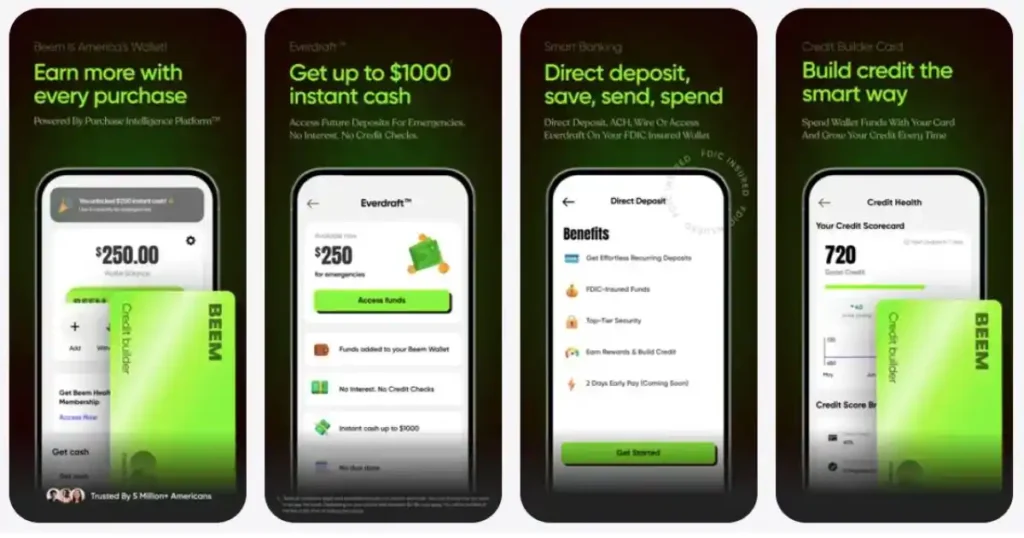
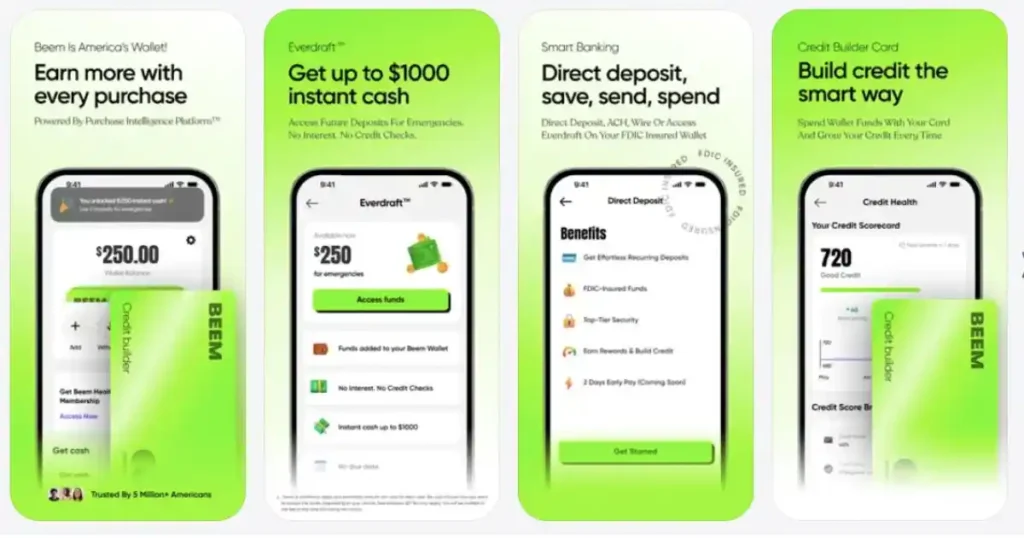
Layer 1: Cash advance apps for small, short-term gaps. Anything under $500 that will be fully repaid from your next paycheck. Zero interest, automatic repayment, savings untouched. Apps like Beem (up to $1,000 via Everdraft™), Dave (up to $500), and Brigit (up to $250) serve this layer.
Layer 2: Emergency fund for large, unpredictable expenses. Anything above $500, anything involving income loss, anything that a single paycheck cannot repay. This is your high-yield savings sitting untouched until something genuinely breaks.
Layer 3: Insurance and credit for catastrophic events. Health insurance, auto insurance, homeowner’s/renter’s insurance, and a low-interest credit line handle five-figure emergencies: major surgery, total car loss, natural disaster damage.
When all three layers are active, Layer 1 shields Layer 2 from unnecessary withdrawals, Layer 2 absorbs genuine shocks without debt, and Layer 3 prevents catastrophes from wiping everything out. The system is only fragile when you operate on a single layer.
Building an Emergency Fund From Zero (Using Advances as Scaffolding)
If you are starting with nothing saved, here is a realistic timeline that uses cash advances as temporary protection while you build permanent savings.
Weeks 1-8: Automate $25/week into a HYSA. Balance: $200. Small, but it is $200 more than zero. Use a cash advance app for any timing gaps during this phase rather than spending your new savings.
Weeks 9-16: Increase to $50/week. Balance: $600. You can now handle most minor emergencies (car battery, prescription, small appliance) without an advance. Your advance frequency should start dropping.
Weeks 17-24: Reach $1,000. This is the first major milestone. You are now better prepared than nearly half of American adults. Cash advances become a backup tool rather than a regular feature. Keep the app installed but aim to use it rarely.
Months 7-12: Build toward one full month of expenses. At $50/week, you reach roughly $2,600 by month 12. Redirect money you used to spend on advance subscriptions and express delivery fees toward savings. Every dollar that previously went to managing cash flow gaps now goes to eliminating them permanently.
Year 2 and beyond: Three to six months. The long game. $10,000 to $21,000 takes time. But once you have one month saved, the psychological shift is enormous. You stop operating in crisis mode. Your HYSA is earning 4-5% interest. Cash advances go from “every paycheck” to “maybe twice a year.” And each time you do not need to use your fund, it compounds quietly in the background.
Throughout this entire process, every cash advance you take instead of raiding your savings is not a failure. It is a strategic decision to protect the fund you are building. The advance repays itself in a week. Your savings keep growing. That is the system working as designed.
Frequently Asked Questions About Emergency Funds vs Instant Cash Advances
Should I use my emergency fund or a cash advance?
Use your emergency fund for large, unexpected, necessary expenses (major medical bills, car repairs over $500, income loss) and for breaking a recurring advance cycle.
Use a cash advance for small, short-term timing gaps ($100 to $500) that will be fully repaid from your next deposit. The smartest strategy treats them as complementary layers rather than an either-or choice.
How much should I have in an emergency fund?
The standard target is three to six months of essential living expenses. If your monthly essentials total $3,500, aim for $10,500 to $21,000. But the first $1,000 is the most impactful milestone, covering roughly 80% of common unexpected expenses. Start there and build over time. Keep the fund in a high-yield savings account earning 4-5% APY.
Are cash advance apps a good substitute for an emergency fund?
No. Cash advance apps are a valuable bridge for short-term gaps, but they cannot replace savings. Advances must be repaid from your next paycheck, meaning they do not help with income loss, multi-week emergencies, or expenses that exceed one pay period’s earnings. Think of advances as Layer 1 (small timing gaps) and emergency savings as Layer 2 (real crises). Both layers are necessary.
Can I use a cash advance to protect my emergency fund?
Yes, and this is one of the smartest uses of a cash advance app. If you have $900 saved and face a $200 expense, a zero-interest advance covers the $200 while your $900 stays intact. The advance repays from your next paycheck. Your emergency fund keeps growing. This “protect the savings, advance the gap” approach accelerates savings progress by preventing repeated withdrawals for small expenses.
How do I stop relying on cash advances every paycheck?
Automate a small weekly savings transfer ($25 to $50) into a separate HYSA. Use cash advances to cover gaps during the building phase, but reduce frequency as savings grow. Once you reach $1,000 in savings, most minor emergencies no longer require an advance. Budgeting tools like BudgetGPT can identify spending patterns that keep you in the advance cycle and help redirect that money toward savings.
What is the best cash advance app for bridging gaps while building savings?
Beem’s Everdraft™ offers up to $1,000 with zero interest, covering both small timing gaps and moderate emergencies. Dave ($500) and Brigit ($250) are also strong options. The best app is the one whose advance limit matches your typical gap amount while costing the least in fees.
Disclaimer: This article is for informational purposes only and does not constitute financial advice. Savings account rates, cash advance app features, and financial product terms are subject to change. Consult a qualified financial advisor for personalized guidance. Beem is not a bank. Banking services are provided by FDIC-insured partner institutions.