

Table of Contents
The bill arrives three weeks after the ER visit. You already forgot what the doctor looked like, but you will remember the number at the bottom of that statement for a long time. You might wonder, “Can Beem help with medical bills? The amount might read $1,800, $3,200, or even $740 for an urgent care visit you thought was covered by insurance—until the explanation of benefits letter explained otherwise. Medical bills are the most financially destructive emergency in America, the number one cause of personal bankruptcy, and the leading source of collection accounts on credit reports.
And unlike a car repair or a broken furnace, you cannot shop around or delay the purchase. When your body breaks, you go to the doctor. The bill comes later. And by the time it arrives, the money is already gone.
One hundred million Americans carry medical debt, according to KFF research. Not one hundred million people who made bad financial decisions. One hundred million people who got sick or hurt in a country where a four-hour ER visit can cost more than a month’s rent.
If you are holding one of those bills right now, here is what Beem can do, what it cannot do, and what else you should know before you pay a single dollar.
What Beem Can Do Right Now
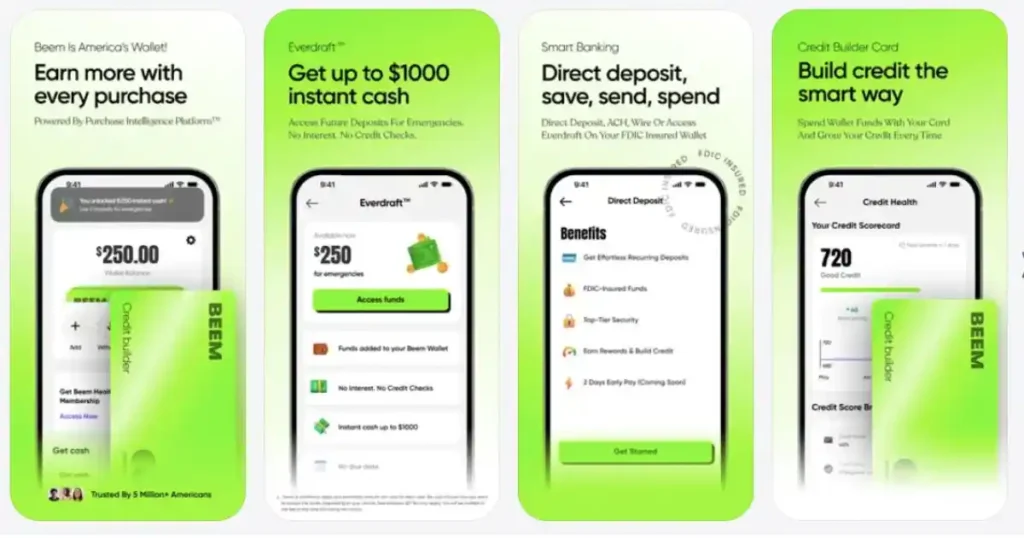
Beem provides cash advances up to $1,000 through Everdraft™ with zero interest, no credit check, and same-day delivery available. That does not make a $6,000 hospital bill disappear. But it does solve the specific, immediate problems that medical bills create before you have time to negotiate, appeal, or set up a payment plan.
Covering copays and prescriptions you cannot afford to skip: Your doctor prescribed a medication that costs $280. Your insurance covered part of it, but your copay is $85, and you have $30 in checking until Friday.
Skipping the medication is not a financial decision. It is a health decision with financial consequences: skipping blood pressure medication, antibiotics, or post-surgical pain management can lead to complications, another doctor visit, and another bill.
An Instant cash advance covers the prescription today and is repaid from your paycheck on Friday. Total interest: zero.
Preventing a medical bill from becoming a credit disaster: Medical providers typically send bills to collections after 90 to 180 days of non-payment. Once in collections, the debt appears on your credit report and can drop your score 50 to 100 points. That score damage can affect your car insurance rates, apartment applications, and loan terms for up to 7 years.
Using an advance to make a partial payment or set up a payment arrangement before the 90-day window closes keeps the bill out of collections and your credit intact.
Paying for follow-up care you might otherwise skip: The ER visit is over, but the follow-up appointment, the physical therapy session, and he specialist referral cost money too. People who cannot afford follow-up care delay it. Delayed follow-up care leads to worse outcomes, which lead to more expensive treatment later. A $150 advance for a follow-up visit today can prevent a $2,000 complication next month.
Covering non-medical costs that a medical emergency creates: Medical bills are never just medical bills. There is a parking garage at the hospital ($20-$40). The Uber to the ER because you could not drive yourself ($25-$60). The family’s takeout meals are because the person who cooks is in recovery ($50-$100 over a week).
The missed day of work that does not get reimbursed. These peripheral costs pile onto the medical bill and drain the same checking account. An advance covers the whole impact, not just the line item from the hospital.
People Also Read: Managing Medical Bills on a Household Budget
What Beem Cannot Do (And What to Do Instead)
Honesty here matters more than a sales pitch. Everdraft™ cash advances provide up to $1,000. Many medical bills exceed that.
If your bill is $4,000, $12,000, or $47,000, a cash advance is one piece of the puzzle, not the whole solution. Here is what else to do:
Negotiate the Bill Before You Pay It
Most people do not know that medical bills are negotiable. They are. Aggressively so.
- Request an itemized bill: Hospitals routinely include duplicate charges, inflated line items, and services you did not receive. An itemized bill (not the summary statement they send first) lets you or a billing advocate identify errors. Studies have found billing errors in up to 80% of medical bills reviewed.
- Ask for the cash pay or self-pay discount: Even if you have insurance, ask what the bill would be if you paid cash. Many hospitals offer 2discounts of 0% to 60% for self-pay patients or for paying in full quickly. A $3,000 bill might drop to $1,200 with a self-pay discount. At $1,200, an Everdraft™ advance covers the full amount.
- Negotiate based on what you can pay: Call the billing department and tell them what you can afford. “I can pay $800 today if you will accept that as payment in full on a $2,400 balance.” Hospitals accept these offers more often than you would expect because they would rather collect $800 now than send the account to collections and recover $400 later (collections agencies take 25-50% of what they collect).
- Ask about financial assistance programs: Non-profit hospitals are legally required to provide charity care to patients who qualify based on income. For-profit hospitals often have hardship programs as well. These can reduce your bill by 50% to 100%. You will not be offered this automatically. You have to ask.
Set Up a Payment Plan
Almost every hospital and medical provider offers interest-free payment plans. The key details to negotiate:
- Monthly payment amount you can actually afford (not what they suggest, which is usually higher)
- Zero interest (most medical payment plans are interest-free, but confirm in writing)
- Length of plan (12, 24, or even 36 months for large bills)
- No penalty for paying off early
A $3,000 bill on a 24-month interest-free payment plan is $125/month. That is manageable for many households. And here is where Beem becomes relevant again: if the $125 monthly payment lands on the 15th but your paycheck arrives on the 20th, a small advance bridges the five-day gap and keeps the payment on time.
The advance is repaid 5 days later, when you get paid. Your payment plan stays current. Your credit stays clean.
Know Your Rights
- The No Surprises Act (effective January 2022) protects you from surprise out-of-network bills for emergency services and certain non-emergency services at in-network facilities. If you received a surprise bill that violates this law, you can dispute it.
- Medical debt under $500 no longer appears on credit reports as of 2023, following changes by the three major credit bureaus. Bills that have been paid and sent to collections are also removed. This does not erase the debt itself, but it significantly reduces credit damage.
- You cannot be denied emergency care for inability to pay. The Emergency Medical Treatment and Labor Act (EMTALA) requires hospitals to stabilize emergency patients regardless of insurance status or ability to pay. The bill still comes later, but treatment cannot be refused.
People Also Read: Emergency Fund for Medical Assistants: A Financial Guide
The Real Cost of Delaying Medical Care
This is the part of the medical bill conversation that does not get enough attention. The question is not just “can I afford this bill?” It is “Can I afford what happens if I avoid care because of the bill?”
The math is brutal. A $200 urgent care visit for chest pain catches a treatable cardiac issue early. The same chest pain, ignored for six months, becomes a $45,000 hospitalization. A $150 dental appointment catches a cavity.
The same cavity ignored for a year becomes a $2,500 root canal and crown. A $75 prescription for blood pressure medication prevents stroke. A stroke costs $100,000 to $200,000 in medical costs, lost income, plus long-term disability.
Americans constantly delay or skip care because of cost. A Gallup survey found that 38% of U.S. adults have postponed medical treatment due to expense. That delay does not save money. It moves the cost forward in time and multiplies it.
If the reason you are delaying a $200 doctor visit is that you do not have $200 right now, but you get paid next week, that is exactly the gap Beem’s cash advance is designed to bridge. Zero interest. Automatic repayment from your next deposit. The visit happens. The early diagnosis happens. The $45,000 hospitalization does not happen.
Building a Buffer Against Future Medical Emergencies
Medical emergencies will happen again. The question is whether the next one creates a financial crisis or just an inconvenience. Two things determine the answer.
A small emergency fund changes everything. Even $500 to $1,000 in a high-yield savings account covers the majority of urgent care visits, prescriptions, copays, and follow-up appointments without borrowing. If you do not have savings yet, download the Beem app.
Beem’s BudgetGPT can build a plan that starts with $25 per week. In five months, you have $500. In ten months, you have $1,000. That buffer absorbs most medical surprises without touching a cash advance.
Understanding your insurance matters more than having it. Most people have insurance but do not know their deductible, their out-of-pocket maximum, their copay structure, or which hospitals are in-network.
That ignorance costs thousands of dollars per year in surprise bills that could have been avoided by choosing an in-network provider or understanding that the deductible resets in January. Spend 30 minutes reading your insurance summary of benefits. It is the most valuable half hour of financial planning you will do all year.
People Also Ask (Can Beem Help With Medical Bills)
1. Can Beem help pay medical bills?
Yes. Beem provides cash advances of up to $1,000 through Everdraft™ at 0% interest, which can be used to cover medical copays, prescriptions, follow-up appointments, and partial payments on larger hospital bills. The advance deposit is made into your bank account (same day or 1-3 business days), and the repayment is automatically deducted from your next deposit.
2. Can I use a cash advance for a hospital bill?
Yes. There are no restrictions on how you use an Everdraft™ advance. You can pay a hospital bill directly, cover prescriptions, pay for transportation to medical appointments, or set up an installment payment plan. The $1,000 maximum covers most outpatient visits, urgent care bills, and prescription costs in full.
3. What should I do if my medical bill is more than $1,000?
Request an itemized bill and check for errors. Ask for the self-pay or cash discount (often 20-60% off). Inquire about the hospital’s financial assistance or charity care programs. Negotiate a zero-interest payment plan with monthly amounts you can afford. Use a Beem advance to cover the immediate portion or to keep payment plan installments on time while your paycheck catches up.
4. Will medical debt affect my credit score?
Medical debt under $500 no longer appears on credit reports as of 2023. Paid medical collections are removed from credit reports. However, unpaid medical debt over $500 that goes to collections (typically after 90-180 days of non-payment) can still significantly damage your score. Making even a partial payment or setting up a payment arrangement before the collections deadline protects your credit.
5. Should I use a cash advance or a credit card for medical bills?
A cash advance through Beem charges no interest and is repaid automatically from your next deposit. A credit card charges an APR of 2-28% if you carry a balance. If you can pay the credit card in full within the grace period (25-30 days), there is no charge. If you cannot, the cash advance is significantly cheaper. For most people facing a medical bill emergency, the cash advance is the safer option because it prevents debt from accumulating.
6. Can I use Beem if I do not have health insurance?
Yes. Beem does not require health insurance. Everdraft™ eligibility is based on your bank account deposit history, not your insurance status. Uninsured patients often face higher medical bills, making the cash advance, combined with aggressive bill negotiation and hospital financial assistance programs, especially valuable.