
Table of Contents
Economic uncertainty rarely arrives as one dramatic event. More often, it shows up as a series of smaller pressures that stack on top of each other: groceries cost more than they used to, rent still feels high, utilities spike at the wrong time, and one delayed paycheck suddenly makes the whole week feel unstable.
That is the financial reality a lot of Americans are navigating in 2026. Headline inflation has cooled compared with its peak, but essentials are still rising in painful categories.
In January 2026, overall CPI was up 2.4% year over year, while shelter rose 3.0%, food 2.9%, food away from home 4.0%, electricity 6.3%, and utility gas service 9.8%. At the same time, consumer confidence remains subdued, with the Conference Board’s Expectations Index at 72.0 in February, still below the level that has historically signaled recession concerns.
That is exactly the kind of environment Beem is built for. Not because any app can make the economy suddenly feel easy, but because financial stress becomes more manageable when you have better tools for timing gaps, spending decisions, income support, and day-to-day protection. Beem is positioned for Americans, especially people living between paychecks, managing variable income, or trying to stay steady without relying on traditional credit. Let’s read about how Beem handles economic uncertainty.
What Economic Uncertainty Actually Looks Like for Everyday Americans
For most households, economic uncertainty is not an abstract macroeconomic term. It is the feeling that one normal month can go sideways faster than it used to. A grocery run costs more. Utility bills are less predictable. A slow work week or late payment can throw off rent timing. And even if income has not disappeared, the margin for error has gotten thinner. That pressure is exactly why cost-of-living data matters so much more than headlines alone.
It is also why tools built only for “perfect” payroll users tend to fall short in real life. A lot of Americans do not need a massive loan. They need flexibility, visibility, and a way to handle short-term disruptions without falling into a much more expensive spiral. That is the lane Beem tries to occupy.
People Also Read: How to Increase Your Cash Advance Limit
How Beem Handles Economic Uncertainty
1) Everdraft™ Helps Absorb Timing Stress
One of the biggest problems during uncertain economic periods is not always total income. It is timing. Bills hit before deposits. Payroll lands later than expected. Gig payouts drift. Unexpected expenses collide with fixed due dates.
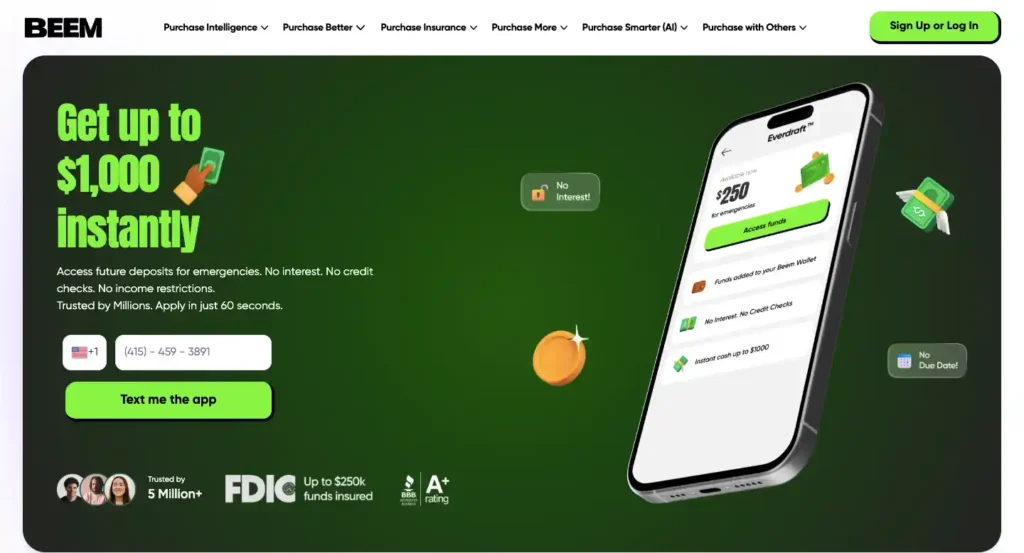
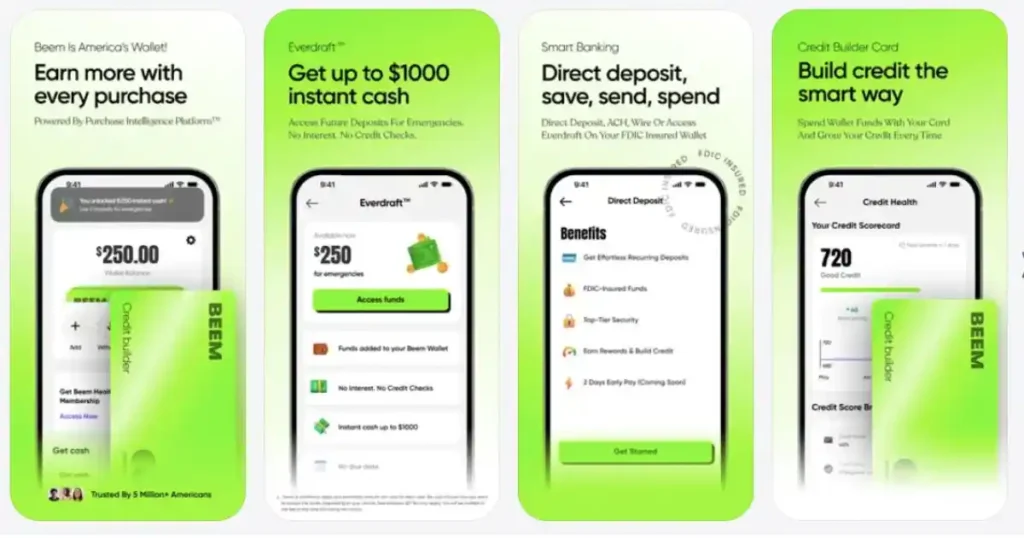
Everdraft™ is Beem’s answer to that specific problem. It is positioned as emergency cash access with no interest, no credit check, and no FICO score requirement, with standard delivery via ACH available at no extra charge and optional instant delivery to a debit card for a flat fee. Everdraft™ limits in the current plan structure run from Lite up to $10, Basic up to $50, Plus up to $100, and Pro up to $1,000.
That matters during economic uncertainty because small timing gaps become more expensive when essentials are already high. A short bridge can keep groceries covered, prevent an overdraft, or stop a late fee from turning a tight week into a worse one. That is where Everdraft™ is strongest: as a buffer, not as a lifestyle.
2) Beem Is Built for People Whose Income Is Not Perfectly Predictable
Economic uncertainty hits variable-income workers even harder. Gig workers, freelancers, shift workers, part-time employees, and people with multiple income sources often do not fit products built around one stable employer and one clean direct deposit pattern.
Beem is explicitly built for those users. It describes itself as serving the working majority, including gig workers, shift workers, freelancers, and part-time employees, and it is positioned as not requiring employer verification for workers with non-traditional income. In Beem’s gig-worker positioning, approval is based on income history and deposits flowing into the linked bank account rather than employer participation.
That makes a real difference in uncertain times. Economic stress does not only affect salaried workers. It also affects people whose income is real, but uneven. A product that can still work for them is materially more useful when the economy feels less stable.
3) BudgetGPT Helps You See Pressure Earlier
During uncertain times, one of the most expensive mistakes is not seeing the shortfall coming. It is not always the size of the bill that hurts most. It is the surprise.
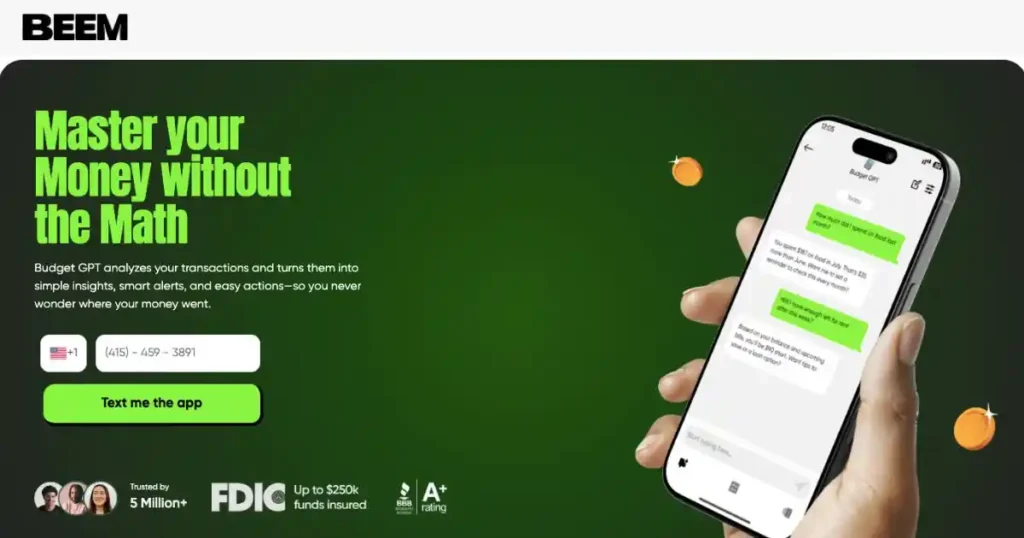
Beem’s AI stack includes BudgetGPT, which is described as an AI-powered budgeting assistant that analyzes income and spending patterns, identifies trends, flags upcoming shortfalls, and gives personalized recommendations. For users with variable income or tight monthly timing, that is one of the most practical forms of support Beem offers.
Economic uncertainty is easier to handle when it becomes visible before it becomes urgent. BudgetGPT is valuable for exactly that reason. It helps turn “I think I’m going to be short” into “I can already see where the pressure is building.”
4) PriceGPT and DealsGPT Help Stretch Everyday Spending
When the cost of living stays high, saving money is not just about earning more. It is also about leaking less.
Beem’s app review describes PriceGPT as comparing prices across sources so users are not paying more than they need to, and DealsGPT as surfacing deals on products and services users were already planning to buy. The same product stack is described as especially helpful for people whose income is unpredictable and who need sharper spending decisions in everyday categories.
That is an underrated way Beem handles economic uncertainty. If groceries, household purchases, and recurring spending are all under pressure, even modest savings become more meaningful. The value here is not flashy. It is cumulative.
5) JobsGPT Supports the Income Side of the Problem
Sometimes economic uncertainty is not just a spending problem. It is an income problem. Hours get cut. Clients slow down. A side hustle stops producing like it used to.
Beem’s app review describes JobsGPT as helping users discover new income opportunities, which is especially relevant for freelancers and workers looking to diversify their income streams. In practical terms, that means Beem is not only trying to help users bridge shortfalls. It is also trying to help them strengthen the other side of the equation.
That matters because a strong financial tool should not only ask, “How do we help you survive this week?” It should also ask, “How do we help you create more breathing room next month?” JobsGPT is one of the clearest examples of that broader approach.
People Also Read: BEEM Smart Wallet Explained
6) Alerts and Visibility Help Prevent Small Problems from Becoming Big Ones
In uncertain economic conditions, preventable mistakes become more expensive. A missed bill, a surprise debit, or an unnoticed low balance hurts more when there is less room in the account.
Beem’s Centre Console is described as showing upcoming bills before they hit, helping users avoid overdrafts, and offering a more connected financial picture. That kind of visibility becomes more valuable when households are trying to manage tighter margins.
This is an important part of how Beem handles economic uncertainty. Not every solution has to be dramatic. Sometimes the best help is simply catching the next problem early enough that it stays small.
7) Protection Features Matter More When Margins Are Thin
Economic uncertainty makes every disruption more dangerous. If job loss, disability, or a major life event happens when rent, food, and utilities are already elevated, the household shock gets bigger.
Beem’s current product stack includes job loss and disability protection with lump-sum payments of up to $500 on Plus and $1,000 on Pro, and the app review also highlights a life benefit inclusion on upper tiers. These are not substitutes for full insurance planning, but they do add resilience in exactly the kind of environment where households feel financially stretched.
That is another way Beem handles economic uncertainty differently from a one-dimensional cash advance app. It layers short-term support with broader protection features, which can matter a lot when one bad event would otherwise hit too hard.
Problem vs How Beem Helps
| Real-life uncertainty | How Beem helps | Why it matters |
| Paycheck timing breaks | Everdraft™ can bridge short-term gaps for eligible users | Timing stress is one of the fastest ways a tight month gets worse. |
| Income is variable or non-traditional | Beem is positioned for gig workers, shift workers, freelancers, and part-time users | A product built only for traditional payroll misses a lot of real workers. |
| Spending pressure keeps rising | PriceGPT and DealsGPT help reduce overpaying | Small savings compound when essentials stay expensive. |
| A shortfall is hard to see early | BudgetGPT helps flag patterns and upcoming gaps | Visibility reduces financial surprises. |
| Income needs to improve, not just stretch | JobsGPT helps surface additional earning options | Economic uncertainty is often both an expense and income problem. |
| One disruption could hit too hard | Protection features add resilience on higher tiers | Thin financial margins make protection more valuable. |
The Best Way To Use Beem During Economic Uncertainty
Beem works best when it is used as a system, not just as a panic button.
The strongest use pattern looks like this: use BudgetGPT to understand pressure before it hits, use PriceGPT and DealsGPT to tighten everyday spending, use Everdraft™ for true timing gaps, use JobsGPT when the issue is earnings, and let alerts and visibility reduce avoidable mistakes. That combination is what turns Beem from “just a cash tool” into something more useful during uncertain times.
That said, it is important to stay honest about the role. Beem can help you manage uncertainty more intelligently. It does not make inflation disappear, and it does not turn a long-term income problem into a solved one. It is strongest when it helps you stay steady, not when it becomes your entire plan.
People Also Read: How Beem’s $1000 Cash Advance Works
The Most Useful Question During Economic Uncertainty: “What Kind Of Problem Is This?”
One reason economic uncertainty feels overwhelming is that people often try to solve every money problem with the same tool. But not every financial squeeze is the same.
Some problems are timing problems, some are spending problems, and some are income problems. The faster you identify which one you’re dealing with, the better your next move becomes.
A timing problem sounds like this: “My paycheck is coming, but the bill is due first.” That is where short-term support like Everdraft™ makes the most sense. A spending problem sounds like: “My money is disappearing faster than I realize.”
That is where tools like BudgetGPT, PriceGPT, and DealsGPT become more valuable because the real issue is not the next 48 hours, it is the pattern underneath them. An income problem sounds like: “Even when I cut back, there still isn’t enough coming in.” That is where JobsGPT matters more, because the answer is not just better timing or smarter spending, it is stronger earning power.
This distinction adds real value because it helps people stop using one tool for the wrong job. The Beem app works best when you use the right part of the platform for the right kind of pressure. That is how you turn economic uncertainty from one giant blur of stress into a problem you can actually act on.
Final Verdict
Economic uncertainty is hardest on people who are already close to the edge of their monthly timing. It is not always one giant crisis. It is the accumulation of higher essentials, slower income flow, and less room for mistakes.
The Beem app suite helps by tackling that pressure from multiple angles. Everdraft™ helps with the immediate gap. BudgetGPT helps you spot the next one sooner. PriceGPT and DealsGPT help your money go further. JobsGPT helps when you need stronger income options. Alerts and protection features add more stability around the edges.
That is the most practical answer to how Beem handles economic uncertainty for everyday Americans: not by pretending uncertainty is gone, but by giving people more ways to stay in control while it is here.
People Also Ask
1. What Does It Mean That Beem Handles Economic Uncertainty?
It means Beem helps with the real financial pressures uncertainty creates: short-term cash gaps, uneven income, spending inefficiency, and limited visibility into what is coming next. It does that through Everdraft™, BudgetGPT, PriceGPT, DealsGPT, JobsGPT, alerts, and protection features depending on the plan.
2. Is Beem Just for Emergency Cash?
No. Everdraft™ is a major part of the value, but it is not the whole product. Beem also includes AI budgeting, price comparison, deal-finding, income opportunity tools, visibility into bills and overdrafts, and protection features on higher tiers.
3. Why Does Beem Matter More in an Uncertain Economy?
Because uncertainty makes timing, visibility, and flexibility more important. When shelter, food, and utilities are still rising in meaningful categories and confidence remains soft, even small shortfalls can feel bigger. Tools that help smooth those shortfalls become more relevant.
4. Does Beem Only Work for Traditional Payroll Workers?
No. Beem is explicitly positioned for everyday Americans with variable income, including gig workers, freelancers, shift workers, and part-time employees. It does not rely only on traditional employer verification.
5. What Is the Most Useful Beem Feature During Economic Stress?
That depends on the kind of stress. Everdraft™ helps most with short-term timing gaps. BudgetGPT helps with planning. PriceGPT and DealsGPT help when everyday spending is the problem. JobsGPT matters more when the pressure is on the income side.