
Table of Contents
For decades, payday loans were the only option. You needed $300 before Friday, the bank would not help, and the storefront on the corner with the neon “CASH NOW” sign was open until 9 PM. You walked in, showed a pay stub, wrote a post-dated check, and walked out with cash. Simple. Fast. And devastatingly expensive.
Now, a new model—Subscription-Based Advances—is changing that equation. Instead of paying punishing fees every time you need a small advance, users pay a predictable monthly subscription to access cash advances when they need them.
The average payday loan charges $15 to $30 per $100 borrowed. That translates to an annual percentage rate (APR) of 400% to 700%. Borrow $500 today, owe $575 in two weeks. Cannot pay it back? Roll it over and owe $650. Then $725. Then you are trapped in a cycle that extracts thousands of dollars from people who could not afford $500 in the first place.
But something has shifted. Millions of Americans are walking past those neon signs and reaching for their phones instead. They are replacing payday loans with subscription-based cash advance apps that provide the same immediate relief without the predatory price tag.
And the numbers tell the story: the cash advance app market has exploded while payday loan storefronts are closing at record rates.
This is not just a trend. It is a fundamental restructuring of how working Americans access short-term credit. And apps like Beem are leading the charge.
The Payday Loan Trap: How It Works and Why It Persists
Understanding why Americans are leaving payday loans requires understanding why they stayed so long in the first place. Payday loans persist because they solve a real, urgent problem.
When your checking account hits zero, and your electricity bill is due tomorrow, you do not have the luxury of shopping around for the best financial product. You need cash now.
Payday lenders understood this urgency and built an entire industry around it. There are roughly 23,000 payday loan storefronts across the United States, more than the combined number of McDonald’s and Starbucks locations. They are concentrated in low-income neighborhoods, near military bases, and in communities with limited access to traditional banking.
The business model is built on repeat borrowing. The Consumer Financial Protection Bureau (CFPB) has found that 80% of payday loans are rolled over or followed by another loan within 14 days. The average payday loan borrower takes out 8 to 10 loans per year.
That means the typical customer is not using payday loans as a one-time emergency tool. They are trapped in a cycle where the cost of borrowing creates the very shortfall that requires the next loan.
For single parents managing a household on one income, this cycle is especially destructive. Every $75 or $100 lost to payday loan fees is money that could have gone toward groceries, childcare, or a utility payment.
For military families, the predatory targeting has been so severe that Congress passed the Military Lending Act to cap interest rates on loans to active-duty service members at 36% APR. But that protection does not extend to veterans or military spouses, who remain vulnerable.
For underbanked Americans who lack traditional banking relationships, payday lenders have historically been the only game in town. No bank account? No credit score? No problem. Payday lenders will take your business and your money.
This is the system that subscription-based cash advance apps are dismantling.
People Also Read: What Makes Beem Different From Payday Stores in 2026?
What Are Subscription-Based Cash Advances?
Subscription-based cash advances are a fundamentally different model for short-term borrowing. Instead of charging triple-digit interest rates per transaction, these apps charge a flat monthly subscription fee (or in some cases, no fee at all) in exchange for access to cash advances when you need them.
The key differences from payday loans are significant. No interest is charged on the advance itself. There are no rollover fees that compound over time. There is no requirement to write a post-dated check or provide access to your bank account for automatic withdrawal on a specific date. And the repayment structure is designed to align with your income schedule rather than creating a financial trap.
This model works because the economics are completely different. Payday lenders make money by trapping you in a cycle. Cash advance apps make money by keeping you as a long-term subscriber. That incentive alignment changes everything.
A payday lender profits when you cannot repay. A subscription-based app profits when you stay satisfied enough to keep subscribing.
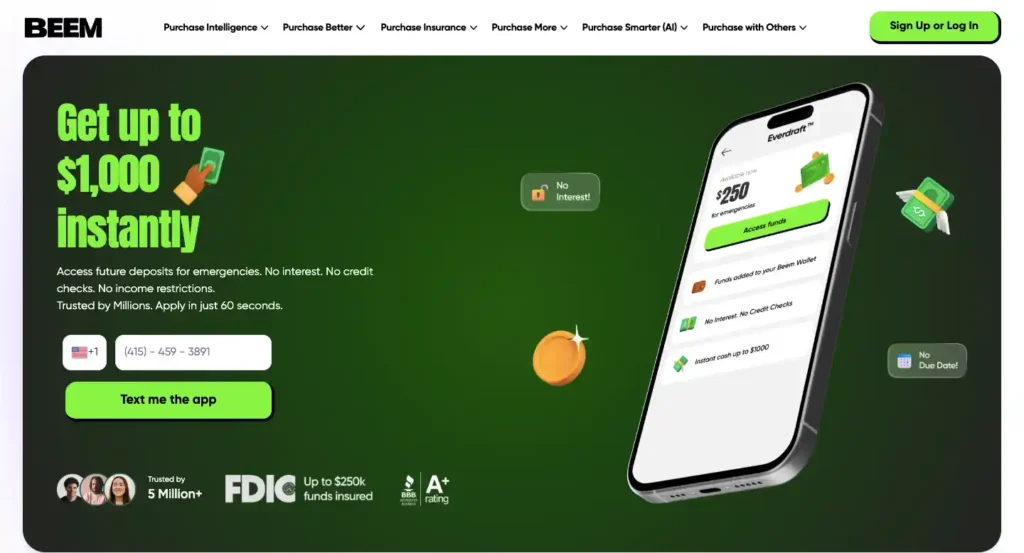
Beem takes this model even further with Everdraft™, which offers cash advances up to $1,000 with no interest, no mandatory tipping, and no hidden fees. The amount is significantly higher than most competitors (Dave caps at $500, Brigit at $250, Earnin at $100/day), and the total cost of borrowing is a fraction of what a payday loan would charge for the same amount.
Five Reasons Americans Are Making the Switch
1. The Math Finally Makes Sense
This is the most straightforward reason. When you compare the actual cost of a payday loan versus a subscription-based cash advance, the difference is staggering.
A $500 payday loan at a typical $ 20-per-$100 rate costs $100 in fees over two weeks. If you roll it over once, the cost doubles to $200. Roll it over twice, and you have paid $300 to borrow $500. That is a 60% effective cost in just six weeks.
A $500 Everdraft™ cash advance from Beem has no interest and no mandatory fees. Even with a subscription cost, you are paying a fraction of what the payday loan would have charged. And there is no rollover trap because the fee structure does not compound.
Americans are not bad at math. They were just never given a viable alternative. Now they have one, and the math speaks for itself.
2. Accessibility Has Caught Up with Need
Payday loans thrived partly because they were accessible to people whom banks rejected. No credit check. No minimum balance. No lengthy application process. Just walk in with a pay stub and walk out with cash.
Cash advance apps have now matched and exceeded that accessibility. Beem requires no credit check for Everdraft™. There are no income restrictions, meaning gig workers who earn through Uber, DoorDash, Etsy, and other freelance platforms qualify. Government benefit recipients (SSI, SSDI, unemployment, VA benefits, SNAP) qualify. There is no minimum income threshold.
And Beem goes a step further than payday lenders in terms of convenience. You do not need to drive to a physical storefront. You do not need to wait in line. You do not need to hand over a post-dated check. You request your advance through the app and choose where to receive it: your bank account, Venmo, or Cash App. The entire process takes minutes, not the 30 to 60 minutes a typical payday loan visit requires.
For underbanked Americans without traditional bank accounts, the ability to receive cash advances through Venmo or Cash App is transformative. It eliminates the need for a bank entirely, which payday lenders can never offer.
3. Gig Workers and Freelancers Finally Have an Option
The gig economy has exploded over the past decade, but the financial tools available to gig workers have not kept pace. Payday lenders require a traditional pay stub, which most gig workers do not have. Some payday lenders accept bank statements showing regular deposits, but gig income is inherently irregular, making many gig workers ineligible for even predatory loans.
This left gig workers in a bizarre financial no-man s-land: too irregular for payday lenders, too thin on credit for banks, and too low-balance for traditional lines of credit.
Beem solves this entirely. Everdraft™ works with gig income from any platform. Drive for Uber on Monday, deliver for DoorDash on Wednesday, sell on Etsy on weekends, and Beem treats all of that as valid income. No pay stubs required. No minimum deposit amounts. No regularity requirements. Your income is real, and Beem treats it that way.
For gig economy power users earning across multiple platforms simultaneously, this is not just an improvement over payday loans. It is the first cash advance product that actually acknowledges how they earn.
4. Protections That Payday Loans Never Offer
Payday loans are purely transactional. You borrow, you repay (with massive fees), and that is the extent of the relationship. There is no safety net. There is no financial education. There is no protection if something goes wrong in your life.
Beem flips this model entirely by offering protections that go far beyond the advance itself. Job loss protection provides a financial safety net if you lose your job involuntarily. For seasonal workers, contract employees, and anyone in an unstable employment situation, this protection addresses the root cause of the cash shortfall rather than just treating the symptom.
Disability protection covers you if you become disabled and cannot work. For gig workers and freelancers without employer-provided disability insurance, this is a critical gap that Beem fills.
These protections represent a philosophical shift in how short-term lending works. Payday lenders profit from your vulnerability. Beem actively protects you from it.
5. AI Tools That Break the Borrowing Cycle
The most insidious aspect of payday loans is the cycle. You borrow because you are short. The fees make you shorter in the next pay period. So you borrow again. The cycle repeats until you either find extra income or dig yourself into a hole you cannot climb out of.
Breaking that cycle requires more than a cheaper advance. It requires tools that help you manage your money, so you need fewer advances over time. This is where Beem’s AI tools create a structural advantage that payday loans could never match.
BudgetGPT analyzes your income and expenses and helps you build a budget that accounts for irregular pay periods, seasonal fluctuations, and unexpected expenses. It does not just tell you to “spend less.” It gives you actionable, personalized guidance based on your actual financial situation.
PriceGPT ensures you are not overpaying for purchases by comparing prices across retailers in real time. DealsGPT surfaces discounts and offers tailored to your spending habits. Together, these tools can save you hundreds of dollars per month, reducing the frequency and size of cash advances you need to take.
JobsGPT helps you find new income opportunities, whether that is a gig to fill a gap, a seasonal position, or a permanent role that increases your baseline income.
Payday lenders want you to come back. Beem’s AI tools are designed to help you need the app less over time. That is a fundamentally different relationship with your money.
People Also Read: Cash Advance Apps and The FTC: How the Financial Landscape Is Changing
The Regulatory Tailwind Pushing the Shift
The move from payday loans to subscription-based advances is not happening in a vacuum. Regulators at both the state and federal levels have been tightening restrictions on payday lending for years.
Multiple states have banned or severely restricted payday lending, including New York, New Jersey, and Arizona. The CFPB has proposed and implemented rules requiring lenders to verify a borrower’s ability to repay before issuing a loan, which directly impacts the payday loan rollover model. Interest rate caps in many states have made the traditional payday loan business model unsustainable.
As payday loan storefronts close, the demand for short-term credit does not disappear. The need is as urgent as ever. What changes is where that demand flows. And increasingly, it flows toward subscription-based cash advance apps that provide the same speed and accessibility without the predatory pricing.
Beem benefits from this regulatory shift because its model is inherently compliant with consumer protection principles. No triple-digit APRs. No debt traps. No predatory targeting. The product is built on transparency, which means it thrives in regulatory environments that punish opacity.
Beem vs. Payday Loans: A Direct Comparison
| Factor | Payday Loans | Beem (Everdraft™) |
| Typical Cost for $500 Borrowed | $75 to $150 (fees) | $0 interest, no mandatory fees |
| APR Equivalent | 400% to 700%+ | 0% |
| Rollover/Renewal Fees | Yes (compounds) | No |
| Credit Check Required | Varies | No |
| Income Restrictions | Pay stub required | None |
| Gig/Freelance Income Accepted | Rarely | Yes |
| Government Benefits Accepted | Rarely | Yes |
| Maximum Advance | Varies ($300 to $1,000) | Up to $1,000 |
| Withdrawal Options | Cash or check | Bank, Venmo, Cash App |
| Job Loss Protection | No | Yes |
| Disability Protection | No | Yes |
| Budgeting Tools | No | BudgetGPT |
| Price Comparison Tools | No | PriceGPT |
| Deal Discovery Tools | No | DealsGPT |
| Job Search Tools | No | JobsGPT |
| Credit Building | No | Yes |
| Physical Location Required | Yes | No (fully mobile) |
Every single line in this comparison favors subscription-based advances. And Beem, specifically, stacks advantages that even other cash advance apps do not match (Venmo/Cash App withdrawals, job loss and disability protection, four AI tools, no income restrictions).
What This Shift Means for Your Financial Future
Moving from payday loans to subscription-based advances is not just about saving money on fees, although that alone can save the average payday loan borrower over $1,000 per year. It is about breaking the cycle of predatory borrowing and replacing it with a system that actually helps you build financial stability over time.
With Beem, the cash advance is just the starting point. Once you are past the immediate crunch, BudgetGPT helps you plan, so the next crunch is smaller. PriceGPT and DealsGPT reduce your expenses. Credit Builder strengthens your financial profile. Cashback puts money back in your pocket. Job loss and disability protection catch you if something goes wrong. JobsGPT helps you increase your income.
This is not just an alternative to payday loans. It is an entirely different trajectory. Payday loans pull you down. Beem pushes you forward.
People Also Ask
1. Are subscription-based cash advances cheaper than payday loans?
Significantly. Payday loans charge an effective APR of 400% to 700% or more. Beem’s Everdraft™ charges zero interest and no mandatory fees on cash advances up to $1,000. Even factoring in a subscription cost, the total is a fraction of payday loan fees.
2. Can I get a subscription-based cash advance with bad credit?
Yes. Beem requires no credit check for Everdraft™. Your credit score is not affected, and bad or thin credit does not disqualify you.
3. Do cash advance apps work for gig workers?
Most have limited support, but Beem fully supports gig income from Uber, DoorDash, Lyft, Instacart, Etsy, and freelance platforms. There are no income restrictions or minimum income thresholds.
4. Can I use a cash advance app if I receive government benefits?
Yes. Beem supports income from SSI, SSDI, unemployment benefits, VA benefits, and SNAP. These qualify as income for Everdraft™ cash advances and other Beem features.
5. What protections do cash advance apps offer that payday loans do not?
Beem offers job-loss and disability protection, features that no payday lender provides. Beem also includes AI budgeting tools (BudgetGPT), price comparison (PriceGPT), deal discovery (DealsGPT), and AI job search (JobsGPT), all designed to help you need fewer advances over time.
6. Can I receive my cash advance on Venmo or Cash App instead of a bank account?
Yes. Beem is one of the only apps that lets you withdraw your Everdraft™ advance directly to Venmo or Cash App. This is especially valuable for underbanked users who may not have a traditional bank account.
7. How do I switch from payday loans to a cash advance app?
Download Beem, create your account in under two minutes, connect your income source (W-2, gig, freelance, or government benefits), and access Everdraft™ for cash advances up to $1,000. No credit check, no income restrictions, and no predatory fees.