

Table of Contents
Inflation does not arrive as a single dramatic event. It arrives gradually, in the form of a grocery bill that is $30 higher than it was eighteen months ago, a utility payment that has crept up every quarter, a rent renewal letter with a number that requires a second read. By the time most households consciously register the rising costs, the cumulative impact on their monthly budget is already substantial.
In 2026, American households are navigating an inflationary environment that has reshaped the financial calculus of everyday life. Wages for many earners have not kept pace with price increases across essential spending categories, and the gap between income and the cost of maintaining a standard of living is wider for millions of Americans than it was two years ago.
The financial tools adequate for a pre-inflation budget are not always adequate for one under sustained price pressure. This guide examines where inflation is hitting hardest and explains precisely how Beem’s tools provide practical, accessible support for managing that pressure without resorting to high-interest debt.
How Inflation Is Affecting Household Budgets in 2026
Grocery and Food Costs
Food costs remain one of the most viscerally felt inflation impacts for American households. Grocery prices have increased significantly across staple categories, and the cumulative effect is a monthly bill that now represents a larger share of household income than in prior years.
Finding smarter ways to spend on food, including price comparison and deal identification, has gone from a nice-to-have habit to a financially meaningful strategy.
Housing Costs
Housing costs represent the single largest inflation impact for most households. Rental price increases in many markets have significantly outpaced overall inflation, and renters facing lease renewals have often absorbed increases that consume the equivalent of several months of savings in a single annual adjustment.
For homeowners, elevated mortgage rates have constrained access to home equity as a financial buffer, compressing what was once one of the most reliable household financial tools.
Utility and Transportation Costs
Electricity, gas, and fuel costs have experienced sustained upward pressure, further compounding the impact of increases in other categories. For households where utilities and transportation are non-negotiable fixed expenses, increases here directly reduce the budget available for discretionary spending and savings, with limited practical ability to reduce consumption below a certain threshold.
The Cumulative Budget Squeeze
The most financially damaging aspect of sustained rapid price escalation is not any single category increase, but the simultaneous compression across multiple categories. When groceries, housing, utilities, and transportation all cost more together, the combined impact on discretionary spending and savings capacity is significantly larger than any individual increase suggests.
Households that were managing comfortably before the inflationary period now find themselves making meaningful trade-offs that were not previously necessary.
People Also Read: The Complete Guide to Beem Pricing
Why Traditional Financial Strategies Fall Short Under Inflation
Static Budgets Become Inaccurate Quickly
Traditional budgeting approaches that assign fixed dollar amounts to spending categories become less effective as prices rise consistently. A grocery budget accurate six months ago may now be insufficient by $50 to $100 per month without any change in consumption. Static budgets require constant manual updating to remain accurate amid rising costs, which most households do not do systematically, leading to budgets that underestimate actual spending and overstate available discretionary funds.
Credit Card Reliance Compounds the Problem
Many households have responded to rising cost-driven shortfalls by increasing credit card utilization, a strategy that provides short-term relief but creates long-term pressure through high-interest debt. With credit card APRs elevated, the cost of carrying a balance has increased significantly, meaning households using credit to bridge inflation-driven gaps are paying substantially more for that bridge than they would in a lower-rate environment.
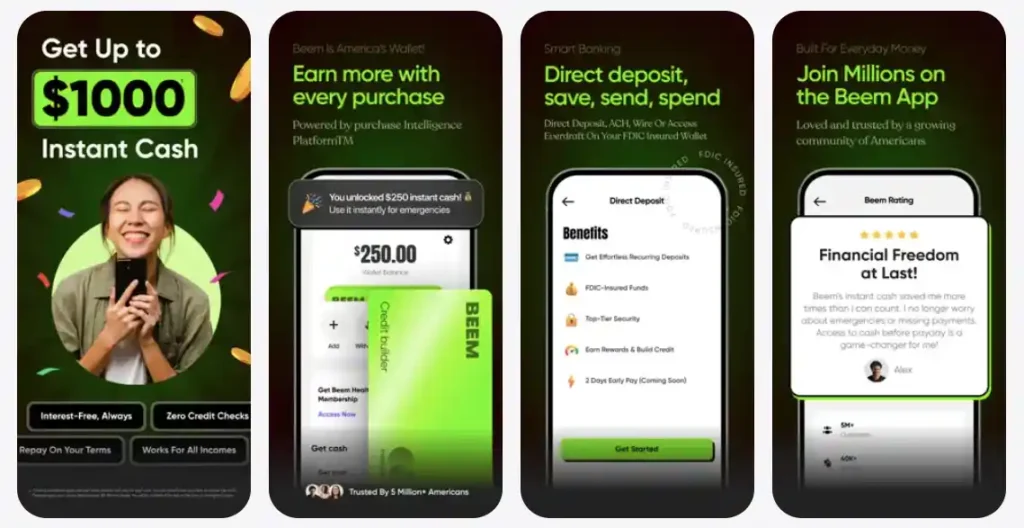
How Beem’s Tools Address Inflation-Driven Financial Pressure
Everdraft
Inflation compresses household budgets, creating cash flow timing problems that did not previously exist. When essential expenses consume a larger share of income, the margin narrows, and the likelihood of a timing gap between when bills are due and when income arrives increases. Everdraft addresses this directly by giving eligible users instant cash advances of up to $1,000 with zero interest and no mandatory fees.
The key distinction is that Everdraft is a bridge, not a supplement. It covers the gap between when an essential expense is due and when income arrives, without adding cost that makes that gap harder to close the following month. During a period of inflation, when the alternatives are often high-interest credit card charges or a $35 bank overdraft fee, Everdraft’s zero-cost model is not just convenient; it’s essential. It provides a meaningful financial advantage that prevents price-driven cash-flow gaps from turning into interest-laden debt.
BudgetGPT: Real-Time Spending Visibility in a Rising-Cost Environment
Static monthly budgets are particularly inadequate during periods of rising prices, as costs are not static. The grocery budget that was accurate in January may be insufficient by March without any change in consumption. BudgetGPT tracks spending in real time, automatically categorizes transactions, and identifies which categories are experiencing the most significant cost increases, allowing households to see the impact of shifting price levels on their specific budgets rather than relying on general economic statistics that may not reflect their personal spending mix.
BudgetGPT also provides forward-looking visibility into whether the current spending trajectory will create a cash flow gap before the next income deposit, enabling proactive action rather than reactive crisis management. In an inflationary environment, this distinction between managing before a gap forms and scrambling after it already has is the difference between financial stability and financial stress.
PriceGPT and DealsGPT: Fighting Inflation at the Purchase Level
During a rapid price escalation, finding better prices on the things you are already buying is one of the highest-return financial habits available. PriceGPT helps users compare prices on everyday purchases, while DealsGPT surfaces relevant savings opportunities based on actual spending behavior rather than generic deal aggregation.
The cumulative effect of consistent price optimization across regular purchases can meaningfully offset inflation’s budget impact over time, creating a partial cost-of-living hedge through behavior rather than requiring income growth to maintain purchasing power.
Credit Building: Lowering the Long-Term Cost of Borrowing
One of inflation’s most damaging long-term effects is increased reliance on high-interest credit to bridge gaps that a discretionary surplus previously covered. Households with strong credit profiles can access personal loans and lines of credit at significantly lower rates, creating a meaningful cost difference that rapid price escalation makes even more consequential.
Beem’s credit-building feature reports positive payment activity to credit bureaus over time, gradually improving the credit profile that determines borrowing costs. In an inflationary environment where the need for credit access is higher, a stronger credit score directly translates into lower borrowing costs and more budget available for the essential expenses that rising costs have made more expensive.
People Also Read: How Beem Protects Your Money
Practical Inflation Management Strategies for 2026
Rebuild Your Budget Around Current Actual Costs
If your household budget has not been reviewed within the last three months, it is almost certainly based on expense levels that no longer reflect your actual costs. Use BudgetGPT to build an accurate picture of what you are actually spending right now across every category, and rebuild your budget framework around those current numbers.
An accurate budget is the foundation of every other rapid price escalation management strategy, and working from outdated figures makes every subsequent financial decision less reliable.
Prioritize Essential Expenses Without Compromise
During an inflationary period and compressed budgets, the priority hierarchy for spending becomes more critical than in comfortable financial conditions. Essential expenses, rent, utilities, groceries, insurance, and minimum debt payments must be funded first without exception. Discretionary spending adjusts to whatever remains after essentials are covered.
Everdraft exists specifically to keep essential expenses intact during months when inflation has pushed those costs close to total available income.
Build and Protect a Liquidity Buffer
The liquidity buffer becomes more important as costs rise, since cash flow timing gaps occur more frequently as budget margins narrow. A reserve of one to two weeks of essential expenses held in an accessible account is what prevents timing gaps from becoming costly overdraft events or high-interest borrowing situations. If you have a buffer, protect it from discretionary spending. If you do not, building one is the highest-priority financial goal in an inflationary environment.
Use JobsGPT to Address the Income Gap Directly
For households where the structural income gap between rising costs and current earnings is genuinely too wide to close through spending optimization alone, income growth is the only complete solution.
Beem’s JobsGPT identifies income opportunities based on a user’s profile and location, helping users discover side income options that can meaningfully relieve budget pressure from rapid price increases. Even modest supplementary income, in the right circumstances, can provide the margin that separates financial stability from financial stress.
Inflation Cost Impact: Then vs. Now
| Expense Category | Pre-Inflation Monthly Cost (Est.) | 2026 Monthly Cost (Est.) | Monthly Increase |
| Groceries (family of 3) | $450 | $570 | $120 |
| Utilities (electricity, gas) | $180 | $230 | $50 |
| Gasoline (monthly) | $120 | $155 | $35 |
| Dining out (2x per week) | $200 | $260 | $60 |
| Renter’s insurance | $25 | $32 | $7 |
| Total estimated monthly increase | $272 |
People Also Read: Why Beem Has No Income Restrictions
Final Thoughts
Inflation in 2026 is not a temporary inconvenience. It is a sustained financial pressure that requires a deliberate, tool-supported response. The households navigating it most successfully are not necessarily those with the highest incomes. They are the ones with the clearest visibility into their spending, the most cost-effective tools for bridging temporary gaps, and the financial habits that prevent cost-driven shortfalls from spiraling into high-interest debt.
The Beem app provides the specific combination of tools that financially pressured households need most: zero-interest cash advances to fill timing gaps, real-time spending awareness through BudgetGPT, smarter purchasing through PriceGPT and DealsGPT, and credit-building to improve long-term financial access. Rising costs are not optional. How you manage them is.
People Also Ask
1. How does Beem help during inflation?
Beem addresses inflation-driven financial pressure through zero-interest Everdraft advances for cash flow gaps, BudgetGPT for real-time spending visibility, PriceGPT and DealsGPT for smarter everyday purchasing, and credit-building tools that lower long-term borrowing costs. Together, these tools reduce the financial impact of rising costs without creating high-interest debt.
2. Can Everdraft help cover rising essential costs during inflation?
Yes. Everdraft provides eligible users with up to $1,000 in zero-interest cash advances specifically designed to bridge the timing gaps between when essential expenses are due and when income arrives. During an inflationary period when budget margins are narrow, Everdraft keeps essential expenses covered without adding the interest cost that makes high-inflation periods harder to navigate.
3. How does BudgetGPT help manage an inflation-affected budget?
BudgetGPT tracks spending in real time, identifies which categories are experiencing the largest cost increases, and provides forward-looking visibility into potential cash flow gaps before they occur. This dynamic awareness is far more useful than a static monthly budget, which quickly becomes inaccurate as prices continue to rise across spending categories.
4. Is using Everdraft during inflation a good financial decision?
Used as a bridge for genuine timing gaps rather than a supplement for structural income shortfalls, Everdraft is one of the most cost-effective inflation management tools available. Zero interest and zero mandatory fees mean the advance adds no cost to an already compressed budget. The alternative, a bank overdraft fee or credit card interest charge, adds cost at exactly the moment the budget can least absorb it.
5. What is the most important financial habit during inflation?
Rebuilding your budget around current actual costs rather than pre-inflation figures is the most important single habit change during a rapid price escalation. An accurate budget identifies exactly where inflation is hitting hardest, which expenses can be reduced, and where cash flow gaps are likely to form, giving you the information needed to take proactive action before financial stress arrives rather than after it already has.