

Table of Contents
Economic uncertainty does not affect everyone the same way or at the same time. For some households, it arrives as a sudden job loss. For others, it builds slowly through reduced hours, stalled raises, rising costs, and the quiet erosion of financial margin that accumulates over months of navigating an unstable economic environment.
What these experiences share is a common financial consequence: the gap between available cash and immediate financial obligations becomes harder to manage, and the tools that worked in stable conditions become less adequate in uncertain ones.
The financial mistakes most commonly made during economic uncertainty are not failures of discipline or intelligence. They are failures of preparation, specifically the absence of accessible, affordable liquidity tools that allow households to bridge short-term gaps without resorting to expensive debt.
This guide examines how the Beem app provides short-term liquidity support that economic uncertainty demands and how to use it strategically as part of a broader financial resilience plan.
What Economic Uncertainty Does to Household Finances
Income Becomes Less Predictable
Economic downturns, market volatility, and sector-specific disruptions reduce income predictability for a wide range of earners. Salaried employees face the risk of layoffs, reduced hours, and benefit cuts.
Freelancers and contractors see project pipelines thin as clients reduce discretionary spending. Gig workers experience reduced demand during broader economic contractions. The common thread is income that was previously reliable becoming less so, often with little warning.
Essential Expenses Do Not Adjust Downward
The fundamental asymmetry of economic uncertainty is that income can decrease rapidly while essential expenses remain largely fixed. Rent does not fall because the economy is contracting. Utility bills do not decrease because household income has.
Grocery costs, insurance premiums, and minimum debt payments continue on their normal schedule regardless of what is happening to the income that funds them. This asymmetry is what turns income volatility into a genuine liquidity crisis for households without a financial cushion.
Emergency Savings Get Depleted Quickly
Households that enter an uncertain economic period with meaningful emergency savings have a buffer. But even well-funded emergency accounts can be depleted faster than expected when income disruption is sustained rather than brief.
The standard recommendation of three to six months of emergency savings assumes a relatively short disruption. Prolonged economic uncertainty can exhaust that buffer, leaving households without the cushion they relied on and increasingly dependent on whatever liquidity tools remain accessible.
High-Interest Debt Becomes a Compounding Problem
The instinctive response to a liquidity gap during economic uncertainty is often to reach for a credit card or take out a short-term loan. This response solves the immediate problem while creating a longer-term one.
High-interest debt accumulates during the uncertainty period and must be repaid from the same constrained income that created the original gap. Each interest payment reduces the funds available for essential expenses in subsequent months, creating a cycle that becomes progressively harder to exit as it deepens.
People Also Read: How Much Money Can I Get From Beem If I Lose My Job
Why Short-Term Liquidity Is the Priority During Economic Uncertainty
Liquidity Keeps Options Open
During periods of economic uncertainty, financial flexibility is more valuable than at any other time. Having accessible cash means being able to respond to opportunities, whether a job that requires relocation expenses, a vehicle repair needed to maintain employment, or simply the ability to make deliberate financial decisions rather than reactive ones driven by immediate cash necessity. Liquidity preserves optionality. The absence of it forces decisions that would not otherwise be made.
The Cost of Illiquidity Is Immediate and Concrete
When a household lacks liquidity during an economic downturn, the costs are not abstract. They are specific, immediate, and documented in overdraft notices, late payment fees, penalty interest rates, and the compounding consequences of missing minimum payments.
Each of these costs reduces the financial capacity to navigate uncertainty, making subsequent decisions harder and costs higher. Short-term liquidity management is not a luxury during economic uncertainty. It is the mechanism by which other financial damage is prevented.
Protecting Savings During Uncertainty Has Long-Term Value
The instinct to raid savings to cover short-term gaps during economic uncertainty is understandable but costly. Withdrawing from retirement accounts triggers taxes and penalties. Breaking fixed-term savings products incurs fees. Depleting an emergency fund leaves the household unprotected against subsequent shocks during the same period of uncertainty.
A low-cost liquidity facility that covers short-term gaps without requiring savings depletion protects the long-term financial structures that are hardest to rebuild once disrupted.
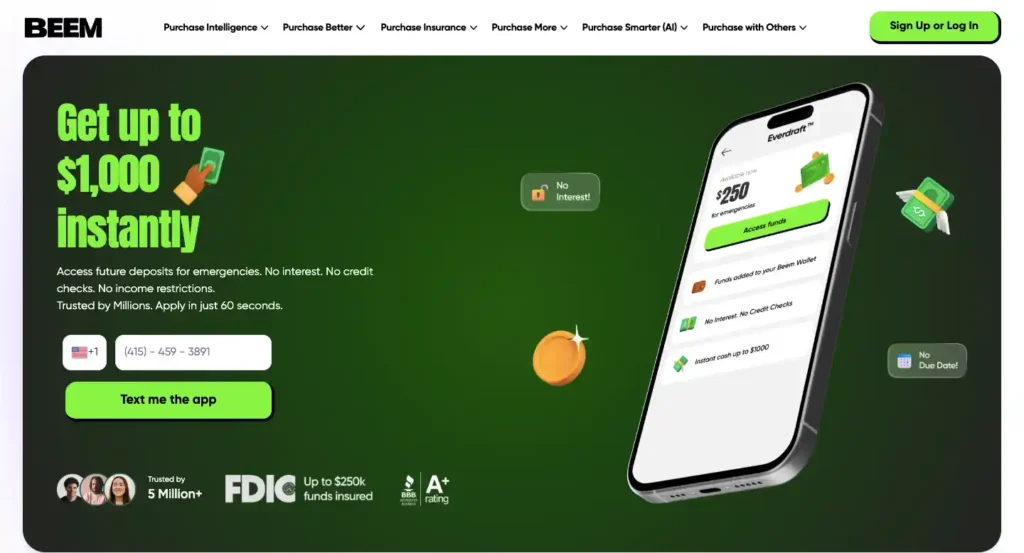
How Beem Everdraft Functions as a Liquidity Tool During Uncertainty
Immediate Access Without a Credit Check
Economic uncertainty often harms credit scores through missed payments and elevated utilization rates, even before households have a chance to stabilize. Beem’s no-credit-check approval process evaluates income patterns and account activity rather than credit bureau data, meaning users whose credit profile has been affected by the same economic conditions that created their liquidity needs can still access the tool they need most.
Zero Interest Prevents the Debt Spiral
The most dangerous feature of liquidity tools used during economic uncertainty is that interest compounds while income remains constrained. A $500 advance at a payday loan APR of 400 percent results in rapidly escalating costs that quickly exceed the original advance amount. Everdraft™ charges zero interest. The $500 advance costs $500 to repay, regardless of how long the uncertainty period lasts or how many income cycles pass before repayment.
Repayment Aligned With Income Recovery
Everdraft repayment is triggered by incoming deposits rather than a fixed calendar deadline. During economic uncertainty, when income arrival may be delayed, irregular, or smaller than usual, this alignment with actual income timing means repayment occurs when financial capacity to repay exists rather than on an arbitrary schedule that may fall before that capacity is restored.
A Safety Net That Does Not Require Perfection to Access
Traditional emergency credit products, personal lines of credit, and home equity facilities require strong credit profiles, established credit history, and often significant documentation to access. They are also most commonly available to households that need them least.
Everdraft’s behavior-based approval process makes it accessible to a much broader range of users, including those who have not previously had access to formal credit facilities, which is precisely the population most likely to face liquidity challenges during economic uncertainty.
People Also Read: Budgeting Tips for Irregular Income
How Beem’s AI Tools Support Financial Decision-Making During Uncertainty
BudgetGPT: Clarity When Clarity Is Most Needed
By tracking spending in real time, identifying where money is going, and providing forward-looking visibility into upcoming gaps, BudgetGPT gives users the information they need to make deliberate financial decisions rather than reactive ones. During economic uncertainty, that clarity is not just comforting; it’s essential. It is practically protective, reducing the likelihood of the reactive financial decisions that make uncertain periods more financially damaging than they need to be.
PriceGPT: Making Every Dollar Go Further
When income is constrained and uncertain, the purchasing power of every dollar that does arrive becomes more important. PriceGPT helps users find better prices on the things they already buy, systematically reducing household costs without requiring any reduction in consumption. During economic uncertainty, consistently paying less for the same essential purchases creates real financial margin, reducing the frequency of liquidity gaps without requiring income recovery.
DealsGPT: Savings That Reduce Advance Frequency
DealsGPT surfaces relevant savings opportunities based on actual spending behavior. During periods of economic uncertainty when household budgets are under sustained pressure, every relevant deal identified and applied reduces the total spending that creates liquidity gaps. The cumulative effect of consistent savings discovery is a meaningfully lower monthly expenditure that reduces reliance on liquidity tools over time, which is the direction every financial plan during uncertainty should be oriented toward.
JobsGPT: Addressing the Income Side of the Equation
Liquidity tools manage the symptoms of income uncertainty. JobsGPT addresses the underlying cause. By identifying income opportunities based on the user’s profile and location, including part-time work, freelance opportunities, and gig-economy options, JobsGPT provides users with a practical pathway to restore income disrupted or reduced by economic uncertainty. Even modest supplementary income can meaningfully reduce the frequency and severity of liquidity gaps during an uncertain economic period.
Building Financial Resilience During Economic Uncertainty: A Practical Framework
Step 1: Establish an Accurate Financial Baseline
The first requirement for managing finances during economic uncertainty is knowing exactly where you stand. Use BudgetGPT to establish a clear picture of your current income, your current essential expenses, and the gap between them. This baseline tells you how much liquidity support you actually need, prevents both over-borrowing and under-preparation, and creates the foundation for every subsequent financial decision.
Step 2: Classify Every Expense by Urgency
Divide all household expenses into three categories. Non-negotiables are the expenses that must be paid regardless of income level: rent, utilities, groceries, insurance, and minimum debt payments. Deferrable expenses are those that can be delayed without immediate serious consequences.
Discretionary expenses are those that can be eliminated during the uncertainty period without a material impact on the household’s basic functioning. During economic uncertainty, spend only on non-negotiables until income stabilizes.
Step 3: Set Up Everdraft Before You Need It
The worst time to set up a new financial account is during a crisis, when time pressure, financial stress, and the urgency of an immediate need combine to make careful decision-making difficult. Set up Everdraft during a calm period, complete identity verification, connect your primary bank account, and understand how the request and delivery process works before a gap arises. Having the tool ready means using it takes minutes rather than the time required to establish a new account under pressure.
Step 4: Use Everdraft for Non-Negotiables Only
During economic uncertainty, Everdraft is most effectively used for Tier 1 essential expenses, the non-negotiable costs that cannot be deferred without serious immediate consequences. Using an advance to cover rent, utilities, or groceries when income has been delayed is a structurally sound use of an advance.
Using an advance to cover discretionary spending during a period of income uncertainty is not, because it creates a repayment obligation that reduces the income available for essentials when earnings do resume.
Step 5: Track the Frequency and Pattern of Advance Use
Monitor how often you request Everdraft advances and whether the frequency is stable, decreasing, or increasing over the uncertainty period. Stable or decreasing frequency indicates that the tool is performing its intended bridge function. Increasing frequency may indicate that the gap it is bridging is growing, which requires addressing the income or expense side of the equation directly rather than through continued advance use.
People Also Read: Beem Everdraft vs Payday Loans: Which Option is Actually Better
Short-Term Liquidity Tools: A Comparison for Uncertain Times
| Tool | Cost | Accessibility | Debt Risk | Best Use During Uncertainty |
| Beem Everdraft | $0 mandatory, 0% interest | No credit check, minutes | None if used as a bridge | Essential expense timing gaps |
| Personal Savings | Zero cost | Immediate | None | First line of defense |
| Credit Card | 20% to 29% APR | Requires good credit | High if carried | Short gaps are paid within the billing cycle |
| Payday Loan | $15 to $30 per $100 | Widely available | Very high | Avoid: debt spiral risk |
| Bank Overdraft | $25 to $35 per event | Automatic | None but costly | Avoid: compounds financial stress |
| Personal Loan | 10% to 36% APR | Requires a credit check | Moderate | Larger, longer-term stabilization needs |
| Federal Assistance Programs | Zero cost | Income-dependent | None | Supplementary essential expense support |
Final Thoughts
Economic uncertainty is one of the most financially and psychologically challenging situations a household can navigate. The combination of income unpredictability, fixed essential expenses, and the compounding cost of reactive financial decisions creates a pressure that well-intentioned financial habits alone cannot always withstand. What matters in those moments is having the right tools available before the pressure peaks, not scrambling to find them after it already has.
Beem’s combination of zero-interest Everdraft liquidity, real-time BudgetGPT awareness, smarter spending through PriceGPT and DealsGPT, and income discovery through JobsGPT addresses economic uncertainty from multiple angles simultaneously. It gives households the liquidity, visibility, and decision-making support to navigate uncertainty without the compounding financial damage that poorly timed, high-cost alternatives can cause. That is the difference between surviving economic uncertainty and emerging from it in a position to rebuild.
People Also Ask
1. How does Beem help during economic uncertainty or a job loss?
Beem provides zero-interest Everdraft advances of up to $1,000 to cover essential expenses when income is delayed or disrupted. BudgetGPT provides real-time spending clarity to support better financial decision-making under stress. JobsGPT identifies income recovery opportunities.
2. Does Beem require a credit check during economic uncertainty?
No. Beem evaluates Everdraft eligibility based on income history and bank account activity rather than credit scores. This is particularly important during economic uncertainty, when credit scores may have been affected by the same conditions that created the liquidity need. Households with a history of regular deposits and responsible account management can qualify regardless of current credit profile.
3. Is Everdraft suitable for covering essential bills during a layoff?
Yes. Everdraft is well-suited for bridging essential expense timing gaps during a layoff, including rent, utilities, groceries, and minimum debt payments. Repayment aligns with incoming deposits rather than a fixed deadline, meaning the advance is repaid when income resumes rather than on an arbitrary schedule that may fall before financial recovery.
4. How does Beem help avoid high-interest debt during economic downturns?
Everdraft’s zero-interest model eliminates the compounding cost that makes high-interest alternatives so damaging during economic uncertainty. When income is constrained, every dollar spent on interest reduces the funds available for essential expenses. Zero mandatory fees and zero interest mean Everdraft adds no financial cost to an already pressured budget, unlike overdraft fees, payday loans, and credit card interest that compound stress at exactly the wrong moment.
5. What should I do if I need more financial support than Everdraft provides?
If your financial needs during economic uncertainty exceed what Everdraft covers, explore Beem’s personal loan options of up to $100,000 through its lending partners for larger, longer-term stabilization needs. Additionally, investigate federal and state assistance programs, and contact creditors about hardship accommodations.