

Table of Contents
Hourly workers know the feeling. A week starts out ordinary, then one extra shift turns into two. A manager asks you to stay late. Someone calls out. You pick up the hours because the money matters. But the catch is obvious. Overtime can make your next paycheck larger, yet it does not necessarily solve the cash gap you are dealing with today.
Under the Fair Labor Standards Act, covered nonexempt workers generally must receive overtime pay for hours worked over 40 in a workweek, and overtime earned in that workweek normally has to be paid on the regular payday for the pay period in which it was earned. That means the money may be coming, but it is not always available when rent, gas, groceries, or childcare hit first.
That is why this comparison matters. If you are choosing between Beem and EarnIn, the real question is not just which app is popular. It is which one handles the reality of hourly work better, especially when overtime pay makes your income stronger but less predictable.
Why Hourly Workers With Overtime Need A Different Comparison
Most comparison blogs flatten every worker into the same profile. That misses the point. Hourly workers with overtime do not just need fast money. They need a system that can deal with changing schedules, changing deposits, and changing paycheck sizes without turning that variability into friction.
Some workers get overtime almost every week with the same employer and the same direct deposit pattern. Others get it in bursts. One week is 38 hours, the next is 52. Some split income across accounts. Some work in one location. Some move between sites. The best app for a neat payroll routine is not always the best app for a messy real-world one.
People Also Read: Apps Like Earnin
How Earnin Works For Hourly Workers
EarnIn is built around earned wage access. Its help center says you need a steady payday, a checking account, and employment information so the app can recognize your pay schedule.
It uses signals such as GPS and work email verification to confirm work activity. EarnIn also says daily earnings are based on your average paycheck amount divided by the number of days in the pay period, and those earnings build as you work until you hit your Pay Period Max.
For a traditional hourly worker, that can feel intuitive. If you work for one employer, receive regular direct deposits, and have a schedule EarnIn can track cleanly, the app is operating in the environment it was designed for. The model makes sense for workers whose income is tied closely to a visible pay cycle and verifiable work pattern.
But there is a nuance here that matters a lot for overtime workers. EarnIn says the hourly rate shown in the app is determined from your average paycheck deposit history and your work hours or schedule. It also notes that the hourly rate can appear lower if you work part-time or split your paycheck between multiple accounts.
Earnin Simplified
In plain English, EarnIn is not simply reacting to one strong overtime shift in isolation. It is looking at the broader pattern of your pay and work signals. For workers with highly variable overtime, that can make access feel more averaged than immediate. That is an inference from EarnIn’s own calculation method, and it is one worth paying attention to.
There is also the verification side. GPS earnings require a fixed physical work address and are not compatible with working from home, traveling during work, or on-demand gig work. Work email verification is another option, but it requires an employer-provided work email and access to that inbox. For hourly workers with rotating job sites, field work, or less standardized setups, this can introduce friction before the money question even begins.
How Beem Works For Hourly Workers With Overtime Pay
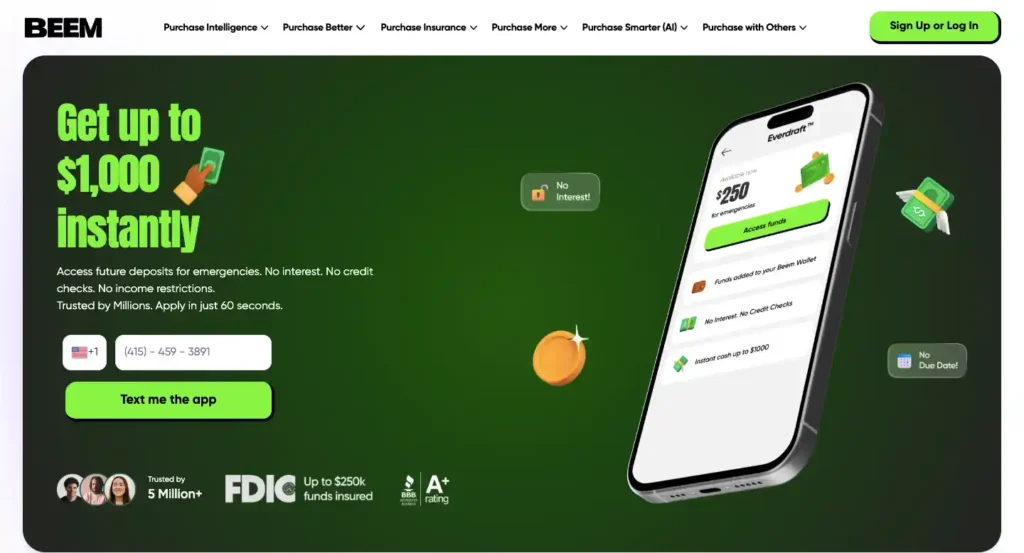
Beem’s Everdraft™ is an instant cash advance feature that lets eligible users access money before the next paycheck without interest or credit checks. Beem’s help center says eligibility requires an active Beem account, a supported U.S. checking account, a verified debit card linked to the primary bank account, an eligible subscription plan, and no pending dues.
Beem also says Everdraft™ can provide access to up to $1,000, with personalized limits based on factors such as income stability, deposit history, banking activity, and repayment behavior.
People Also Read: How to Get $10 Fast
The Beem Difference
For hourly workers, the important difference is what the system appears to lean on. EarnIn is built around verifying current work activity and pay cycle signals. Beem leans more on the linked bank history, deposits, and account behavior.
That makes it a different kind of fit. It is less about proving you were at a fixed work location today and more about whether your bank profile shows the cash flow and stability needed to support an advance.
That does not mean Beem has no requirements. It does. Beem says the primary checking account should have at least six months of transaction history, and it notes that changing your primary linked bank can change your qualification amount. So Beem is not a shortcut around every type of qualification. It is simply solving the problem from a different angle than EarnIn.
The Overtime Timing Problem Most Blogs Miss
A lot of content around overtime pay quietly assumes the bigger paycheck is the solution. It is not. The size of the next check and the timing of the next check are two different issues.
Federal guidance is clear that overtime pay is generally tied to the regular payday for the pay period in which the wages were earned. So if you work extra hours on Thursday and Friday, that may strengthen your next paycheck, but it does not automatically help with an urgent bill due on Monday.
This is why hourly workers should care so much about how an app handles timing, verification, and access rules, not just maximum headline amounts.
Where Earnin Can Work Really Well
EarnIn makes a lot of sense for a certain kind of worker. If you are a W-2 hourly employee with one main employer, consistent direct deposit, and a work pattern that the app can verify through GPS or work email, EarnIn can align well with how you earn.
Because it adds available earnings during the pay period and re-evaluates your Pay Period Max over time, it can feel close to having a wage-access layer built around your regular payroll rhythm.
That can be especially useful if your overtime is frequent but not chaotic. In that kind of setup, EarnIn’s structure feels less like a generic cash advance and more like a bridge between shifts worked and payday received.
People Also Read: Red Flags to Watch Out For in Cash Advance Apps
Where Beem Feels Stronger
Beem becomes especially compelling when the worker’s income is real, but not perfectly tidy. If your overtime is lumpy, your schedule changes often, your deposit history matters more than a worksite check-in, or you simply want a system that is less dependent on employer-style verification signals, Beem may feel more forgiving in day-to-day use.
That is because Beem’s qualification logic centers on bank activity, deposit patterns, and repayment behavior rather than on-the-job confirmation methods like GPS or employer email.
That distinction matters more than it first appears. Hourly workers with overtime pay often do not have an unstable income. They have uneven income. Those are not the same thing. An app that reads unevenness more comfortably can sometimes be the better fit, even if both products are trying to solve the same core problem.
The Daily Access Issue Matters More Than Marketing
This is one of the most practical differences in the comparison. EarnIn says its Daily Max is up to $150 in most states and $100 in New York and Washington, D.C., subject to available earnings.
Its Pay Period Max can range from $50 to $1,000, with a possible increase if you route direct deposit through EarnIn. That means a worker can have a decent pay period ceiling but still run into a same-day limit.
For an hourly worker, that detail is not small. If you need $65 for gas, EarnIn’s structure may feel completely fine. If you need $240 for an emergency tire replacement before the next shift, the daily cap becomes much more important.
Beem, by contrast, says eligible users can access between $10 and $1,000 based on their profile, account history, and repayment behavior. That does not guarantee a larger advance for every user, but it does mean the access conversation is shaped differently.
Speed Also Matters, But Not In A Simplistic Way
EarnIn offers fee-free standard transfers that typically arrive within 1 to 2 business days. It also offers Lightning Speed, which can deliver funds within 30 minutes, including weekends and holidays, for an optional fee.
Beem Everdraft™ often enables access within minutes once the user is eligible and the app displays an available amount.
For hourly workers, the real question is not just which one is fast. It is what kind of fast you need. If you can wait a day or two and you fit EarnIn’s model well, its standard transfer may be enough. If speed is urgent and frequent, then the structure behind that speed matters more.
One system uses optional expedited fees. The other markets Everdraft™ as fast access within minutes once you qualify.
People Also Read: What Makes Beem Different
A Simple Way To Think About The Choice
Choose EarnIn if your work life is traditional, stable, and easy to verify. One main job. One main paycheck. Clean direct deposit. A predictable work pattern. Frequent overtime with the same employer. In that environment, EarnIn can feel well-matched to how you actually earn.
Choose Beem if your work life is still legitimate and consistent enough to show up in your bank history, but less neat on the surface: Overtime that comes in waves. Deposits that matter more than worksite tracking. A desire for qualification based on cash flow behavior rather than employer-side confirmation. In that case, Beem may feel more natural.
Conclusion
For hourly workers with overtime pay, this is not really a story about which app is “best” in the abstract. It is about which one matches the shape of your paycheck.
EarnIn is strongest when your job looks traditional and verifiable. If you have one employer, one predictable deposit stream, and overtime that follows a stable pattern, its earned-wage model can feel very natural.
The Beem app stands out when your income is solid but less tidy. If overtime comes in bursts, if your schedule moves around, or if you want an app that leans more on bank-side cash flow than on work-status verification, Beem may fit better.
The smartest way to compare them is not by headline branding. It is by asking a much simpler question: when overtime hits your life, does the app understand how you actually get paid?
FAQs on Beem vs EarnIn for Hourly Workers
1. Is EarnIn better for workers who get overtime every week?
It can be, especially if that overtime happens inside a stable W-2 job with predictable direct deposits and verification that EarnIn can read cleanly. EarnIn is designed around average paycheck history, pay schedule recognition, and work activity signals, so it tends to fit workers whose overtime is regular rather than erratic.
2. Does overtime automatically increase how much I can access?
Not always in a simple, immediate way. EarnIn says its daily earnings are based on average paycheck amount divided by days in the pay period, and its displayed hourly rate is based on average paycheck deposit history plus work hours or schedule. Beem says qualification is based on deposit history, banking activity, and repayment behavior. So in both cases, overtime can help, but it is usually filtered through a broader pattern, not treated like an instant dollar-for-dollar unlock the moment you work extra hours.
3. Which app is better if my schedule changes every week?
Beem may be easier for workers whose income is real but uneven, because its help content points to qualification based on bank activity and deposit behavior. EarnIn can still work, but its system depends more on recognized pay cycles and work verification signals such as GPS or work email.
4. Can I use EarnIn if I travel between job sites?
Possibly, but GPS earnings are not compatible with people who travel during work, and a fixed physical work address is one of the requirements for that method. Work email verification can be another path if your employer provides a valid work email and you can access it.
5. Does Beem work if I recently changed bank accounts?
It may affect your qualification. Beem says your primary account needs at least six months of transaction history to qualify, and changing your primary linked bank can increase or decrease your qualification amount.