
Table of Contents
Not every household is unbanked by choice. Sometimes it is about minimum balance rules. Sometimes it is about fees. Sometimes it is a trust problem built from bad experiences. Sometimes it is simply that traditional banking has never fit the way income actually comes in and bills actually go out.
The FDIC’s national survey found that 4.2% of U.S. households, about 5.6 million households, were unbanked in 2023. Among unbanked households, “don’t have enough money to meet minimum balance requirements” was the most cited main reason for not having a bank account, followed by “don’t trust banks.”
That is why this topic matters. If you are trying to use Beem without a full bank account, the answer is not a simple yes or no. Some parts of Beem are accessible earlier.
Some require a verified debit card. Some features, especially Everdraft™, still require a supported U.S. checking account. The smartest way to approach this is with clarity, not false promises.
First, The Honest Answer
If you are fully unbanked today, you should not expect every Beem feature to unlock immediately. Beem’s wallet tools are more flexible than its cash advance feature. For basic money movement, Beem’s transaction rules say you can get started by linking either a bank account or a debit card with verified ownership.
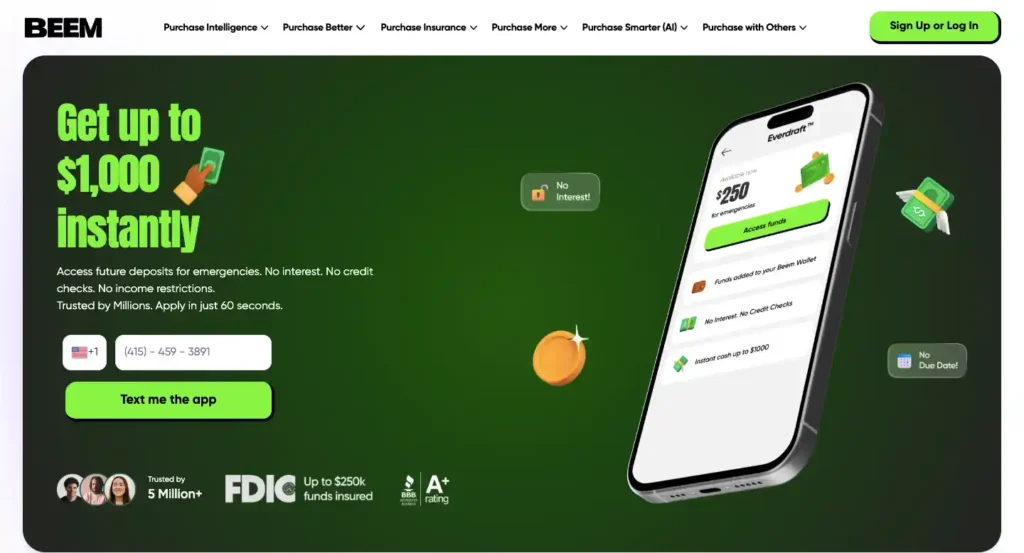
But Everdraft™ is different. To qualify for Everdraft™, you need a supported U.S. checking account, a verified debit card linked to that primary bank account, an eligible subscription plan, and no pending dues.
That distinction is the key to the whole article. Beem can still be useful if you do not have a traditional full-service banking setup right now. But it is more accurate to think of it as a step-in tool first and a full-feature tool later, depending on what account access you can add.
People Also Read: How BEEM Handles Economic Uncertainty
What “Without A Full Bank Account” Can Realistically Mean
A lot of people are not completely disconnected from the money system. They may not have a standard checking account with a mainstream bank, but they may still have a debit card, a prepaid card, or a nontraditional way of receiving or moving money.
That matters because Beem’s wallet setup is built around verified ownership of a payment source, not only around a classic bank relationship. To activate transactions, Beem allows a linked bank account or a verified debit card. Once the account is active, a Beem account can be used to send and receive money and to withdraw funds to a linked bank account, debit card, or prepaid card.
That is a much more useful way to frame the topic. The issue is not just “banked versus unbanked.” The real issue is whether you have enough verified rails to move money safely inside the app. In Beem, that starting point can be lighter than a full traditional banking setup for wallet activity, but it is still stricter for features like Everdraft™.
What You Can Do In Beem Before You Have A Full Checking Relationship
If your goal is to start somewhere instead of staying locked out, this is the most practical part.
1. Use Beem as a digital money hub
A Beem account can function as a digital wallet inside the app. It supports sending and receiving money electronically, and it also allows withdrawals to a linked bank account, debit card, or prepaid card. That makes Beem useful even before you unlock every premium or qualification-based feature.
2. Start money movement with a verified debit card
Beem’s transaction rules say you can activate money movement by linking a bank account or a debit card with verified ownership. That means a person who does not have a full checking relationship may still be able to start with the debit-card route, depending on what verified card access they have.
3. Send money to someone even if they are not on Beem
This matters for households that rely on family support, informal networks, or shared financial survival. Beem lets you send money to someone who is not already on the app.
The recipient can choose how to receive it, including to a bank account by ACH, to a debit card instantly, to a prepaid card, to a gift card, or to a Beem account for future use. That creates more flexibility than a closed-loop system where both sides must already be fully set up.
People Also Read: How Fast Is BEEM’s Instant Transfer
Where The Limits Show Up
This is where accuracy matters more than optimism.
1. Everdraft™ is not a no-bank shortcut
If you are searching “beem for unbanked households” because you want instant cash access without a full bank account, the honest answer is that Everdraft™ is not built that way.
Everdraft™ requires a supported U.S. checking account and a verified debit card linked to that primary account. So while Beem can be part of your path forward, it does not replace that checking-account requirement for the cash advance feature.
2. Instant transfer also has its own requirement
Fast money movement inside fintech usually depends on card rails, and Beem is no exception. Instant transfer requires a linked U.S. debit card because that is what enables real-time payment processing.
Without a linked debit card, transfers fall back to wallet balance or bank-account routes that may take 3 to 5 business days.
3. Unsupported banks are still a real barrier
Even if you do have some kind of checking account, not every institution is supported. Beem says the most accurate way to check compatibility is in-app during the bank-linking process.
If your bank does not appear, the practical next move is to link another eligible U.S. checking account. Beem also notes that accounts with at least six months of transaction history, regular income deposits, and stable activity are more likely to connect smoothly and function well.
Why Payout Flexibility Matters More In Unbanked Households
For banked users, receiving money is usually simple. For unbanked households, it is rarely that clean. Money may need to move to a prepaid card, a debit card, a gift card, or a future wallet balance, depending on what the receiving person can actually use that day.
That is where payout flexibility becomes more than a convenience. It becomes part of financial access itself. Beem allows money sent to someone who is not already on the app to be received through ACH to a bank account, instantly to a debit card, to a prepaid card, to a gift card, or into a Beem account for future use.
That flexibility is especially useful for households that depend on shared support. A parent helping an adult child, a sibling covering groceries, or a relative stepping in before payday may all need different receiving options. In those situations, an app that assumes everyone already has the same financial setup is less helpful than one that offers multiple ways to receive money.
What First-Time Access Really Looks Like Inside Beem
One of the most useful things a guide can do is explain what the first few steps actually feel like. In Beem, first-time access is structured. Your first deposit cannot exceed $50 if you are unsubscribed and $100 if you are subscribed. Single transaction limits also vary by subscription status, and instant withdrawals to debit cards require that the card be verified.
Instant transfer also needs a linked U.S. debit card because that card connection is what enables real-time payment processing. Without it, transfers can still move through wallet balance or bank routes, but they may take 3 to 5 business days instead of happening right away.
People Also Read: BEEM And Cost Of Living
The Best Way To Think About Beem If You Are Unbanked
Do not think of Beem as a magic bypass around the financial system. Think of it as a bridge.
If you have no full-service banking relationship today, Beem can still help you start managing digital money in a more structured way. You may be able to activate wallet transactions with a verified debit card, send and receive money, move funds to a prepaid card, and interact with the app without having every traditional banking piece in place on day one.
But if your goal is to unlock Everdraft™, you will eventually need a supported U.S. checking account and a verified debit card tied to it.
That is not a weakness in the explanation. It is the value of the explanation. A lot of content online tells financially stressed readers what they want to hear. A better guide tells them what path is actually open.
A Practical Path To Start Using Beem Without A Full Bank Account
Here is the clearest way to approach it.
1. Start with the wallet, not the advance
If you are unbanked, begin by treating Beem as a wallet and money-movement tool, not as an instant cash product right away. That keeps expectations realistic and lets you use the features that are actually available earlier.
2. Link what you do have
If you have a verified debit card, that may be enough to activate basic transaction functionality. If you later add a supported U.S. checking account, your access can expand.
3. Use flexible payout paths
If you need to receive money from someone, Beem gives multiple options, including debit card, prepaid card, gift card, bank transfer, or a Beem account path. For many unbanked households, that flexibility is not a small detail. It is the difference between “I can use this” and “this app still does not fit my life.”
4. Move toward qualification only when the account setup is ready
If your end goal is Everdraft™, do not force it too early. First get to the point where you can link a supported checking account with real transaction history and a verified debit card attached to it. That is when Beem’s advance model becomes relevant.
People Also Read: What Makes BEEM Different?
Why This Matters For Real Households
Unbanked households do not only need “access.” They need access that does not assume a polished financial life already exists. That is what makes this conversation important. Some people are rebuilding after overdrafts. Some are dealing with inconsistent income.
Some are using prepaid tools because traditional accounts never felt stable or safe. When a financial app gives partial access before full eligibility, that can still be meaningful. It gives people a way to begin moving money digitally, receive support, and build toward fuller access later.
BEEM is useful in that middle ground. Not as a fantasy replacement for every missing banking rail, but as a practical platform that can work in stages.
Conclusion
The right way to talk about Beem for unbanked households is with honesty.
Yes, you may be able to start using the Beem app without a full bank account, especially for wallet-based actions, money movement, and flexible receiving options. But no, that does not mean every feature is open immediately. Everdraft™ still requires a supported checking account and verified debit card setup.
That may sound like a limitation, but it is actually the clearest value Beem offers here: a way to begin before everything is perfect. For households living outside traditional banking, that kind of step-by-step access can matter a lot. It creates a usable on-ramp instead of another dead end.
FAQs on Beem for Unbanked Households
1. Can I use Beem if I do not have a traditional checking account?
You may still be able to use parts of Beem. For basic transaction activation, Beem allows a linked bank account or a verified debit card with verified ownership. That can open wallet-style functions even before you have a full traditional checking setup.
2. Can I get Everdraft without a full account?
Not in the usual sense. Everdraft™ requires a supported U.S. checking account, a verified debit card linked to that primary account, an eligible subscription plan, and no pending dues.
3. Can I receive money through Beem without a bank account?
Yes, there are flexible receiving paths. Money sent through Beem can be received to a debit card instantly, to a prepaid card, to a gift card, or to a Beem account, depending on the option chosen and verification requirements.
4. Does instant transfer work without a debit card?
No. Beem requires a linked U.S. debit card for instant transfer. Without that card connection, transfers may move through slower wallet or bank routes instead.
5. What should I do if my bank is not supported?
Check support directly in the app during the linking process. If your institution is not supported, the practical next step is to link another eligible U.S. checking account with stable history and regular deposits when you are ready to unlock more features.