
Table of Contents
Budgeting cash advance apps help you avoid payday loan debt by providing interest-free bridge funding for short-term cash gaps — while giving you the financial visibility to prevent those gaps from recurring. The math of a payday loan is hard to unsee once you’ve seen it: a $300 loan at a $45 fee sounds manageable until you annualize it to 391% APR, and the Consumer Financial Protection Bureau has found that most payday loan revenue comes from borrowers taking out ten or more loans per year.
The loan isn’t designed to solve a short-term problem — it’s designed to extend one. Apps like Beem work on the opposite principle: solve the immediate need at zero cost through Everdraft, then use BudgetGPT to build the financial visibility that makes the need less likely to return.
What Makes Payday Loans So Financially Destructive
Before examining how budgeting cash advance apps provide a better path, it is worth being specific about what makes payday loans so consistently damaging to the people who use them. The problem is not that payday loans exist.
The Fee Structure Is Deliberately Obscured
A $15 fee per $100 borrowed sounds modest. The same cost expressed as a 390% APR sounds alarming. Lenders have every incentive to present the flat fee rather than the annualized rate — and borrowers systematically underestimate what they’re taking on as a result.
The Repayment Structure Traps Rather Than Resolves
Payday loans are due in full — principal plus fee — on the borrower’s next payday. That paycheck covers the loan, which leaves the account short for regular expenses, which creates the need for another loan. The cycle isn’t a willpower failure. It’s the mathematically predictable outcome of a repayment structure that ignores whether repayment is actually feasible.
Loan Rollovers Compound the Cost Geometrically
When a borrower can’t repay in full, lenders offer a rollover: pay the fee, extend the loan, touch none of the principal. A $300 loan rolled over four times at $45 per rollover costs $180 in fees before the principal is ever reduced — turning a two-week loan into two months of compounding debt.
Payday Loans Target the Moments of Maximum Vulnerability
The borrowers most likely to use payday loans are those with the fewest alternatives and the least ability to absorb high fees. The product is structurally most damaging to exactly the people it’s most aggressively marketed toward.
How Budgeting Cash Advance Apps Work Differently at Every Level
The contrast between payday loans and budgeting cash advance apps like Beem is not just a matter of cost, though the cost difference is significant. It is a difference in fundamental design philosophy. Payday lenders profit from financial distress continuing.
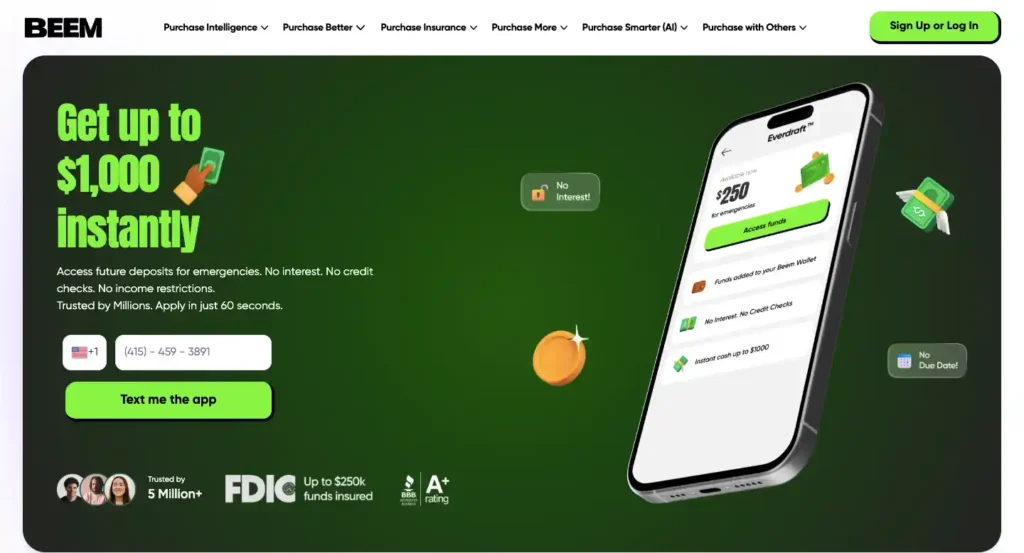
The Advance Costs Nothing: Beem Everdraft charges no interest, no fees, no tips, and no subscription. A $300 advance costs exactly $300 to repay. For households that would otherwise use payday loans monthly, that’s more than $500 saved in fees annually.
Repayment Is Structured Around Real Income Timing: Everdraft repayment is scheduled around the borrower’s next actual income deposit, not a fixed calendar date. This eliminates the primary mechanism of the payday loan trap — when repayment aligns with when money actually arrives, the rollover cycle doesn’t start.
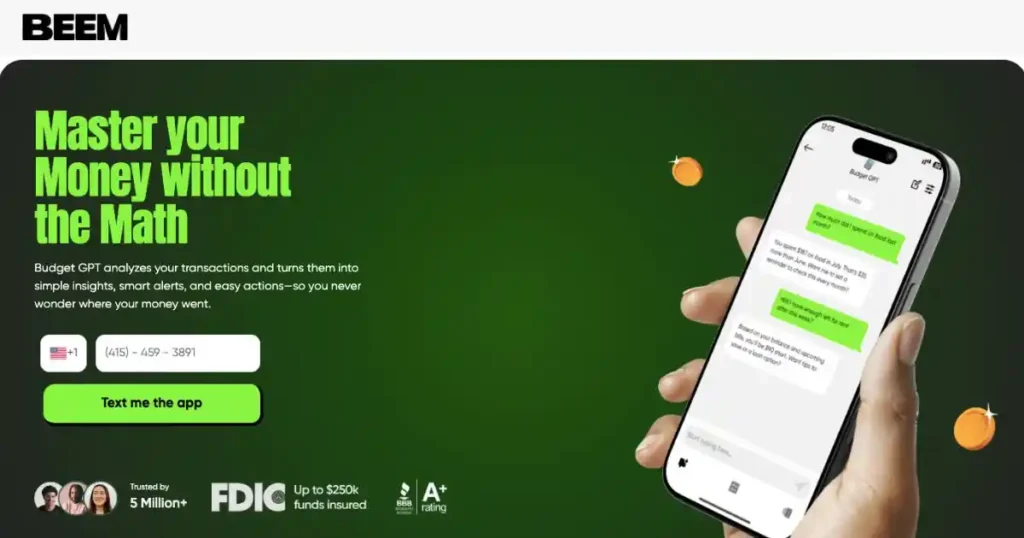
The Budgeting Layer Addresses the Root Cause: BudgetGPT doesn’t just cover the cash gap — it analyzes the income and spending patterns that created it. A payday lender has no interest in why you needed the loan. Beem has a direct interest in making sure you won’t need it again.
Building Financial Behavior Is Rewarded, Not Penalized: Responsible financial behavior earns progressively higher Everdraft limits over time. Payday lenders do the opposite — the worse your situation becomes, the more dependent you are on their product. Beem’s model succeeds when you do.
The Real Cost Comparison: Payday Loan vs. Beem Everdraft
Numbers make the comparison concrete. Here is what the same financial need actually costs across two different products over the course of a year.
Single Use Scenario
A borrower needs $300 to cover an unexpected expense before payday. Using a payday loan at the industry standard fee of $15 per $100 borrowed, the cost is $45 for a two-week loan. Using Beem Everdraft, the cost is zero. Single-use saving: $45.
Monthly Use Scenario
A borrower uses short-term bridge funding once per month throughout the year. Using payday loans at $45 per use, the annual cost is $540 in fees on top of the principal repaid twelve times. Using Beem Everdraft, the annual cost is zero. Annual saving: $540.
Debt Trap Scenario
A borrower enters the payday loan cycle, taking a new loan to repay each previous one over six months. At $60 in fees per $400 loan, six cycles cost $360 in fees while the principal is never reduced. With Beem Everdraft, the same six months of bridge funding costs zero, and BudgetGPT actively works to identify and address the spending pattern creating the recurring need.
Comparison Table: Payday Loans vs. Budgeting Cash Advance Apps
| Feature | Beem Everdraft Plus BudgetGPT | Traditional Payday Loan | Tip-Based Cash Advance App | Bank Overdraft Coverage |
| Cost Per $300 Advance | $0 | $45 | $6 to $15 in tips and fees | $25 to $35 per transaction |
| Annual Cost (monthly use) | $0 | $540 | $72 to $180 | $300 to $420 |
| Interest Rate | None | 300 to 400% APR equivalent | None stated | 18 to 28% on credit lines |
| Rollover Risk | None | High | Low | None |
| Repayment Timing | Tied to income deposit | Fixed due date | Tied to income deposit | Automatic per transaction |
| Budgeting Tools Included | Yes, BudgetGPT | No | No | No |
| Credit Check Required | No | No | No | No |
| Maximum Advance | Up to $1,000 | Typically $100 to $500 | Up to $250 to $750 | Transaction by transaction |
| FDIC-Backed | Yes | No | No | Bank dependent |
| Debt Trap Risk | Very low | Very high | Low | Low |
How BudgetGPT Specifically Prevents the Patterns That Lead to Payday Loan Dependency
The budgeting component of a cash advance app is only valuable if it provides genuinely actionable intelligence rather than generic advice.
Identifying Cash Flow Gap Windows
For most households that experience recurring short-term cash shortfalls, the problem is not that expenses exceed income over a full month. It is that expenses cluster in one part of the pay cycle while income arrives at a different point. BudgetGPT maps this pattern precisely, identifying the specific days in your monthly cycle when cash flow is consistently tightest.
Flagging Recurring Costs That Consistently Create Shortfalls
Some expenses create cash gaps not because they are unexpected but because they are consistently underbudgeted. An annual insurance renewal that arrives every October, a quarterly utility spike in January, a semi-annual car registration fee in June: these costs are predictable if you know they are coming, but they function as surprises if your budgeting system does not surface them in advance.
Building a Minimum Balance Buffer
One of the most practical tools BudgetGPT provides is a minimum balance recommendation based on your specific spending patterns and income timing. Rather than recommending a generic emergency fund target, BudgetGPT identifies the smallest buffer that would prevent the specific types of cash gaps your account has historically experienced. For many households, this buffer is smaller than they would assume, because the gap is a timing problem rather than a magnitude problem.
The Psychological Dimension: Why Payday Loans Feel Easier in the Moment
Understanding why people choose payday loans even when better alternatives exist requires acknowledging the psychological dynamics of financial stress. This is not a criticism of borrowers. It is an honest examination of how financial decision-making works under pressure, and why product design matters as much as product cost.
Availability and Familiarity
Payday lenders are physically and digitally accessible in a way that reflects decades of deliberate market positioning. They are on the corner, in the app store, and in the search results. They are familiar. When a financial need is urgent and options feel limited, familiarity is a powerful factor in decision-making. Building awareness of better alternatives, before the moment of need rather than during it, is the most effective way to shift that decision.
The Illusion of Speed
Payday lenders market same-day or instant funding as a key differentiator. The implication is that their product is faster than alternatives. In reality, Beem Everdraft delivers funds in minutes with no credit check, no employment verification, and no mandatory in-person visit. The speed advantage that payday lenders claim does not actually exist when compared to a well-designed cash advance app. The perception persists because many people encounter payday lenders before they discover Everdraft.
Practical Steps to Break Free From Payday Loan Dependency With Beem
For readers who are currently in a payday loan cycle rather than trying to prevent one, these steps outline a practical path toward resolution using Beem’s full platform.
Map your current loan obligations: List every payday loan balance, due date, and fee structure currently outstanding. Understanding the full picture of what you owe, when it is due, and what it costs prevents the common mistake of taking a new advance to repay an existing loan without addressing the underlying pattern.
Use Everdraft strategically: If you are approaching a payday loan due date and know you cannot repay in full, an Everdraft advance can cover the repayment and eliminate the rollover fee. The Everdraft advance costs nothing, the payday loan fee is avoided, and repayment of the Everdraft advance comes from your next deposit without a fee added. This single substitution saves the rollover fee and begins the process of replacing high-cost debt with zero-cost bridge funding.
Use BudgetGPT: Once the immediate loan obligation is resolved, use BudgetGPT to map the cash flow pattern that made the payday loan feel necessary in the first place. Most recurring payday loan users have a specific, identifiable gap window in their monthly cycle. Identifying it precisely allows for a targeted intervention that reduces the likelihood of needing bridge funding at all.
Build toward Beem Boost: As you repay Everdraft advances on time and maintain healthier account activity, your available limit increases through Beem Boost. A higher Everdraft limit provides more financial runway for genuine emergencies without requiring any high-cost product at all.
Treat the cost savings as a dedicated buffer fund: If you were spending $45 per month on payday loan fees, redirect that exact amount into a dedicated buffer savings goal within your Beem budget. Over six months, that creates a $270 buffer. Over twelve months, $540. The money was already leaving your account. Keeping it in your account instead is the most direct possible path to financial stability.
The Bottom Line
Every financial decision compounds over time. A household that spends $540 per year on payday loan fees for five years has spent $2,700 on the cost of accessing their own income, with nothing to show for it and a cash flow pattern that is no healthier than when the cycle started. A household that uses Beem Everdraft for the same five years pays zero in fees, builds progressively higher financial access through Beem Boost, and uses BudgetGPT to actively reduce the frequency and severity of cash gap events over time.
The payday loan industry is not going to change its structure. It exists to profit from the gap between when people need money and when they have it. Beem exists to close that gap at zero cost and then reduce it over time by building genuine financial intelligence into the product itself.
No interest. No fees. No rollovers. No debt trap. Just a fast, honest bridge to your next paycheck and an AI-powered tool working actively to make that bridge shorter, smaller, and less necessary with every passing month.
Frequently Asked Questions
1: How do cash advance apps help you avoid payday loan debt?
Cash advance apps like Beem provide the same immediate bridge funding that payday loans offer but at zero cost, with no interest and no fees. More importantly, apps like Beem include budgeting tools like BudgetGPT that identify and address the underlying cash flow patterns that make short-term bridge funding necessary in the first place.
2: What is the real cost difference between a payday loan and Beem Everdraft?
A typical payday loan charges $15 per $100 borrowed, equivalent to a 390 percent APR for a two-week loan. On a $300 advance, that is $45 in fees. Beem Everdraft charges zero fees and zero interest on the same advance. For a household that uses short-term bridge funding monthly, the annual cost difference between payday loans and Everdraft exceeds $540 in fees saved, with no reduction in the funding access received.
3: Can Beem help someone who is already in a payday loan cycle?
Yes. Beem Everdraft can be used strategically to break a payday loan rollover cycle by covering an existing loan repayment at zero cost, eliminating the rollover fee, and replacing the high-cost loan with an interest-free advance repaid from the next income deposit.
4: What makes BudgetGPT different from a regular budgeting app?
BudgetGPT is built around your actual income timing and spending patterns rather than generic monthly averages or static budget templates. For households experiencing recurring cash gaps, the issue is almost always a timing problem rather than a total income problem.
5: Is Beem Everdraft a safe alternative to payday loans?
Yes. Beem is FDIC-backed for eligible deposit accounts, charges no interest or fees on Everdraft advances, and uses bank-level encryption to protect user financial data. Unlike payday lenders, Beem does not profit from rollovers, late repayments, or financial distress continuing.