

Table of Contents
Tip-based cash advance apps present tips as optional, but their design, defaults, and social framing make these prompts function more like fees in practice. A user who tips just $1 to $5 per advance across 12 advances in a year can pay $60 or more annually for a product marketed as free. Understanding how these costs accumulate is the first step toward choosing a genuinely transparent alternative.
Most people download a cash advance app in search of a straightforward solution to a short-term cash gap. The promise is simple: get funds now, repay when your next deposit arrives, no interest, no catch.
What many users discover only after several months of use is that the tip prompts, express delivery fees, subscription charges, and account upgrade costs embedded in these apps create a real financial cost that was never clearly disclosed upfront. For a product used by people already navigating tight finances, that lack of transparency is a serious problem worth examining closely.
What Is a Tip-Based Cash Advance App?
A tip-based cash advance app is a financial product that asks users to leave a voluntary tip each time they make an advance request. The app frames the tip as a way to support the service or keep it running, while presenting it as entirely optional. In practice, the tip prompt is designed to generate revenue and often defaults to a suggested amount that users must actively choose to reduce or remove.
Tip-based apps occupy an interesting regulatory space. Because tips are technically voluntary, they do not qualify as interest under most state lending regulations. This means the effective cost of borrowing through a tip-based app rarely appears in any advertised rate, annual percentage rate disclosure, or fee schedule. The cost is real. It is simply not labeled as a cost.
People Also Read: Fixed vs Variable Fee Cash Advance Apps: Which One Actually Costs Less?
How Do Tip Prompts Actually Work?
Understanding the mechanics of tip prompts helps clarify why they function so differently from a genuine voluntary gratuity.
Default Tip Amounts Are Set High
Most tip-based cash advance apps pre-select a tip amount when the request screen appears. The default is rarely zero. It is typically between $1 and $5, or in some cases, a percentage of the advance amount. Users who do not notice the pre-selected amount or feel social pressure to leave something accept the default without changing it.
The Interface Makes Removing the Tip Uncomfortable
App design plays a significant role in tip conversion. The button to accept the suggested tip is typically prominent, brightly colored, and positioned as the primary call to action. The option to reduce or remove the tip is smaller, less prominent, and sometimes requires navigating to a separate screen.
This asymmetry is intentional and is known in behavioral economics as a dark pattern. This design choice steers users toward the option that benefits the company rather than the user.
Tips Are Requested on Every Single Advance
Unlike a subscription fee that you pay once per month regardless of how often you use the product, tip prompts appear on every individual advance request. A user who takes one advance per month at a $3 tip pays $36 per year. A user who takes two advances per month at the same tip pays $72. The cost scales directly with how frequently you use the service, so users who rely on the app most heavily pay the most.
Social Framing Creates Pressure
Some apps include messaging around the tip prompt that frames leaving a tip as an act of community support or as a way to help keep the service available for everyone. While this framing is not inherently deceptive, it introduces a social dynamic into what should be a neutral financial transaction. Users who would otherwise skip the tip may feel that removing it reflects poorly on them or puts the service at risk.
True Cost of Tip-Based Apps vs Beem Everdraft
| Cost Factor | Beem Everdraft | Tip-Based App A | Tip-Based App B | Tip-Based App C |
| Mandatory Subscription Fee | None | $9.99/month | $9.99/month | None |
| Tip Per Advance | None | $1 to $5 (default) | $1 to $14 (default) | $1 to $5 (default) |
| Express Delivery Fee | None | $2.99 to $4.99 | $3.99 to $5.99 | $1.99 to $3.99 |
| Interest on Advance | None | None | None | None |
| Max Advance Amount | $1,000 | $500 | $750 | $250 |
| Estimated Annual Cost (moderate user) | $0 | $120 to $200 | $150 to $250 | $60 to $120 |
| Estimated Annual Cost (heavy user) | $0 | $250 to $400 | $300 to $450 | $150 to $250 |
| Transparent Fee Disclosure | Yes | Partial | Partial | Partial |
| FDIC-Backed | Yes | No | Varies | No |
Why Express Delivery Fees Deserve Separate Attention
The express delivery fee is one of the most quietly expensive components of many cash advance apps, and it is almost always presented as optional. The reality is that for most users who need a cash advance, waiting two to three business days for free delivery defeats the purpose of the product entirely.
If you need money because rent is due tomorrow or because your car needs repairs before you can get to work, standard delivery is not a viable option. The express delivery fee is, in practical terms, a mandatory cost for anyone using the app for its intended purpose: immediate access to funds in a moment of need.
Beem Everdraft™ does not charge an express delivery fee. Instant transfer is part of the core product, not an upsell. For a user who takes even 6 advances per year, the absence of an express delivery fee results in $18 to $36 in direct savings compared to apps that charge $3 to $6 per instant transfer.
The Subscription Fee Problem
Several cash advance apps use a freemium subscription model: the base app is free, but access to larger advance amounts requires a paid monthly subscription. The monthly fee is typically between $8 and $10 and is charged regardless of whether you use the app that month.
This creates a particularly poor value proposition for occasional users. A freelancer who needs a cash advance twice a year but pays $9.99 per month for subscription access spends $119.88 annually for two advances. If those advances are $200 each, the effective cost of borrowing is significant, despite the app technically charging no interest.
How Beem Everdraft Is Structurally Different
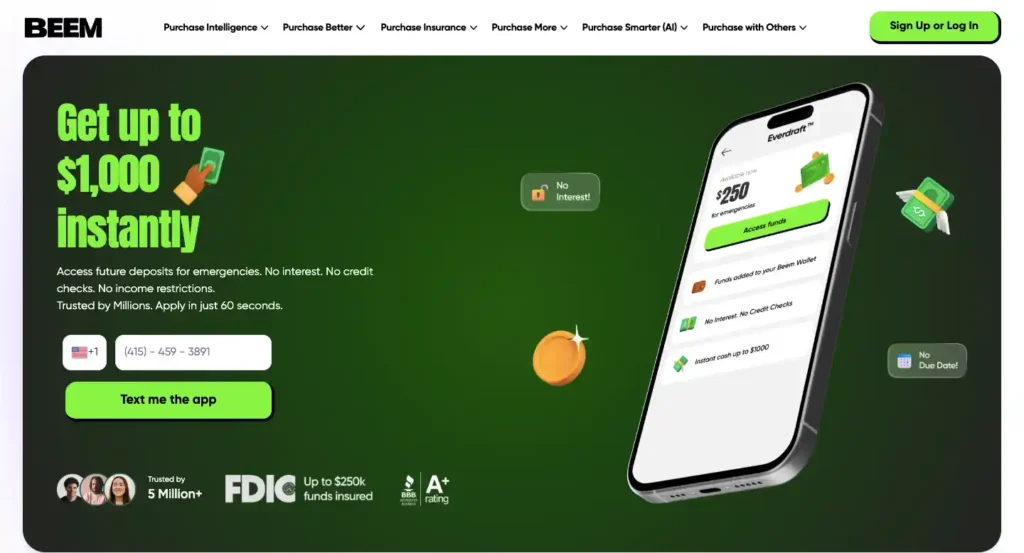
Beem Everdraft was designed around a principle that most cash advance apps ignore: transparent financial tools should not extract money from users through friction, defaults, or social pressure. There are no tip prompts, no default amounts to override, no express delivery fees, and no monthly subscription required.
Your eligibility is determined by your account activity and financial behavior, not by how much you pay to access the platform. The total additional cost of an Everdraft advance, beyond what you borrow, is zero.
What makes that even more compelling is the ceiling. Beem Everdraft offers advances up to $1,000, which is among the highest available in the no-fee, no-credit-check category. That limit is not locked behind a premium subscription tier. It is earned through responsible use via Beem Boost, a program that progressively increases your available advance as you demonstrate consistent, healthy financial behavior. More access, no extra cost, and a clear growth path. That is the structural difference.
What Regulators Are Starting to Say About Tip-Based Apps
The tip-based cash advance model has attracted increasing scrutiny from consumer protection advocates and financial regulators. The core concern is whether voluntary tips, when combined with default settings and interface design that make removing the tip unintuitive, should be reclassified as fees under consumer lending law.
Several state attorneys general have investigated cash advance platforms for potentially deceptive fee disclosures, and the Consumer Financial Protection Bureau has signaled interest in examining how costs are presented and disclosed to users across the earned wage access and cash advance category.
None of this means tip-based apps are illegal today. It does mean the regulatory environment around these products is evolving, and platforms that rely on opaque cost structures may face meaningful changes in how they are required to disclose those costs in the future.
For users, the practical implication is straightforward: choosing a platform with transparent, zero-cost pricing is not just financially smarter today; it’s also better for the environment. It’s also better for the environment. It is also choosing a product built on a model that does not depend on obscuring its true cost from those who use it.
People Also Read: Flexible Repayment Cash Advance Apps That Don’t Trap You in Debt
How to Identify Hidden Costs Before You Download a Cash Advance App
Before connecting your bank account to any cash advance app, these questions can help you understand the true cost of the product.
Does the app charge a monthly or annual subscription fee? If yes, calculate your annual cost, including the months you do not use the product. A $9.99 monthly fee amounts to nearly $120 per year, whether you take one advance or twenty.
Does the app ask for tips? If you check the default tip amount, how easy is it to set the tip to zero, and is that option clearly visible or buried in the interface?
Is there a fee for instant or same-day delivery? If so, treat that fee as a mandatory cost for any advance you actually need urgently, because waiting 2 to 3 days defeats the purpose of a cash advance in most genuine emergencies.
Is the maximum advance amount clearly stated? Some apps advertise high limits but make them available only to subscribers or only after extended platform engagement. Understand what you can access from day one, and what requires additional spending or waiting.
Is the platform FDIC-backed? FDIC backing applies to eligible deposit accounts and provides an additional layer of protection for your funds. It is a meaningful indicator of a platform’s financial credibility and stability.
The Bottom Line: Free Should Mean Free
The cash advance market faces transparency issues. Products that describe themselves as free or interest-free are generating significant revenue through tip defaults, express delivery charges, and subscription upsells, costs that are real but structured to avoid the scrutiny that comes with being labeled as fees or interest.
For users navigating tight finances, this matters. Every dollar paid in tips, delivery fees, or subscriptions is a dollar that was not disclosed clearly when you signed up, and a dollar that compounds across every advance you take. The cumulative cost of a “free” cash advance app can reach hundreds of dollars per year for regular users.
Beem Everdraft is built on the belief that short-term financial support should not come at the cost of hidden extraction. No tips. No express fees. No subscriptions. No interest. Up to $1,000 based on your financial behavior, delivered instantly, at a total additional cost of zero. That is what transparency in financial products actually looks like. Download the app now!
People Also Ask
1. Are tips on cash advance apps really optional?
Tips are technically optional on most cash advance apps, but interface design, pre-selected default amounts, and social framing make them function more like soft fees in practice. Many users accept the default tip without realizing they can reduce it to zero.
2. How much do cash advance app tips cost per year?
The annual cost of tips depends on how often you use the app and on the default tip amount. At a modest $3 tip per advance, monthly users pay $36 per year. Users who also pay the $3 express delivery fee have it doubled to $72.
3. Do all cash advance apps charge express delivery fees?
No. Many cash advance apps charge $2 to $6 per advance for instant or same-day delivery, treating immediate access as a premium feature rather than a basic function. Beem Everdraft does not charge an express delivery fee.
4. Is Beem Everdraft actually free to use?
Yes. Beem Everdraft charges no tips, no express delivery fees, no subscription fees, and no interest on cash advances. The total additional cost beyond your borrowed amount is zero.
5. What is the difference between a cash advance tip and interest?
Legally, tips are voluntary payments and therefore not classified as interest under most lending regulations. In practice, when tips are pre-selected by default and presented through interfaces designed to discourage removal, they function economically like fees.