
Table of Contents
Yes, cash advance apps are legal in Texas. But that does not mean every app works the same way, follows the same rules, or creates the same risks for borrowers.
Texas regulates several nonbank credit models, and the legal answer depends on whether the product is structured as a payday or title loan arranged through a credit access business, a regulated consumer loan, a direct-to-consumer earned wage access product, or an offering through a bank partnership or another exempt structure.
The Texas Office of Consumer Credit Commissioner (OCCC) is the primary state regulator of non-depository consumer lenders in Texas.
That is why this topic matters. When people search for “cash advance apps legal in Texas,” they usually want to know not only whether the app can operate, but also whether the product is offered in a licensed, transparent, and less likely to lead to repeat borrowing way. Texas borrowers need to focus on the product structure first, not the marketing language.
The Short Answer
Cash advance apps are legal in Texas, but legality depends on how the product is built and whether the provider is following the right Texas licensing and regulatory path.
Texas explicitly regulates credit access businesses for payday and title-style products, and the OCCC’s current regulated-lender licensing materials also list direct-to-consumer earned wage access, online payday lending, and title lending among activities authorized under that license type.
So the right borrower question is not just “is this app legal.” The better question is: what kind of product is this app actually offering in Texas, and under what regulatory model?
Why The Legal Answer Is Not One-Size-Fits-All
Texas does not have one single “cash advance app law” that covers every product people lump together under that label. Instead, different products can fall into different legal buckets. That is why two apps that both market “fast cash” may be operating under very different rules.
The OCCC itself explains this broader structure. It licenses and regulates non-depository lenders in Texas and oversees multiple categories of consumer credit activity, including regulated lenders and credit access businesses.
The agency also says that new forms of credit keep becoming available to Texas consumers. That part of its job is to help the public understand their rights and responsibilities.
People Also Read: The Complete Cash Advance App Checklist
The Main Legal Buckets Texas Borrowers Should Know
1. Credit Access Businesses, Which Are The Texas Payday And Title Model
In Texas, payday and title-style products are commonly offered through credit access businesses, or CABs. The OCCC explains that a CAB obtains credit for a consumer from an independent third-party lender through a deferred presentment transaction or a motor vehicle title loan.
In plain English, that is the Texas structure commonly associated with payday loans and title loans. The CAB itself is the licensed entity in Texas, and it charges the consumer a fee for obtaining the third-party loan, usually calculated as a percentage of the loan amount. The borrower signs both a promissory note with the lender and a separate credit service agreement with the CAB.
This is one reason Texas borrowers should read carefully. A payday-style app operating through the CAB model is not the same thing as a simple wage advance or a flat-fee liquidity tool. The fee structure, repayment pressure, and repeat-use risk can look very different.
2. Regulated Lenders, Which Can Cover Several App-Based Models
Texas also has a regulated-lender framework. The OCCC’s January 2026 regulated-lender company checklist says that this license authorizes business activities including consumer loan lending, direct-to-consumer earned wage access, online payday lending, storefront payday lending, and title lending.
That is important because it shows Texas is not treating all app-based advances as one thing. The licensing path depends on the product’s structure.
For borrowers, that means some apps may be operating as regulated lenders rather than as CABs. That does not automatically make one product “good” or another “bad,” but it does mean you should understand which legal bucket you are actually dealing with.
3. Bank-Or Exempt Structures
Texas also recognizes that some lenders and transactions fall outside the OCCC’s licensing requirements. The OCCC’s 2025 availability and pricing report notes that some lenders, such as banks, and some transactions, such as loans with interest rates below 10%, are exempt from OCCC licensing.
That means a Texas borrower may encounter an app whose product sits partly inside or partly outside the OCCC’s direct license framework, depending on the provider and structure.
That is why “legal in Texas” is not enough by itself. Borrowers still need to know who is making or arranging the credit, who is licensed, and what rules actually apply.
People Also Read: Best Cash Advance Apps
What Texas Borrowers Should Check Before Using Any Cash Advance App
Check Whether The Company Or Model Falls Under Texas Licensing Or Oversight
Texas borrowers should start with the OCCC. The agency maintains a licensee search and a complaint process for regulated companies. If a lender or app says it operates legally in Texas, you should be able to verify the relevant license or at least understand the regulatory path it is using.
The OCCC also has a consumer assistance helpline and allows borrowers to request complaint-file information about a lender under the Texas Public Information Act.
Understand Whether You Are Taking A Loan, Paying A Broker Fee, Or Using Another Kind Of Advance
This is the most important practical rule. If the product is offered through a CAB model, you are not just dealing with one agreement.
The OCCC says the borrower typically signs a promissory note with the lender and a separate credit service agreement with the CAB. That should immediately tell you that the product is more complex than a simple “advance.”
Look Hard At The Cost Structure
Texas law may permit the product, but that does not make the economics good for you. The OCCC’s 2025 report notes that many consumers take out multiple loans within a year through refinancing or successive borrowing.
That is not necessarily proof of illegality, but it is a warning sign for borrowers. A legal product can still turn out to be a financially bad pattern if it keeps leading you back for another round.
The Real Risk In Texas Is Often Not Legality. It Is Repeat Use
This is where borrowers need to be especially careful. In Texas, app-based cash access may be legal, but the bigger question is whether the product design encourages short-term relief or repeat dependency.
The OCCC’s 2025 report explicitly says its data reflect loans made, not unique borrowers, and notes that many consumers obtain multiple loans within a year through refinancing or successive loans.
That is why the smartest borrower mindset is not “Is this legal enough for me to tap yes?” The better mindset is “does this structure help me solve one timing gap, or is it likely to pull me into another borrowing cycle next month?”
Where Beem Fits In This Conversation
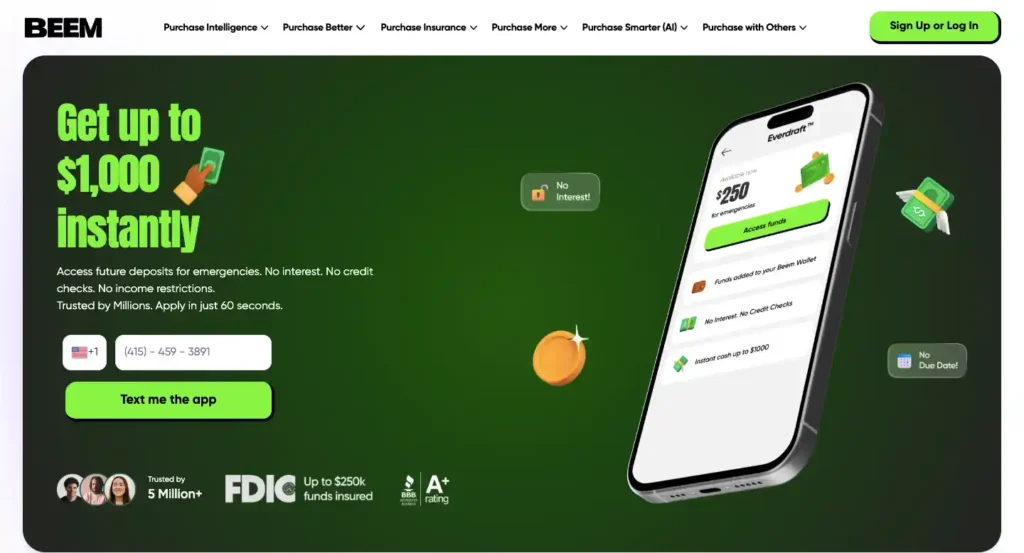
If you are comparing the Beem app to classic Texas payday or title models, the biggest difference is structure. Everdraft™ is positioned as a no-interest, no-credit-check cash advance with no rollover fees on the advance itself.
Beem uses a flat subscription model and, if you want speed, an optional flat instant-transfer fee. Standard ACH delivery is free. That is very different from percentage-based payday fees or a product that becomes more expensive each time the borrower extends the loan.
That does not mean a borrower should use Beem carelessly. Responsible use still matters. But if your real question is whether every Texas “cash advance app” is basically a payday loan in disguise, the answer is no.
Product structure matters, which is exactly why Texas borrowers should compare fee structures, repayment designs, and rollover risks before deciding what to use.
People Also Read: BEEM And Responsible Borrowing
A Practical Texas Borrower Checklist
| Question | Why It Matters In Texas |
| Is this product being offered through a CAB, a regulated lender, a bank partner, or another exempt structure? | Different Texas rules can apply depending on the product model. |
| Am I paying a loan charge, a broker fee, an optional speed fee, or some mix of all three? | Texas CAB products often involve both a loan note and a separate credit service agreement. |
| Can I verify the provider through the OCCC or find complaint information? | Texas borrowers can use OCCC resources, file complaints, and request complaint files. |
| Does this product create a one-time bridge or a likely repeat cycle? | OCCC data show many consumers take multiple loans in a year through refinancing or successive borrowing. |
| Are the total costs obvious before I use it? | Transparency matters more than marketing language, especially in short-term cash products. |
If Something Goes Wrong In Texas
Texas borrowers are not stuck guessing. The OCCC licenses and regulates non-depository lenders that provide consumer loans to Texas residents, oversees businesses that offer payday and auto title loans, and helps consumers resolve issues with regulated companies.
The agency has a complaint process, a consumer helpline at 800-538-1579, and a process for requesting complaint-file information about a particular lender.
That is one of the most important takeaways for readers. If a company is operating legally in Texas, there should be a clear regulatory path, and Texas consumers should know where to turn if a product is confusing, disputed, or feels off.
Conclusion
Cash advance apps are legal in Texas, but that is only the starting point. The more important question is what kind of product you are actually using and whether its structure helps you solve one short-term need or nudges you toward repeated borrowing.
Texas has clear regulatory paths for several app-based credit models, and borrowers should use those rules to compare products more intelligently, not less.
The practical takeaway is simple. Do not judge a product by the phrase “cash advance app” alone.
Judge it by the legal bucket it fits into, the fee structure it uses, the regulator that oversees it, and whether it is likely to leave you steadier next month or needing another advance again. That is the difference between using a legal product and using one wisely.
FAQs on Cash Advance Apps Legal in Texas
1. Are Cash Advance Apps Legal In Texas?
Yes. Cash advance apps are legal in Texas, but their legal treatment depends on how they are structured. Texas regulates multiple models, including credit access businesses for payday and title-style products and regulated lenders for other forms of consumer lending and direct-to-consumer earned wage access.
2. Are Payday Loan Apps Legal In Texas?
Yes, payday-style lending is legal in Texas. Still, it is commonly structured through licensed credit access businesses that obtain credit for consumers from independent third-party lenders and charge a fee for that service.
3. Are Earned Wage Access Or Paycheck Advance Apps Legal In Texas?
Some are. The OCCC’s current regulated-lender licensing checklist specifically includes direct-to-consumer earned wage access as an authorized activity under that license type, which shows Texas is actively regulating at least part of that market.
4. How Can Texas Borrowers Check Whether A Cash Advance Provider Is Legit?
Start with the OCCC. Texas consumers can use the OCCC licensee search, file complaints, call the consumer assistance helpline, and request complaint-file information about a lender.
5. What Should Borrowers In Texas Worry About Most?
Not just whether the app is legal, but whether the product structure is likely to trigger repeat borrowing. OCCC data show that many consumers obtain multiple loans within a year through refinancing or successive loans, a strong signal that repeat-use risk matters in this market.