
Table of Contents
When people need money before payday, they often assume all “advance” products work the same way. They do not.
Some products are tied directly to your employer and payroll system. Others are app-based and use your linked bank account, cash-flow activity, or subscription model to deliver short-term cash support.
Regulators have become much more focused on these differences because the structure of the product can shape everything that matters to a user: who qualifies, how fast money arrives, what it costs, and whether the product helps solve one short-term gap or nudges the user into repeat borrowing.
The CFPB said in 2024 that paycheck advance products are commonly offered through two primary models, employer-partnered and direct-to-consumer, and that many of these products may be consumer loans subject to Truth in Lending requirements.
That is why this comparison matters. If you are evaluating employer cash advance programs versus cash advance apps, the right question is not “which one is faster?” The better question is “which structure fits my financial life, and which one is less likely to create a bad borrowing pattern?”
That is also where Beem becomes relevant, because Everdraft™ is built differently from both a classic employer-sponsored paycheck advance and a high-cost short-term loan.
What Employer Cash Advance Programs Usually Are
Employer cash advance programs are usually paycheck-advance or earned-wage products connected to your workplace. In the CFPB’s 2024 paycheck-advance market report, the agency describes employer-partnered products as offerings from companies that partner or integrate with employers’ payroll systems.
The report uses the phrase “earned wage product” to describe third-party products that tie funding amounts to accrued or estimated wages and that are repayable on the next payday or withheld from the next paycheck.
That structure matters because employer cash advance programs usually depend on your workplace being involved somehow. In many cases, the employer relationship is what makes the product possible in the first place.
That can make the product feel seamless for some workers, but it can also make it less flexible for people with mixed income, side income, changing employers, commission-based timing, or jobs that do not offer this kind of benefit.
People Also Read: Beem App Review
What Cash Advance Apps Usually Are
Cash advance apps are a broader category. Some are paycheck-linked. Some are subscription-based. Some use optional “tips.” Some rely on linked bank-account cash-flow data rather than employer integration.
That is one reason the category can feel confusing to users: two apps that both market “fast cash” may have very different pricing logic and very different repayment structures.
The CFPB’s 2024 report specifically notes that direct-to-consumer paycheck advance products may charge monthly subscription fees and often collect payments characterized as “tips,” while employer-partnered products often rely heavily on expedited transfer fees.
In other words, a cash advance app is not automatically simpler or safer just because it lives on your phone. The product design still matters. Some app-based models are trying to solve real timing gaps cleanly. Others can start to look expensive when you add up tips, memberships, speed fees, and repeated use over time.
The Biggest Structural Difference: Employer Dependency vs User-Controlled Access
This is the cleanest way to understand the whole comparison. Employer cash advance programs often depend on your workplace being part of the system. Cash advance apps usually do not.
The CFPB’s paycheck-advance report says the employer-partnered products in its sample all integrated with employers’ payroll systems. That creates a very specific access model. If your employer participates, you may be able to use the product. If your employer does not, you often cannot.
Cash advance apps, by contrast, are typically built around your own account behavior, bank linking, or user-level eligibility rather than requiring your employer to have signed a relationship with the provider.
That difference is especially important for people with variable income, side jobs, gig work, seasonal work, commission structures, or multiple income sources. A product that depends on one employer relationship may not fit that kind of financial life very well. A product that looks at actual bank-account activity can be much more adaptable.
What Regulators Are Watching Closely
This is not just a product-design issue. It is also a regulatory issue. In July 2024, the CFPB proposed an interpretive rule explaining that many paycheck advance products marketed as “earned wage” products are consumer loans subject to the Truth in Lending Act.
The agency also highlighted that fees for certain “tips” and expedited delivery can count as finance charges, and it published findings that workers using employer-sponsored products took out an average of 27 loans per year and that a typical employer-partnered earned-wage cash advance carried an APR over 100% when fees were expressed as credit cost.
In January 2025, the CFPB rescinded its narrower 2020 advisory opinion on earned wage access, saying that earlier legal analysis had created substantial regulatory uncertainty.
That does not mean every employer cash advance program is harmful, or that every cash advance app is better. It means borrowers should stop assuming that “advance” automatically means “cheap” or “safe.” The details matter, and regulators are increasingly signaling that the details should be transparent.
Cost Is Where The Difference Often Becomes Real
A lot of users assume employer cash advance programs must be cheaper because they are connected to work. That is not always true.
The CFPB found that more than 90% of workers paid at least one fee in 2022 when employers did not cover the costs of employer-sponsored paycheck advance products. Most of the fee revenue in that market came from expedited transfers, with fees ranging from $1 to $5.99 and an average of $3.18.
The same CFPB release says the average employer-sponsored transaction amount was $106, which means those fees can add up quickly when usage becomes frequent.
This is why borrowers need to compare products based on actual economics, not labels. A product may look low-friction and still be expensive in practice if the user keeps paying to get money faster or keeps using the same short-term bridge again and again.
People Also Read: What Is Everdraft? Instant Cash Advance Explained
Where Beem Fits In This Comparison
This is where our structure matters. Everdraft™ is not built like a classic employer-partnered paycheck advance program. We do not require employer integration, and we do not rely on a payroll-system relationship to make the product work.
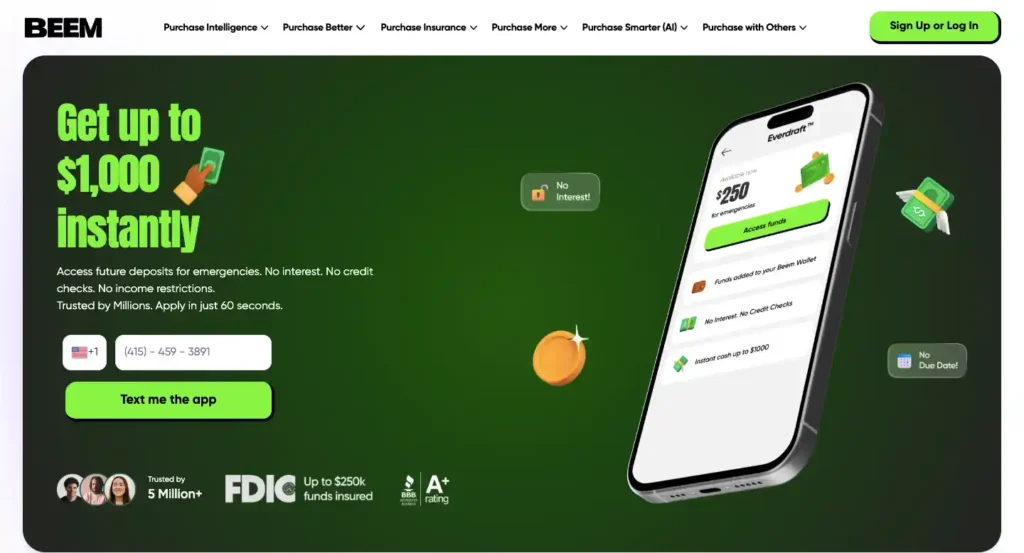
Instead, we use your linked bank account and account activity to determine eligibility. We position Everdraft™ as an instant cash advance feature that lets eligible users access money before their next paycheck without interest or credit checks, and our help guidance says users need a supported U.S. checking account, an eligible subscription plan, and a verified debit card linked to the primary bank account.
That difference matters because many people do not have one neat payroll identity. They may have mixed deposits, variable income, freelance work, commission income, or seasonal gaps. Employer-linked products can miss those users entirely. Beem is built to work with actual account behavior instead.
Why Beem Can Be More Practical For More Types Of Workers
A product that depends on your employer can work well if your job, payroll, and HR systems all line up neatly. But that is not how a lot of people live.
With Beem, Everdraft™ is available to eligible users without interest or credit checks, and we explicitly say users can access it before their next paycheck once the core requirements are met.
We also explain that eligibility and limits can change over time based on account activity. That makes the product useful not only for workers with traditional payroll, but also for users whose financial lives are less tidy and more cash-flow driven.
In a practical sense, that means Beem can make more sense for readers who want a short-term bridge without being locked into whether their employer chose a specific advance vendor. It is a user-side model, not an employer-side one.
Employer Cash Advance Programs vs Cash Advance Apps
| Category | Employer cash advance programs | Cash advance apps broadly | Beem / Everdraft™ |
| Core model | Usually employer-partnered and payroll-integrated | Mixed models: subscriptions, tips, bank linking, cash-flow review | User-side bank-linked emergency cash access |
| Who needs to participate | Often your employer | Usually just you | Just you, if eligible |
| Approval basis | Often tied to accrued or estimated wages through payroll integration | Varies by app | Linked checking account, account activity, and eligibility requirements |
| Common cost pressure | Expedited transfer fees, and in some cases other fees depending on the model | Tips, subscriptions, speed fees, or mixed fee structures | Flat subscription; optional flat instant-transfer fee; standard ACH free |
| Best fit | Workers whose employer already offers it and who want payroll-linked access | Depends heavily on app structure | Users who want a short-term bridge without employer dependency |
People Also Read: How Fast Is BEEM’s Instant Transfer
Conclusion
Employer cash advance programs and cash advance apps are not interchangeable. The employer-linked model is often built around payroll integration and accrued wages, while app-based models vary widely in how they decide eligibility, charge fees, and structure repayment. That is why borrowers should compare product design, not just speed or branding.
Where we fit is clear. The BEEM app gives eligible users a way to access Everdraft™ without relying on employer participation, without interest on the advance itself, and without credit checks. For readers who want a short-term bridge that works from the user side instead of the employer side, that is the real difference. The right product is the one that helps you cover one timing gap cleanly, without making the next gap more likely.
People Also Ask
1. What Are Employer Cash Advance Programs?
They are usually paycheck advance or earned-wage products connected to an employer’s payroll system. The CFPB’s 2024 market report describes employer-partnered products as offerings from companies that partner or integrate with employers’ payroll systems and tie funding amounts to accrued or estimated wages.
2. How Are Cash Advance Apps Different?
Cash advance apps are a broader category. Some are employer-linked, but many are direct-to-consumer and rely on subscriptions, tips, linked bank accounts, or account-activity review rather than payroll-system integration.
3. Are Employer Cash Advance Programs Always Cheaper?
No. The CFPB found that workers using employer-sponsored paycheck advance products took out an average of 27 loans per year and that a typical employer-partnered earned-wage cash advance carried an APR over 100% when costs were expressed as credit charges.
4. Where Does Beem Fit In This Comparison?
Beem fits on the app side, but with a specific structure. Everdraft™ is a bank-linked, user-side emergency cash feature for eligible users. It does not require employer integration, and it is positioned as interest-free and without credit checks.
5. Which Is Better For Someone With Mixed Or Variable Income?
A product that depends on one employer and one payroll integration may be harder to use if your income is mixed, seasonal, freelance, or variable. That is one reason Beem can be more practical for some users, because Everdraft™ is based on linked-account activity rather than employer participation.
Source: CFPB