

Table of Contents
Employer-sponsored cash advance programs are often marketed as a modern way to help workers handle the gap between payday and real life. That promise sounds simple, but the product structure underneath it matters a lot.
A worker may see “get paid early” and assume it is just a cleaner version of payday lending, or just another employee benefit. In reality, these programs sit in their own category, and regulators have been paying much closer attention to how they operate, what they cost, and how often workers end up using them.
Paycheck advance products are typically offered through two primary models, employer-partnered and direct-to-consumer, and that many of these products may be consumer loans subject to Truth in Lending requirements.
If you are trying to understand how employer-sponsored cash advance programs work, the key is not just whether they deliver money before payday.
What An Employer-Sponsored Cash Advance Program Usually Is
In the employer-sponsored model, a third-party provider partners with an employer and connects to the employer’s payroll or time-and-attendance systems.
The CFPB’s 2024 market report describes employer-partnered products as offerings where a third-party firm contracts with employers, integrates with payroll or attendance records, and advances funds tied to accrued or estimated wages that have been earned but not yet paid. Repayment is then typically made by payroll deduction on the next paycheck.
That setup creates a very specific kind of product. It is not built first around your credit score, and it usually is not built first around your bank account either. It is built around the relationship between the provider and your employer.
If your employer participates and the provider can verify your accrued wages through the payroll connection, you may be able to access part of your expected paycheck before the normal payday arrives.
People Also Read: Cash Advance Apps With No Income Requirements
How The Money Amount Is Usually Decided
Employer-sponsored cash advance programs usually do not just let a worker pick any number they want. In the CFPB’s description of the market, the amount is generally tied to earned or estimated wages that the worker has already accrued but not yet been paid.
That means the provider is not just making a broad credit decision. It is using payroll-linked data to estimate what part of the upcoming paycheck can be advanced now.
That design can feel intuitive for workers with stable hours and clean payroll records. If you clock in, work predictable shifts, and your employer’s payroll system is tightly integrated, the provider may be able to estimate your earnings with relatively high confidence.
But it also means access depends on that payroll relationship existing in the first place. If your employer does not offer the program, or if your income is not easy to map through payroll records, the model becomes much less useful.
How Repayment Usually Happens
Repayment is one of the biggest differences between employer-sponsored programs and many app-based products. In the employer-partnered model described by the CFPB, repayment is typically collected by payroll deduction from the worker’s next paycheck.
The same report says these products generally do not need access to the worker’s bank account for repayment because the employer-linked payroll system is already doing that work.
That can make repayment feel smooth when everything goes as planned. But it also means the product is deeply tied to the employer relationship. If a worker leaves the job, changes hours unexpectedly, or has a paycheck that comes in lower than expected, the product may stop working as smoothly as it did when the payroll pattern was stable.
The CFPB’s report notes that in rare instances, employer-partnered providers may be unable to recover funds when employment ends before repayment or when incoming pay is unexpectedly low.
How Much These Programs Usually Cost
A lot of employer-sponsored cash advance programs market themselves as low-cost or worker-friendly, but the fee picture gets more complicated in practice. The CFPB found that more than 90% of workers paid at least one fee in 2022 when employers did not cover the cost of the product.
Most fee revenue came from expedited transfer fees, with fees ranging from $1 to $5.99 and an average fee of about $3.18. The CFPB also found the average transaction amount was $106 and that workers took out an average of 27 paycheck advance loans per year. Based on the average inputs in the CFPB’s sample, the typical employer-partnered earned wage cash advance equated to an APR of 109.5%.
That does not mean every employer-sponsored program is automatically predatory. It does mean borrowers should stop assuming “through my employer” automatically means “cheap.”
A product can feel light because each fee looks small, but frequent use can make the real cost much larger than it appears at first glance. That is one reason the CFPB has pushed for clearer disclosures under Truth in Lending rules.
People Also Read: Free Instant Cash Advance Apps
Why Workers Use Them So Often
The CFPB’s data spotlight helps explain why these products can become sticky. Workers do not usually use them because they are trying to finance a luxury purchase. They use them because there is a mismatch between when expenses hit and when wages are paid.
The CFPB notes that nearly three-quarters of workers on nonfarm payrolls are paid every two weeks or monthly, and that this timing mismatch is a major source of demand for short-term credit.
That makes employer-sponsored cash advance programs feel useful in the moment. They can smooth out a timing gap without asking a worker to wait for payday. But it also explains why repeat usage can get high.
If the worker’s budget is already tight, the next paycheck is no longer a full paycheck once the advance comes out, and that can make the next gap easier to repeat. The CFPB’s finding of 27 average transactions per year is important because it shows these are often not one-off events.
A Simple Way To Think About The Tradeoff
Employer-sponsored cash advance programs are often strongest for workers who have a stable employer relationship, predictable hours, and an employer that already offers the benefit. In that situation, the program can feel seamless because it is built right into the payroll environment.
The worker may not need to upload extra paperwork, and the provider may not need to review a bank account in the same way a direct-to-consumer product would.
But that same strength is also a limitation. The worker does not control the relationship. The employer does. If the employer does not offer the program, there is no product to use.
If the worker has variable income, side income, multiple jobs, commission swings, freelance deposits, or seasonal work, the employer-linked model may not capture their real financial picture very well.
Where Beem Works Differently
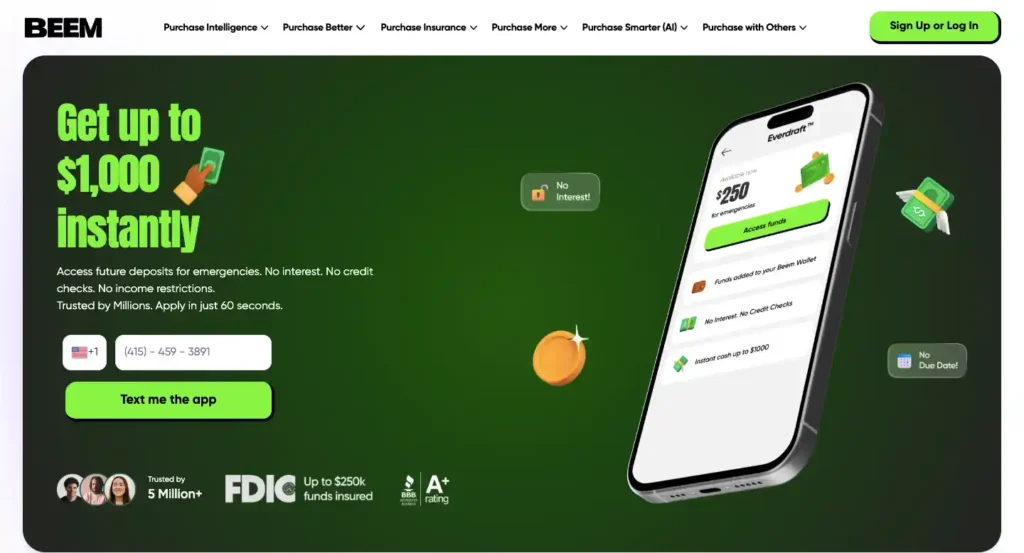
Beem solves the short-term cash-flow problem from the user side, not the employer side. Everdraft™ is Beem’s instant cash advance feature, and our support guidance explains that eligible users can access money before their next paycheck without interest or credit checks.
To qualify, users need an active Beem account, a supported U.S. checking account, a verified debit card linked to the primary bank account, an eligible subscription plan, and no pending dues. We also make clear that eligibility and limits can change over time based on account activity.
That difference matters because Beem does not require employer participation. We are not waiting on your HR team, payroll platform, or a company-level vendor relationship. We look at real banking activity to determine eligibility, and we position Everdraft™ as flexible access without traditional credit stress.
That makes the product much more practical for users with mixed deposits, freelance income, commission income, seasonal gaps, or employers that simply do not offer a paycheck advance benefit.
People Also Read: Cash Advance Apps With Flexible Repayment Options
How Employer-Sponsored Cash Advance Programs Compare With Beem
| Question | Employer-sponsored cash advance programs | Beem / Everdraft™ |
| Who has to participate? | Your employer and the provider | Just you, if eligible |
| How is access usually determined? | Payroll integration and accrued/estimated wages | Linked checking account, account activity, and Beem eligibility requirements |
| How is repayment usually collected? | Payroll deduction on the next paycheck | Repayment tied to the next qualifying deposit |
| What kind of worker fits best? | Stable payroll workers at participating employers | Users with real cash-flow needs, including many variable-income users |
| Main strength | Seamless payroll-linked access when employer offers it | User-controlled access without employer dependency |
What Borrowers Should Watch Closely
The two biggest things to watch are frequency and fee logic. If a worker uses an employer-sponsored advance once to cover a clean timing gap, that may be perfectly reasonable.
If the same worker is using it two or three times a month and paying repeated expedited-transfer fees to do it, the product may no longer be acting like a benefit. It may be acting like a recurring liquidity patch.
The same caution applies to any short-term cash product, including app-based ones. A healthy bridge should solve one gap and then get out of the way.
The moment it becomes part of the monthly routine, it is worth asking whether the real issue is no longer timing, but the underlying budget, bill calendar, or income pattern.
Conclusion
Employer-sponsored cash advance programs work by connecting a third-party provider to an employer’s payroll system, advancing a portion of earned wages before payday, and collecting repayment through the next paycheck.
That can work well for some workers, especially when the employer relationship is stable and the program is low-cost. But the structure comes with tradeoffs, especially when fees pile up or repeated use becomes normal.
That is where the Beem app matters. We built Everdraft™ to solve the short-term liquidity problem from the user side. No employer integration is required, and eligibility is based on linked-account activity rather than payroll participation. For readers who want a cash-flow bridge that fits real life, especially life that is not perfectly organized around one employer and one payroll system, that difference is often the whole point.
People Also Ask
1. What Are Employer-Sponsored Cash Advance Programs?
They are usually paycheck advance or earned-wage products offered through a provider that partners with an employer and integrates with payroll or time-and-attendance systems. The amount is generally tied to wages the worker has already earned but not yet been paid.
2. How Do Employer-Sponsored Cash Advance Programs Work?
The provider typically connects to the employer’s payroll system, estimates or confirms accrued wages, advances part of that amount before payday, and then collects repayment from the worker’s next paycheck through payroll deduction.
3. Are Employer Programs Usually Free?
Not always. The CFPB found that when employers did not cover the cost, more than 90% of workers paid at least one fee, and most fee revenue came from expedited transfers.
4. Why Do Some Workers Like Employer Programs?
They can feel convenient for workers whose employers already offer them because the payroll integration can make access relatively seamless and quick. For a stable payroll worker, that can make the product feel built into the job.
5. How Is Beem Different From Employer Programs?
Beem does not require employer participation. Everdraft™ is a user-side cash access feature based on linked checking-account activity and eligibility, not payroll-vendor integration, and Beem positions it as interest-free emergency cash without credit checks.