

Table of Contents
FloatMe gives you up to $50. That is not a starting limit that builds over time. That is the maximum. Fifty dollars. Enough to cover a tank of gas or a week of ramen. Not enough to cover a car repair, a utility bill, a medical copay, or $200 in rent.
The Beem vs Floatme comparison is unusual because these two apps operate at completely different scales. FloatMe is a micro-advance platform designed for the smallest possible cash needs. Beem provides Everdraft™ up to $1,000. The question is not which app is “better.” It is whether $50 is enough for the emergencies you actually face, and what happens when it is not.
What FloatMe Actually Offers
FloatMe launched with a simple proposition: small, fast advances with a low subscription fee. The app charges $1.99/month for access to advances up to $50. Express delivery adds a fee. Standard delivery is free but takes 1-3 business days.
The $50 Ceiling
FloatMe’s maximum advance is $50 per pay period. New users typically start at $20-$30 and build to $50 over time. There is no path to $100, $200, or $500. The $50 cap is structural, not a starting point.
Users searching for apps like floatme are often looking for this exact niche: a tiny advance to avoid a single overdraft or cover one specific small expense.
Where $50 Works
FloatMe’s limit covers a narrow band of needs: avoiding a $35 overdraft (the advance is cheaper), buying groceries for two or three days before payday, covering a prescription copay, or paying for gas to get to work.
These are legitimate needs. They are also the smallest possible version of the “I need cash before payday” problem. The moment the need exceeds $50, the app cannot help.
Where $50 Fails
A $280 car registration. A $150 utility catch-up. A $400 rent shortfall. A $200 medical copay. A $120 phone bill. None of these fit inside FloatMe’s limit. Users who downloaded the app expecting small cash advance apps to cover these expenses discover that “small” means $50, and most real-world emergencies are not $50. The gap is not about features. It is about whether your emergency costs more than a restaurant dinner.
People Also Read: Cash Advance Apps and The FTC: How the Financial Landscape Is Changing
What Beem Offers at 20x the Limit
Everdraft™ Cash Advance provides up to $1,000. Starting limits are built based on deposit history, similar to FloatMe, but the ceiling is twenty times higher. A user who needs $50 can request $50. A user who needs $700 can request $700. The same app covers both the overdraft-avoidance and real-emergency scenarios without requiring a second funding source.
The Financial Tools Gap
FloatMe is a cash advance app and nothing else. It does not offer budgeting tools, credit building, deal-finding, or income matching.
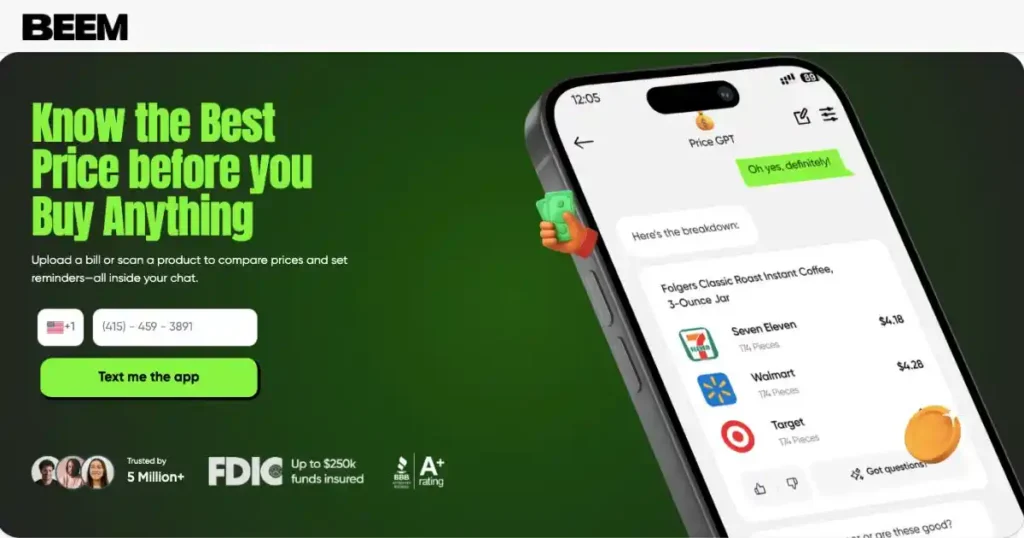
Beem includes BudgetGPT (AI-powered, personalized budgeting), DealsGPT (cashback on purchases), PriceGPT (price comparison), JobsGPT (income opportunity matching), and credit-building that reports to bureaus. The Beem vs FloatMe comparison on tools is not close. FloatMe provides $50 and stops. Beem provides a 1,000-plus advanced intelligence layer that helps you access advanced features less often.
Credit Building
FloatMe does not build credit. Beem does. For users with thin or no credit files, the credit-building feature alone can justify the membership difference over time. A stronger credit score reduces insurance premiums, improves apartment approval odds, and lowers interest rates on future loans. FloatMe offers none of this.
The Cost Comparison
FloatMe
$1.99/month subscription ($23.88/year). Express delivery fees on top. No tipping. The annual cost is low, but the product it buys is a $50 advance. The cost per dollar of advance capacity is relatively high: $23.88/year for access to $50 at a time means you are paying roughly 48 cents per dollar of maximum advance per year.
Beem
Membership fee for access to $1,000 advances at zero interest, plus financial tools and credit building. The cost per dollar of advance capacity is significantly lower because the limit is 20 times higher, while the membership does not scale by 20 times. For users whose needs regularly exceed $50, Beem’s membership delivers dramatically more value per dollar spent. Download the app now!
Who Should Use Each App
FloatMe Is For
Users who genuinely only need $20-$50 between paychecks. If your cash needs never exceed a tank of gas or a few days of groceries, and you want the absolute lowest monthly cost ($1.99), FloatMe covers that narrow use case. It is the right app for users whose financial life is stable enough that a $50 buffer is all they need.
Beem Is For
Users whose emergencies are real-world-sized. Car repairs average $300 to $800. Medical copays run $100 to $500. Rent shortfalls are $200 to $600. Utility catch-ups are $150 to $400. None of these fit inside $50. If you need a small cash advance app that can also handle the not-so-small emergencies that actually happen, Everdraft™’s $1,000 limit covers the full range without a second funding source.
Users searching for apps like FloatMe because they want something similar but bigger will find Beem covers FloatMe’s entire use case (you can request $50 if that is all you need), plus every emergency FloatMe can’t reach structurally.
People Also Read: 7 Best Apps Like FloatMe for Cash Advances in 2026
Side-by-Side Comparison
| Feature | FloatMe | Beem |
| Max advance | $50 per pay period | $1,000 (Everdraft™) |
| Interest | 0% | 0% |
| Monthly cost | $1.99 | Membership fee |
| Express delivery | Fee | Fee (same-day) |
| Credit building | No | Yes (included) |
| AI financial tools | No | BudgetGPT, DealsGPT, PriceGPT, JobsGPT |
| Covers rent shortfall | No ($50 max) | Yes (up to $1,000) |
| Covers car repair | No ($50 max) | Yes (up to $1,000) |
| Covers utility catch-up | No ($50 max) | Yes (up to $1,000) |
Final Thoughts
The Beem vs FloatMe decision is simple: Is $500 enough? If your financial life is stable and your only need is to avoid a $35 overdraft once a month, FloatMe’s $1.99 monthly fee is the cheapest way to build a tiny safety net.
If your life includes car repairs, medical bills, rent shortfalls, utility catch-ups, or any emergency that costs more than a dinner for two, FloatMe will fail you exactly when you need it most. Beem provides 20 times the advance limit, AI financial tools, and credit-building. The membership costs more than $1.99. It also does twenty times more.
The cheapest app isn’t always the best. It is the one that actually covers your emergency.
People Also Ask: Beem vs FloatMe
1. What is FloatMe’s maximum advance?
$50 per pay period. New users start at $2- $30 and build to $50 over time. There is no path to higher limits. The $50 cap is permanent.
2. Can Beem do everything FloatMe does?
Yes. Everdraft™ Cash Advance lets you request any amount up to $1,000. If you only need $50, request $50. Beem covers FloatMe’s full use case, plus every amount between $51 and $1,000 that FloatMe cannot.
3. Is FloatMe cheaper than Beem?
FloatMe costs $1.99/month ($23.88/year). Beem’s membership is higher. But FloatMe provides $50 maximum. The cost per dollar of advance capacity favors Beem for anyone whose needs exceed $50.
4. Which app is better for emergencies?
Beem. Most real emergencies (car repairs, medical bills, rent shortfalls, utility catch-ups) cost $100 to $800. FloatMe’s $50 limit covers almost none of these. Beem covers all of them within a single advance.