

Table of Contents
Gas prices are sitting at $3.75 to $3.85 per gallon nationally in March 2026, the highest level since 2023, and for millions of Americans, the question is no longer academic. When your tank is empty,y and your next paycheck is days away, you need a solution right now. The question is: which solution costs you the least, harms your finances the least, and actually works given your real situation?
Three options come up most often in this conversation: dipping into an emergency fund, putting gas on a credit card, and using a cash advance app. Each one has a legitimate use case. Each one also has risks and drawbacks that are rarely explained clearly before someone is already in the middle of a stressful financial moment.
This article lays out an honest, detailed comparison of all three so you can make the right call for your situation, not just the fastest one.
Why the Gas Price Situation Makes This Decision More Urgent
Under normal conditions, a $10 to $15 increase in monthly fuel costs is manageable for most households. The current situation is not normal.
The national average has jumped sharply in just a few weeks, driven by Middle East tensions threatening key oil supply routes, crude oil crossing $100 per barrel, and U.S. refineries already operating near capacity. Monthly fuel costs for an average household have increased by $50 to $100. For gig workers and multi-vehicle families, the number is higher.
This is not a one-tank problem. It is a sustained cost increase that spans weeks or months, which means any tool you use to cover it needs to be evaluated not just for how well it solves today’s problem, but also for what it costs you over time.
Read: Beem For Avoiding Late Credit Card Fees
Option One: Using an Emergency Fund
What It Is
An emergency fund is money you have already saved and set aside specifically for unexpected expenses. Financial advisors typically recommend three to six months of living expenses held in a liquid, accessible account, usually a high-yield savings account.
When It Makes Sense
Using your emergency fund for a genuine fuel emergency is exactly what the fund is designed for. If you have one and the gas price spike is creating real financial strain, this is a legitimate use of the money. There is no interest, no credit impact, no application process, and no repayment schedule. You simply use your own money.
The Real Limitation
The fundamental problem with this option is that most Americans do not have one. According to consistent survey data, more than half of U.S. adults cannot cover an unexpected $1,000 expense from savings. For paycheck-to-paycheck households, gig workers with irregular income, and single parents managing on one income, an emergency fund is a theoretical concept rather than a practical tool.
Even for people who do have savings, repeatedly dipping into an emergency fund during a sustained multi-month fuel price spike can deplete it quickly, leaving nothing for an actual emergency, such as a car repair, a medical bill, or a job loss.
The Hidden Risk
Using emergency savings to cover recurring elevated fuel costs rather than genuine one-time emergencies can create a false sense of financial security. Once the fund is depleted, there is no buffer left for anything else.
Best suited for: People who have three or more months of savings, are facing a genuine one-time fuel emergency rather than a sustained spike, and can realistically replenish the fund within one to two pay cycles.
Option Two: Using a Credit Card
What It Is
Putting gas on a credit card means charging fuel purchases to an existing revolving credit line and either paying the balance in full at the end of the billing cycle or carrying it forward with interest.
When It Makes Sense
If you pay your credit card balance in full every month, using a rewards card for gas is a smart move. Cards like the Citi Custom Cash offer 5% back on gas as your top spending category. The Blue Cash Preferred from American Express offers 3% at U.S. gas stations. If you are already spending $200 to $300 per month on fuel, 3% to 5% cashback adds real money back over the course of a year.
Used this way, a credit card is not a borrowing tool. It is a payment method with a delayed clearing date and a small reward attached. The keyword is: if you pay it in full.
The Real Limitation
Most Americans who use a credit card to cover a gas emergency during a financially tight period do not pay it off in full at the end of the month. They carry the balance. And that is where the tool becomes dangerous.
Standard credit card APRs in 2026 range from 20% to 27% for most cardholders. A $200 balance carried for six months at 24% APR costs roughly $24 in interest on top of the original charge. That does not sound catastrophic, but if the gas price spike lasts several months and you add $150 to $200 to your balance each month, the compounding becomes meaningful quickly.
There is also the credit utilization factor. If your credit card has a $1,500 limit and you put $450 of gas charges on it over a month, your utilization on that card hits 30%, the threshold where credit score impact begins. Push it to $600, and you are at 40%, which causes measurable score damage.
The Credit Card Cash Advance Trap
In addition to using a credit card for purchases, a credit card cash advance is a specific transaction in which you withdraw cash from your credit line at an ATM or bank branch. This is a significantly worse option than regular card purchases. Cash advances typically carry APRs of 24% to 29%, begin accruing interest immediately with no grace period, and come with a transaction fee of 3% to 5% of the amount withdrawn.
A $200 credit card cash advance at 27% APR with a 5% transaction fee costs $10 upfront, plus $4.50 in interest per month you carry it. This is not a safe way to cover fuel costs and should be treated as a last resort.
Best suited for: People with a rewards card, a low current balance, and a confirmed ability to pay the full balance in the same billing cycle.
Read: Beem Instant Cash Advance During an Economic Crisis
Option Three: Using a Cash Advance App
What It Is
A cash advance app gives you early access to funds based on your expected income. The app reviews your bank account cash flow, determines an advance limit, and deposits money directly to your account, typically within minutes. Repayment is scheduled around your next income deposit.
When It Makes Sense
A cash advance app is specifically designed for the timing gap that most financial emergencies actually represent. Your tank is empty on Wednesday. Your paycheck clears on Friday. You are not broke in any structural sense. You are just on the wrong side of a two-day timing gap.
For this exact scenario, a cash advance app is often the cleanest solution available. There is no credit check, no interest, no impact on utilization, and no emergency fund to deplete. You get the money now, it clears your bank account instantly, and you repay it when your income arrives.
The Real Limitation
Not all cash advance apps are equally safe or cost-effective. Some charge a monthly membership fee of $9.99 or more, regardless of whether you use the advance that month. Others charge per-transfer fees for instant access that add up if you use the service frequently. Some have advance limits as low as $50 to $100, which does not meaningfully cover a week of elevated fuel costs.
The key is choosing an app with no mandatory fees, a meaningful advance limit, and eligibility criteria that actually match how you earn.
Why Beem’s Everdraft™ Stands Out
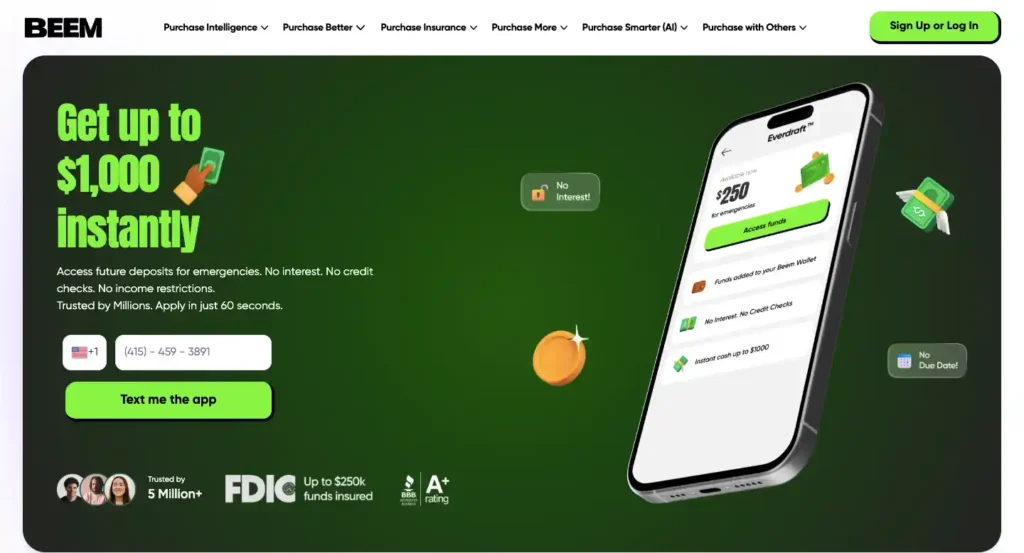
Beem’s Everdraft™ offers up to $1,000 with no credit check, no mandatory fees, and instant delivery to your bank account. Eligibility is based on your actual bank account cash flow rather than a credit score or employer verification, which means gig workers, freelancers, and people with irregular income qualify just as easily as traditional salaried employees.
There is no monthly membership fee required to access Everdraft™. You are not paying $9.99 per month for the right to borrow $50 occasionally. The advance is available when you need it, and repayment is tied to your actual income cycle, so it does not create a new financial problem while solving the current one.
Best suited for: Anyone facing a timing gap between a fuel need and an expected income deposit, including gig workers, hourly employees, and households with variable income.
Side-by-Side Comparison: All Three Options
| Factor | Emergency Fund | Credit Card | Beem Everdraft™ |
| Availability | Only if you have savings | Requires existing credit line | Available based on cash flow |
| Cost | Free | 0% if paid in full, 20% to 27% APR if carried | No mandatory fees |
| Credit impact | None | Increases utilization if the balance is carried | None |
| Credit check required | No | Already on file | No |
| Repayment required | No | Yes, with potential interest | Yes, aligned with income |
| Best advance amount | Whatever you have saved | Up to your available credit | Up to $1,000 |
| Risk level | Low | Medium to high if balance is carried | Low |
| Best for | One-time genuine emergencies | Rewards users who pay in full monthly | Timing gaps, gig workers, irregular income |
Which Option Is Actually the Safest?
The honest answer is that safety depends on your specific financial situation. There is no single right answer for every person, but there is a clear framework for thinking it through.
Use your emergency fund if:
You have savings that cover at least two months of expenses beyond what you are about to withdraw, the fuel cost is a genuine one-time spike rather than an ongoing elevated cost, and you have a clear plan to replenish the fund within the next one to two pay cycles.
Use a credit card if:
You have a rewards card with a low current balance, you are certain you will pay the full balance by the end of the billing cycle, and you want to earn cashback on purchases you were going to make anyway. Do not use a credit card for gas if you are already carrying a balance or if there is any chance you will not pay it off this cycle.
Get instant cashback at gas stations with Beem. Turn your regular fuel spending into savings that add up fast. Start earning cash back on gas!
Use Beem’s Everdraft™ if:
You do not have savings to draw from, you are already carrying a credit card balance, you are a gig worker or have irregular income, or you simply need the money now and want to avoid any credit impact. Everdraft™ is also the right choice when the fuel cost is part of a longer elevated price period rather than a single one-tank emergency, because it does not compound interest the way a credit card balance does.
Final Thoughts
There is no shame in needing a short-term financial bridge during a gas price spike that is driven by global events completely outside your control. The goal is to choose the bridge that costs you the least and leaves your financial position intact on the other side.
An emergency fund is the ideal tool when you have one and can replenish it. A credit card works when you genuinely pay it off every month. And Beem’s Everdraft™ fills the gap for everyone else: no savings required, no credit check, no interest, no mandatory fees, and up to $1,000 available the moment you need it. Download the app now!
When gas prices are high and your options feel limited, having the right tool in place before the tank hits empty is what separates a manageable situation from a stressful one.
People Also Ask
Is it better to use a credit card or a cash advance app for gas?
It depends on how you use the credit card. If you pay your balance in full every month, a rewards card is a smart option for gas purchases. If you are likely to carry a balance, a cash advance app like Beem’s Everdraft™ is safer because it charges no interest, has no impact on credit utilization, and has no mandatory fees.
Does using an emergency fund for gas count as a real emergency?
Yes, a genuine inability to afford fuel that prevents you from getting to work or meeting essential needs qualifies as an emergency. The concern is using the emergency fund for a recurring elevated cost rather than a one-time event, which can deplete savings quickly and leave nothing for a more severe emergency later.
Will a cash advance app charge me interest on a gas advance?
Beem’s Everdraft™ does not charge interest on cash advances. There are no mandatory fees and no APR applied to the advance amount. You repay exactly what you borrowed, aligned with your next income deposit. This is fundamentally different from a credit card cash advance, which begins accruing interest immediately at rates of 24% to 29%.
How much can I get from Beem’s Everdraft™ for gas?
Beem’s Everdraft™ offers advances up to $1,000 based on your bank account cash flow. The actual amount you qualify for depends on your account activity and income history. Most other cash advance apps cap advances at $250 to $500, making Everdraft™ the highest-limit option for covering multiple fill-ups or combining fuel costs with other daily expenses.
What is the safest way to cover gas costs during a price spike?
For people with savings: use an emergency fund for a single fill-up and replenish it quickly. For people who pay their credit card bill in full, use a rewards card to earn cashback. For everyone else, especially gig workers, paycheck-to-paycheck earners, and people with irregular income: Beem’s Everdraft™ offers the most accessible, lowest-cost, and credit-safe solution available right now.