


AI Banking Apps Like Beem
Most people now live in a world where their favorite apps predict what they want before they even ask. Streaming platforms recommend the next show, ride apps remember frequent routes, and shopping apps surface deals that actually make sense. Traditional banking apps, on the other hand, still mostly show a balance, a list of transactions, and a few static buttons. They tell you what happened, but they rarely help you decide what to do next.
At the same time, money has become harder to manage. Costs are rising, income can be uneven, and one surprise bill can throw an entire month off track. People do not just want digital access to their accounts; they want a smart layer sitting on top that can warn them, guide them, and offer solutions. AI banking apps like Beem are built for this reality. They use data, intelligence, and automation to make money management feel more like having a helpful co-pilot than a cold ledger.
What Makes an AI Banking App Different From a Regular Banking App
From Static Dashboards to Living, Learning Money Coaches
A regular banking app is essentially a viewer: it retrieves your balance, displays recent transactions, and lets you tap through a fixed set of screens. Nothing about that experience really learns from you. By contrast, an AI banking app watches how money flows in and out over time, learns when you get paid, how you tend to spend, and which bills you pay regularly. That learning allows it to act more like a money coach, surfacing patterns, opportunities, and risks without waiting for you to go hunting for them.
Real Time Insights Instead of Monthly Statements
Traditional banking still revolves around statements and snapshots that arrive after the fact. You often find out you overspent only when you look back at the month. AI banking apps flip this timeline. They analyze behavior in real time and can flag issues as they start to form, not weeks later. If your card spend spikes, a bill is about to hit a thin balance, or a subscription jumps in price, the app can alert you early enough that you can still act.
Key Ways AI Banking Apps Reinvent Customer Experience
Hyper Personalized Dashboards for Different Money Lives
No two financial lives look alike, and AI banking apps can finally reflect that. Instead of giving everyone the same dashboard, they can rearrange what you see based on what you actually do. A gig worker might see upcoming payouts and cash flow forecasts front and center, while a parent might see shared bills, school expenses, and savings goals. Over time, the app becomes a view of your money that feels designed specifically for your situation.
Proactive Alerts That Feel Helpful, Not Noisy
The difference between useful alerts and notification fatigue is intelligence. AI banking apps use pattern recognition to decide which events truly deserve a nudge: an upcoming cash crunch, a sudden price increase, a duplicate charge, or spending that has jumped well above your norm. Instead of constant pings for every minor update, you receive fewer but more meaningful notifications that feel like they are on your side, not nagging you for the bank’s sake.
Smarter Search and Natural Language Conversations
AI banking apps reduce friction by letting you talk to your money in plain language. Instead of digging through five menus to find a spending breakdown, you can ask, “How much did I spend on groceries last month” or “What subscriptions renew next week under 20 dollars”. The system can interpret your question, scan your data, and respond with a clear answer. This conversational interface turns a complex financial system into something most people can navigate quickly and confidently.
Integrated Credit Building Without Confusion
Credit is one of the most intimidating parts of personal finance. AI banking apps can weave credit awareness into everyday activity rather than treating it as a separate world. They can show how your payments, balances, and usage might affect your credit health, and they can pair this insight with tools that help you build history in safer ways. That turns credit from a mysterious score into something you understand and can intentionally improve.
The Beem Example: AI Wallet, Instant Cash, Credit Builder, and GPTs in One Experience
One App for Daily Money, Not Just a Bank Account
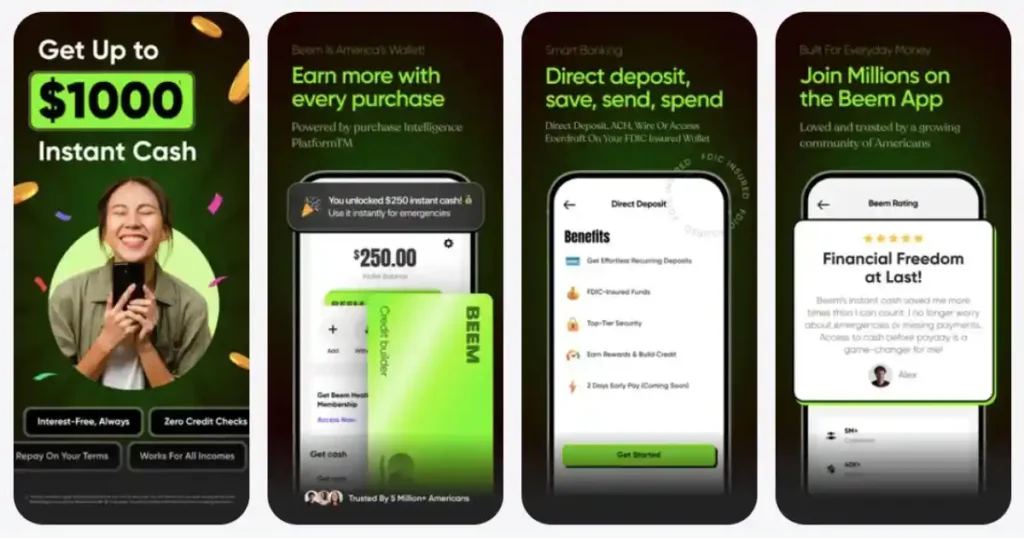
Beem is built as a money hub rather than a traditional bank account. Its AI Wallet connects to your financial life and focuses on how your money actually moves day to day. Instead of simply telling you your balance, it can help you see how much is safe to spend after accounting for upcoming bills, recurring subscriptions, and essential expenses. The goal is to give you a live, practical view of your month instead of a static snapshot.
Purchase Intelligence That Watches Your Spending Patterns
At the heart of Beem’s approach is Purchase Intelligence, which goes beyond simple categories like “Dining” or “Travel”. It looks at trends across merchants, prices, and time. It can spot subscription creep, rising prices at certain providers, or impulse-heavy categories that quietly drain your budget. Instead of forcing you to scan line items, it surfaces the handful of patterns that deserve your attention so you can make quick, targeted changes.
Instant Cash That Reduces Stress in Tough Moments
Even with smart planning, many people still face short term gaps between income and bills. Beem integrates instant cash options inside the same environment where it sees your cash flow. When the AI Wallet detects that your account is likely to go negative or that an important bill might bounce, it can surface instant cash as a stabilizing tool. This is designed to help you avoid overdraft fees, late charges, and high interest products that add long term damage.
Beem GPTs: BudgetGPT, DealsGPT, PriceGPT, JobsGPT in the Same Flow
Inside Beem, specialized AI assistants handle different parts of your financial life. BudgetGPT helps you understand where your money really goes and how to adjust your spending. DealsGPT and PriceGPT focus on saving you money on what you already buy, surfacing better offers and highlighting where you might be overpaying. JobsGPT looks at the income side, helping you explore side gigs or earning opportunities. Because all of these sit in one app, you can move from “What is going wrong?” to “What can I do about it?” in a single flow.
Read: How Beem Combines Digital Banking With AI Tools Like BudgetGPT
Design Principles Behind Great AI Banking Experiences
Clarity First, AI Second
The most effective AI banking apps do not drown users in technical language. They present clear summaries, write in plain English, and keep actions as simple as possible. AI runs in the background to crunch the data, but what you see is calm, organized guidance: “Your subscription spending increased by 35 percent this quarter” or “You are on track to run short three days before payday.” That clarity is what builds habit and trust.
Trust, Transparency, and Control
Because money is so sensitive, trust is as important as features. AI banking apps that succeed tend to be explicit about what data they use, how they protect it, and what users can opt out of. They avoid hidden fees and make settings for notifications and connections easy to change. When users feel in control, they are far more willing to let the app analyze their behavior at a deeper level and to act on its recommendations.
Real Outcomes Over Vanity Metrics
Charts and scores can look impressive, but what really matters is whether people feel less stressed and more secure. Great AI banking experiences focus on real outcomes: fees avoided, subscriptions canceled, savings increased, emergencies handled without panic, and credit strengthened over time. By tying insights to practical improvements in everyday life, these apps earn long term loyalty instead of just driving one-time curiosity.
How Banking Apps Like Beem Change Support and Human Interaction
Tier One Support Handled by AI, Complex Cases Escalated Gracefully
AI can resolve a large share of routine questions that used to clog up support queues. It can answer “What is this charge?”, “How do I lock my card?”, or “When is my next bill due?” in seconds because it sees the account context in real time. When something is too complex or sensitive for automation, AI can still help by packaging the history and context for a human agent, so you do not have to repeat yourself multiple times.
Coaching Instead of Just Customer Service
In an AI banking environment, support can shift from emergency-only to ongoing coaching. Instead of waiting until you are already in trouble, the app can reach out when it notices risky patterns, like recurring late payments or frequent low balances. The tone becomes less about resolving tickets and more about helping you build better routines, which changes how you feel about interacting with your financial provider in the first place.
24/7 Availability Without Burning Out Teams
Money worries do not follow office hours. AI lets users get help at any time of day without long waits or closed lines. You can ask questions late at night, on weekends, or between shifts and still get relevant answers. This always-on availability improves the experience for users while allowing human teams to focus on problems where empathy and judgment really matter.
Financial Safety, Security, and Peace of Mind in AI Banking
Smarter Fraud Detection Based on Behavior
AI based fraud systems do not rely only on rigid rules like transaction size or country. They learn your normal patterns: the places you typically shop, the ranges you usually spend in, and the devices you use. When something falls far outside those norms, the app can respond quickly, flagging a risk and asking you to confirm. This behavioral layer improves both protection and convenience by reducing false alarms and catching subtle threats.
Safer Decision Making Through Scenario Simulations
Another advantage of AI banking apps is their ability to model “what if” scenarios before you commit. You can ask what a new monthly payment might do to your cash flow, or how a rent increase would affect your budget. The app can simulate these changes against your actual history, giving you a realistic view of how tight things might get. That helps you avoid commitments that would quietly put your finances under constant pressure.
Helping Users Build Better Habits Over Time
Most financial stress comes from small habits that compound: takeout that adds up, unused subscriptions, and late fees that never quite go away. AI can surface these patterns in a nonjudgmental way and suggest small corrections at the right moment. Over time, a series of small adjustments can create real breathing room, and users start to experience the app as a steady source of calm guidance instead of a tool they only open in crisis.
What This Means for the Future of Banking Customer Experience
From Product Centric to User Journey Centric
Banks have traditionally organized around products, but customers live through journeys: managing paychecks, covering rent, handling emergencies, paying down debt, and saving for the future. AI banking apps like Beem are built around these journeys. They connect spending analysis, instant cash, credit building, and savings insights in one place, so the experience follows the path of real life rather than the internal structure of a bank.
Banks That Do Not Use AI Will Feel Outdated
As more people get used to apps that anticipate needs and offer targeted help, simple balance-and-transactions apps will start to feel bare. AI is becoming part of the baseline expectation for digital money management, especially for younger users who already rely on intelligent tools in every other part of their lives. Providers that ignore this shift risk being seen as tools of last resort rather than primary partners.
Why Beem Like Models Point to the Future
Beem’s model illustrates where customer experience is heading: one intelligent environment that connects income, spending, credit, savings, and opportunities instead of scattering them across separate apps. The AI Wallet, Beem Card, instant cash, and GPT assistants do not stand alone; they work together to help users navigate each month with fewer surprises. As more people experience this kind of joined-up support, it is likely to become the benchmark for what “good” banking feels like.
How to Evaluate AI Banking Apps as a Customer
Look Beyond Marketing Labels
Any app can claim to be “AI powered”. What matters is whether it changes your daily experience in a meaningful way. When you evaluate an AI banking app, ask whether it shows you things you would not have noticed, helps you avoid specific problems, or makes decisions easier. If the AI features are hard to find or feel like add-ons, the technology may not be doing much for you.
Test Everyday Journeys, Not Just Onboarding
Onboarding flows are often polished, but they do not tell the whole story. The real test is how the app behaves after a few weeks of real use. Try routing a portion of your spending through it, connect bills, and see how it responds when your month gets complicated. A strong app will begin to offer timely insights and supports without you having to dig around for them.
Conclusion: Banking That Understands You, Not the Other Way Around
For a long time, people have had to adapt to the way banks operate, reading dense statements and navigating rigid apps to get even basic clarity. AI banking reverses that dynamic. It brings intelligence to the front, learns from how you actually live, and offers support at the moments when a small nudge could prevent a big problem.
Beem takes that idea seriously by combining an AI Wallet, the Beem Card, instant cash, and GPT based assistants into one experience that is built around real life, not bank systems. As AI becomes a standard part of how we manage money, the services that stand out will be the ones that understand people first and products second. That is what reinvention of banking customer experience really looks like.