
Table of Contents
New Yorkers looking for fast cash often face three very different realities at once. First, classic payday lending is illegal in New York. Second, some mainstream banks offer small-dollar products that are much more structured than payday loans, but they usually come with relationship requirements and tighter eligibility.
Third, cash advance apps use a mix of models, and not all of them work the same way. New York’s Department of Financial Services has been very clear that payday lending is illegal under the state’s civil and criminal usury laws, and the agency has also said high-cost payroll advance products are scrutinized closely when they appear to collect unlawful or usurious charges in the form of tips, memberships, or add-on fees.
That is why this comparison matters. If you are searching for bank advance programs in New York, you should not ask a legal theory question. You are trying to figure out which short-term help is actually available, how banks compare to cash advance apps, and whether Beem is a safer or more practical fit for the liquidity pressure you are facing right now.
The answer depends less on the marketing label and more on the product structure underneath it.
The New York Starting Point: Payday Loans Are Illegal
The cleanest place to start is with what New York does not allow. New York DFS says payday loans are illegal in New York under both civil and criminal usury statutes, including payday loans offered over the internet into New York. DFS has also warned that some companies try to skirt that ban by changing the product’s presentation while still creating the same high-cost, short-term debt pressure.
That matters because many people hear “cash advance” and assume all short-term products are basically the same. In New York, they are not. A bank-offered small-dollar credit product is different from an illegal payday loan.
A paycheck advance product may also be treated differently depending on its structure and pricing. New York borrowers need to compare the mechanics, not just the app-store description.
People Also Read: BEEM And Responsible Borrowing
What People Usually Mean By “Bank Advance Programs”
In practice, people searching this term are usually talking about one of three things:
First, they may refer to a small-dollar bank loan offered through a checking account relationship. Second, they may refer to a line of credit or an overdraft-style backup tied to an existing account. Third, they may refer to a paycheck-linked advance or a wage-like product, even if the bank or app uses different branding.
The CFPB’s 2024 paycheck-advance research makes this complexity explicit, noting that the market uses many different labels for products that try to address the gap between a consumer’s expenses and the arrival of wages or other funds.
That is why a bank advance program and a cash advance app should not be compared only by speed. They should be compared on who qualifies, how repayment works, the real cost, and whether the structure makes repeat use more or less likely.
How Bank Advance Programs Usually Work
Bank-style advance programs are often more conservative than app-based cash products. They usually require an existing deposit relationship, a history of account activity, and often recurring direct deposits or a minimum deposit pattern before you can qualify.
For example, Bank of America’s Balance Assist lets eligible checking customers borrow up to $500 in $100 increments for a $5 flat fee, with repayment in three equal monthly installments over 90 days.
Huntington’s Standby Cash is structured as a line of credit, typically between $100 and $750, as noted on its current customer pages, with eligibility based largely on checking and deposit history rather than credit score, and a 5% cash-advance fee when funds are transferred.
U.S. Bank’s Simple Loan requires an open US Bank personal checking account with recurring direct deposits and requires customers to wait 30 days after payoff before taking another Simple Loan; U.S. Bank also says the program is not available in all states for all loan amounts.
That structure tells you something important right away. Bank advance programs are usually designed for existing customers with cleaner, more traditional deposit patterns. They can be useful, but they are often not designed for people with irregular, mixed, or not perfectly tied incomes.
How Cash Advance Apps Usually Work
Cash advance apps are a broader category, and that is part of the problem. Some apps behave like paycheck-linked advances, some operate with memberships or optional tips, and some position themselves more like emergency liquidity tools.
The CFPB said in 2024 that many paycheck advance products are consumer loans subject to Truth in Lending requirements, and its public explanation noted that the APR for a typical employer-partnered paycheck advance could be 109.5% when expressed as a credit rate.
DFS has also warned that some payroll advance firms may collect usurious or otherwise unlawful charges through tips, memberships, or extra fees.
So when New Yorkers compare bank advance programs to cash advance apps, the real question is not “bank versus app.”
The real question is which structure is more transparent, more predictable, and less likely to create a habit of repeated use. In New York, that question matters even more because the state has already taken a hard line against payday-style debt traps.
People Also Read: BEEM For Avoiding Payday Loans
Where Beem Fits In This Comparison
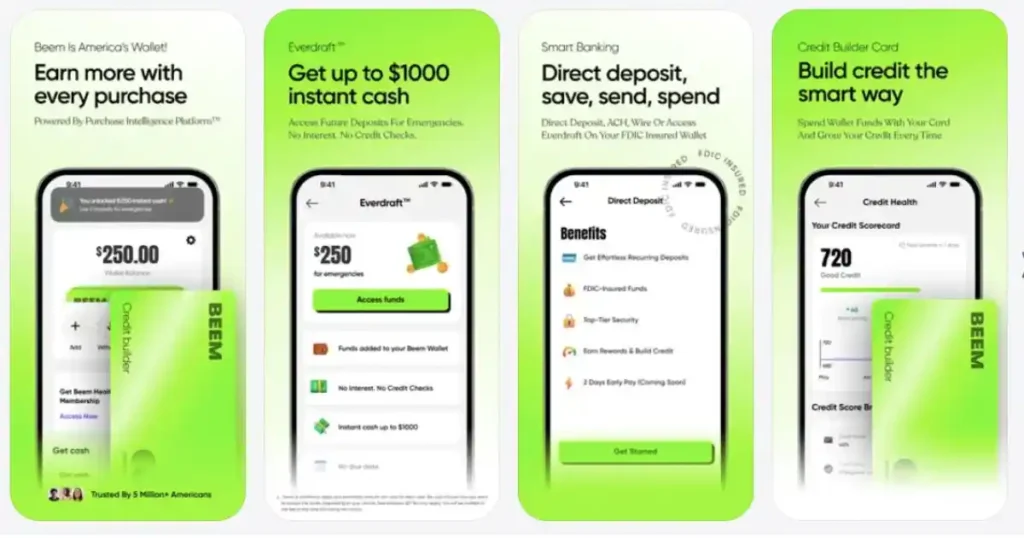
This is where our structure matters. Everdraft™ is not built like a classic payday loan, nor like a traditional bank small-dollar product that assumes a long-standing checking relationship and recurring employer direct deposits.
We position Everdraft™ as interest-free emergency cash with no credit check, no rollover fees on the advance itself, and no minimum direct-deposit requirement. We use a flat subscription model and, if you want faster access, an optional flat instant-transfer fee.
Standard ACH transfer is free. That means the economics are simpler than the high-cost roll-and-renew pattern regulators worry about, and the eligibility model is more flexible than many bank programs that require a fixed deposit pattern or long-standing account relationship.
For a New Yorker who cannot legally use payday loans and does not neatly fit a bank’s “recurring direct deposit plus long relationship history” box, that difference can matter a lot. We are designed to work for real cash-flow timing issues, including people with variable or nontraditional income, while keeping the pricing structure more legible.
The Cost Comparison Is Not Just About APR
Many borrowers compare short-term products by asking which has the lowest APR. That matters, but it is not the whole story. The structure of repayment matters too.
Balance Assist spreads repayment over three equal monthly installments. Huntington’s Standby Cash can be fee-free with autopay in some structures, or more expensive if you do not set it up that way.
U.S. Bank Simple Loan requires recurring direct deposits and blocks immediate re-borrowing for 30 days after payoff. These are all meaningful design choices because they reduce or reshape the need for repeat use.
Beem’s design choice is different. We offer a flat monthly subscription and an optional flat instant-transfer fee, while Everdraft™ is positioned as interest-free and with no rollover fees. That does not remove the need for discipline, but it does make the pricing more visible upfront, which is a big part of responsible short-term borrowing.
People Also Read: BEEM For When Your Direct Deposit Lands Late
A Practical New York Comparison Table
| Product type | How it usually works | Best fit | Main limitation |
| Illegal payday loan in New York | High-cost, short-term loan against future income; prohibited in NY | None in New York because it is illegal | DFS says payday lending is illegal in New York, including online payday loans. |
| Bank small-dollar program | Existing-customer loan or line, often with deposit history or direct-deposit requirements | Borrowers with long bank relationships and predictable deposits | Many products require recurring direct deposits, account history, or bank-specific eligibility. |
| Cash advance apps broadly | Mixed models: memberships, optional tips, paycheck-linked advances, or flat-fee emergency cash | Borrowers need faster, more flexible access | Structure varies widely, and regulators have warned that some models can become expensive or legally problematic. |
| Beem / Everdraft™ | Interest-free emergency cash, no credit check, no minimum direct-deposit requirement, optional flat instant-transfer fee | People with real short-term cash gaps, including variable-income users | Best used as a short bridge, not as a recurring substitute for income. |
What New York Borrowers Should Ask Before Choosing Between A Bank Program And An App
Before using any short-term cash product in New York, ask four questions.
1. Is this legal in New York under the way it is structured? New York has no patience for payday-style products that evade usury law.
2. What does the provider require from me to qualify? Bank programs often expect more relationship history and cleaner deposit patterns.
3. How exactly do I repay, and how quickly? A product that looks cheap can still cause problems if the repayment terms are too aggressive.
4. Does this solve one gap or quietly set me up for another round of borrowing? Those are the questions that separate a short-term tool from the beginning of a cycle.
Conclusion
In New York, the comparison between bank advance programs, cash advance apps, and Beem is really a comparison between structures. Classic payday lending is illegal.
Bank programs can be useful, but they often expect a stronger deposit relationship and more traditional income signals. Cash advance apps range from careful and transparent to expensive and legally questionable.
That is where the Beem app enters. We built Everdraft™ for real short-term liquidity needs, especially for people who do not fit perfectly into the old payroll-and-branch-banking mold. The goal is not to turn short-term cash into a habit.
The goal is to address a real timing gap without drifting into the kind of long-term, repeat-borrowing pattern that New York regulators have spent years trying to keep out of the state.
People Also Ask
1. Are Bank Advance Programs Legal In New York?
Some banks offer small-dollar programs, but classic payday lending is illegal in New York. The important issue is not the label “advance.” It is the product’s legal structure and its compliance with New York law.
2. Are Cash Advance Apps Legal In New York?
Some are, some are not, and legality depends on structure. DFS has made clear that payday lending is illegal in New York and has also scrutinized high-cost payroll advance models that may use tips, memberships, or extra fees in ways that could violate state law.
3. How Are Bank Advance Programs Different From Cash Advance Apps?
Bank programs usually require an existing checking account relationship, a deposit history, and, often, recurring direct deposits. Cash advance apps vary widely, and some are more flexible, but pricing and legal structures can vary much more.
4. Where Does Beem Fit In This Comparison?
We fit as a short-term liquidity tool that is more flexible than many bank programs and more structurally transparent than the high-cost short-term products New York regulators warn about. Everdraft™ is interest-free, requires no credit check, and does not require a minimum direct deposit pattern.
5. What Should A New Yorker Check Before Using Any Short-Term Cash Product?
Check whether the product is legal in New York, whether the pricing is clear, what the repayment structure looks like, and whether the product is likely to solve one gap or start a repeat-use pattern in New York. Legality and product design both matter.