
Table of Contents
You are not looking for someone to explain why payday stores are expensive. You already know. You have signed the paperwork, paid the fees, driven back two weeks later to sign it again, and watched the same $300 cost you $600 by the time you were done.
The math is not a mystery. The problem is that when rent was due Thursday and your paycheck did not arrive until the following Tuesday, the payday store was the only door that was open.
This article is not another lecture about predatory lending. It is for people who need what the payday store provides, fast cash before payday, but want it without the fees, the cycle, and the cost. Beem is that payday store alternative.
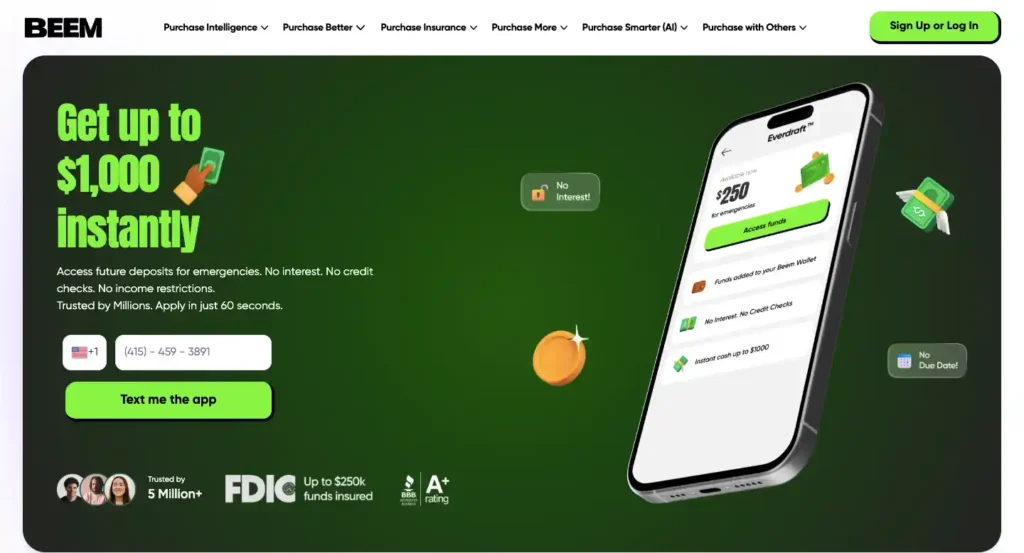
Up to $1,000 through Everdraft™, zero interest, no credit check, money in your bank account same day or within a few business days.
But “zero interest, $1,000 limit” is just a number on a screen until you see how it works for someone whose life looks like yours. So here are five people. Five situations. Five reasons each one used to walk into a payday store. And how Beem replaced that walk for every one of them.
The Single Parent Juggling Two Timelines
She earns $2,600 per month working full time at a distribution center. After rent ($1,050), car payment ($340), utilities ($180), phone ($65), childcare ($480), and minimum credit card payments ($90), she has roughly $395 left for groceries, gas, clothing, school supplies, and everything else two kids need.
The problem is never the total. The problem is the timeline. Childcare is due on the first. Her paycheck lands on the fifth. Every single month, there is a four-day gap where $480 needs to exist in an account that has $60 in it. She used to walk into the payday store on the 29th, borrow $500, pay childcare on the first, and repay $575 on the fifth. That $75 fee happened twelve times per year: $900 annually just to synchronize two dates on a calendar.
How Beem replaces the store: She requests a $500 Everdraft™ advance on the 29th. Childcare is paid on the first. Her paycheck on the fifth repays the advance automatically. Total interest: $0. That $900 per year she was paying in payday fees now covers three months of groceries. Nothing about her income changed. Nothing about her bills changed. The only thing that changed is where the bridge money comes from and what it costs.
And here is what the payday store never offered: BudgetGPT looked at her cash flow and identified that her car insurance ($180/month) could drop to $120 by switching carriers. That $60/month savings, found in five minutes, nearly closes the childcare timing gap on its own. After two months of the cheaper insurance, she needs the advance less often. After six months, she barely needs it at all.
The Immigrant Building a Life Without a Credit History
He arrived from Guatemala eighteen months ago. He works construction, earning $700 to $900 per week in cash and direct deposits. He has a bank account, a driver’s license, and a taxpayer identification number.
What he does not have is a credit score, a credit card, a relationship with a bank that will lend to him, or family nearby who can spot him $400 when the car insurance premium lands in a bad week.
The payday store did not care about his credit history. That was the appeal. Walk in, show ID and a pay stub, sign, and walk out with cash. He used it three or four times in his first year: $200 here, $300 there. The fees were $45, $60, $75. He paid them because the alternative was not paying rent or losing the car he needs for work.
How Beem replaces the store: Everdraft™ does not require a credit score, a credit history, or a Social Security number to function. It verifies income through bank account deposits. His weekly construction deposits qualify him the same way a salaried office worker’s biweekly paycheck would. He accesses up to $1,000 at zero interest, and the advance repays from his next deposit.
But the bigger shift is credit building. Beem’s credit-building feature reports payment activity to credit bureaus. After six to twelve months of consistent activity, he has a credit file where none existed before.
That file unlocks a real credit card, a lower car insurance rate, and eventually a shot at a small auto loan without a cosigner. The payday store took $75 from him and gave him nothing that lasted beyond that afternoon. Beem takes a membership fee and builds something permanent.
The Veteran Living on VA Disability
She served eight years, including two deployments. She left the military with a VA disability rating that provides $1,900 per month in tax-free benefits. It is a stable, predictable income. It is also fixed. It does not increase when the car needs a $600 repair or when the furnace dies in December.
The payday store near the base was a familiar presence. Half the people in line were veterans or military spouses. She used it twice after separation: once for a $400 appliance replacement, once for a $300 vet bill when her service dog needed emergency surgery. The fees were $60 and $45. Combined with the stress of walking into a place designed to process financially vulnerable people as quickly as possible, the experience left her feeling like she had traded one kind of service for another.
How Beem replaces the store: VA disability payments deposit on the first of every month, creating the most consistent deposit pattern Everdraft™ can evaluate. Her limit reflects that reliability. When the next car repair or unexpected expense hits, she opens the app, requests the advance, and the money deposits into her bank account. No storefront. No line. No one profiting from the fact that her sacrifice left her with a fixed income and a body that limits her earning potential.
Her VA benefits are not employment income, but Beem does not require employment. The system sees $1,900 arriving on the first of every month and treats it as what it is: stable income. For veterans on disability who have been told by traditional lenders that they “do not qualify” because they are not employed, that distinction is not a technicality. It is access.
The Warehouse Worker Whose Check Keeps Coming Up Short
He earns $18.50 per hour at a fulfillment center. On a 40-hour week, that is $740 gross, roughly $620 after taxes. But hours fluctuate. Some weeks are 40. Some are 32. Some are 44 with overtime. The inconsistency means his biweekly paycheck swings between $1,100 and $1,500, and his bills do not swing at all. Rent is $950. Every month. Regardless of whether Amazon gave him 80 hours or 65.
In short-check months, the payday store covered the gap. $200 here, $150 there. Small loans. Small fees. Except small fees twelve to fifteen times per year add up to $300 to $500 in annual costs on money he was going to earn anyway, just not fast enough.
How Beem replaces the store: Everdraft™ handles variable income better than payday stores because the system evaluates deposit patterns over time rather than requiring a fixed paycheck amount. His biweekly deposits, whether $1,100 or $1,500, qualify him. On short-check weeks, he requests the amount he actually needs ($150, $200, $300) and repays from the next deposit. No fee per $100 borrowed. No percentage taken off the top.
The deeper fix: BudgetGPT built a budget based on his lowest typical paycheck ($1,100) rather than his average. Budgeting for the floor instead of the average means every higher paycheck creates surplus rather than false expectations. After four months of floor-based budgeting, he had $600 in savings. Not a fortune. But enough that a short-check week no longer triggers a borrowing event at all.
The Home Health Aide Paid in Irregular Deposits
She works for a small home health agency that pays weekly, but the deposits are not always on the same day. Sometimes Friday. Sometimes Monday. Occasionally Wednesday. The agency is small, the payroll is manual, and “it will be there by Friday” sometimes means Saturday or the following Tuesday.
This inconsistency made traditional financial products nearly useless. Banks would not give her a credit card because her deposit pattern looked irregular. Cash advance apps that required biweekly direct deposit on a fixed schedule rejected her because her employer’s payroll was unpredictable. The payday store was the one place that did not care about deposit schedules. Show up, show a pay stub, sign, leave with cash.
How Beem replaces the store: Everdraft™ verifies income through cumulative bank account activity, not fixed deposit schedules. Her weekly deposits, even when they arrive on varying days, register as consistent income because the amounts and frequency are regular even if the exact date shifts. The system evaluates the pattern across weeks and months, not the precision of a single deposit day.
For workers at small businesses, home care agencies, independent contractors, and anyone whose employer’s payroll is not automated down to the minute, this flexibility is the difference between qualifying and being rejected. The payday store accepted her because it had low standards. Beem accepts her because it has smart standards, ones that read financial reality rather than demanding a textbook deposit schedule that her employer cannot provide.
What Every Payday Store Alternative Needs to Actually Work
These five stories share a pattern. The payday store was never the first choice. It was the only choice that said yes when everything else said no. A real payday store alternative has to clear the same bars the store clears while removing the costs the store imposes.
It has to say yes to people traditional lenders reject. No credit check. No employment verification. No fixed deposit schedule requirement. Beem clears this bar. Everdraft™ approves based on bank activity, not credit scores, employer calls, or payroll system connections.
It has to deliver money fast enough to solve the problem. A $400 advance that arrives in five business days does not prevent Thursday’s overdraft. Beem’s express delivery puts money in your bank account the same day. Standard delivery (free) works when you can see the expense coming a few days ahead.
It has to cost dramatically less. A payday store alternative that charges 200% APR instead of 400% APR is still predatory. Beem charges zero interest. The advance amount is the repayment amount. The only cost is the membership, which is a fraction of a single payday fee.
It has to not trap you. Payday stores profit from repeat borrowing. The structure encourages rollovers that keep you in debt for months. Beem’s automatic repayment from your next deposit closes each advance cycle cleanly. No rollover option. No extending the balance. No minimum payment that stretches a two-week advance into a six-month debt.
It has to help you need it less over time. This is where every payday store fails completely and where Beem’s platform model creates a genuine difference. BudgetGPT finds where money leaks. Credit building opens doors to cheaper financial products. JobsGPT connects you to additional income. The payday store wants you back in two weeks. Beem’s tools work toward the day you do not come back at all.
Getting Started Takes Less Time Than Driving to the Store
The payday store requires a car ride, parking, standing in line, filling out paperwork, and driving home. Twenty to forty minutes minimum. Setting up Beem takes five.
- Download the app from the App Store or Google Play
- Create your account (name, email, phone)
- Link your bank account through Beem’s secure connection
- The system evaluates your deposit history and determines your Everdraft™ limit
- Request your first advance when you need it
No ID photocopy. No pay stub printout. No voided check. No signature on a document full of fee disclosures you do not have time to read. Five minutes on your phone, and the next time an emergency hits, you open an app instead of driving to a strip mall.
FAQ: Beem as a Payday Store Alternative
1. Is Beem a real alternative to payday stores?
Yes. Beem provides the same core service (cash before payday) without the costs that make payday stores harmful. Up to $1,000 through Everdraft™ at zero interest versus $15 to $30 per $100 at a payday store. No credit check, no employment verification, same-day delivery available. For any borrowing need under $1,000, Beem replaces the payday store completely.
2. Can I use Beem if I have bad credit?
Yes. Beem does not run a credit check. Your Everdraft™ eligibility is based entirely on your bank account deposit history. Whether your credit score is 500 or 800 or nonexistent, it does not affect your ability to use Beem. This is the same accessibility that draws people to payday stores, without the predatory pricing.
3. Can I use Beem if my income is irregular?
Yes. Everdraft™ evaluates your bank account activity over time, not the precision of a single deposit schedule. Gig workers, freelancers, variable-hour employees, and people with small employers whose payroll timing fluctuates all qualify based on cumulative deposit patterns. You do not need a fixed biweekly paycheck to use Beem.
4. Does Beem work for people on government benefits?
Yes. Social Security, SSDI, SSI, VA disability benefits, unemployment insurance, and pension payments all qualify as income for Everdraft™ eligibility. These deposits appear in your linked bank account like any other income, and the system evaluates them accordingly. No employment is required.
5. How much can I save by switching from a payday store to Beem?
The savings depend on how often you borrowed and what fees you paid. A person who took six payday loans per year at $300 each with $45 fees per loan paid $270 in annual fees. With two rollovers per loan, that jumps to $540 to $810 per year. Beem charges zero interest on advances, with costs limited to the membership fee. Most payday store users save hundreds of dollars in the first year after switching.
6. Can Beem help me stop needing cash advances altogether?
Yes, over time. Beem includes BudgetGPT for personalized budgeting that identifies spending leaks, credit building that opens doors to cheaper financial products, and JobsGPT for finding additional income. These tools work on the root causes of the cash flow gaps that send people to payday stores. The goal is fewer advances over time, not a permanent borrowing cycle.