
Table of Contents
A government shutdown is not an abstract political event for the millions of Americans whose income depends on federal paychecks, government benefits, or publicly funded programs. When funding stops, real people face real consequences: rent due with no paycheck coming, utility bills that do not pause for political negotiations, and the particular anxiety of not knowing how long the disruption will last.
The financial pressure of a shutdown is made worse by its unpredictability. Unlike planned income gaps that allow preparation time, shutdowns arrive with little warning and end on timelines no one can reliably forecast. What affected households need is fast, fair, and genuinely affordable access to funds that bridge the gap until income resumes.
This guide explains how Beem helps, who qualifies, and how to use it effectively during a government-related income disruption.
Who Is Affected by Government Shutdowns and Benefit Delays
Understanding who faces income disruption during a government shutdown helps clarify the financial impact and why accessible financial tools matter so much during these periods.
Federal Government Employees
Approximately 2.9 million civilian federal employees are directly affected by a government shutdown. Essential workers designated as excepted employees are required to continue working without pay until the shutdown ends and Congress appropriates back pay.
Non-essential employees who are furloughed receive no income during the shutdown period, and, while back pay has historically been approved after shutdowns end, that approval is not guaranteed, and the timing is unpredictable.
Government Contractors
Unlike federal employees, government contractors are not guaranteed back pay when a shutdown ends. Contractors who provide services to shuttered agencies stop working and stop earning for the duration of the shutdown, with no legal entitlement to compensation for lost income.
Social Security and Benefit Recipients
During most government shutdowns, Social Security payments continue because the Social Security Administration operates from dedicated trust funds rather than annual appropriations. However, other benefit programs are more vulnerable to disruption.
Supplemental Nutrition Assistance Program (SNAP) benefits, housing assistance, and various other federally funded programs can face delays or interruptions during extended shutdowns, affecting millions of households that depend on those benefits for basic expenses.
Veterans Benefit Recipients
Veterans’ benefits, including disability compensation, pension payments, and education benefits, are subject to disruption during extended government shutdowns. While short shutdowns often do not affect payment timing, prolonged funding gaps create real uncertainty for veterans who depend on these payments as a primary or significant source of income.
State and Local Government Employees
State and local government employees are generally not directly affected by federal shutdowns, but they can face their own benefit delays and pay disruptions during state-level budget impasses, which follow a similar dynamic to federal shutdowns but operate on state-specific timelines and rules.
People Also Read: How Fast is Beem Instant Transfer
The Financial Reality of a Shutdown or Benefit Delay
The practical financial consequences of a government shutdown or benefit delay are straightforward and immediate.
Bills Do Not Pause for Political Negotiations
Rent, mortgage payments, utility bills, car payments, insurance premiums, and grocery expenses do not stop accumulating because the federal government has run out of funding authorization.
Creditors and landlords are not required to grant grace periods during shutdowns. While some do offer hardship accommodations, those accommodations are discretionary, inconsistent, and often require documentation and processing time that the immediate situation does not allow.
Emergency Savings Run Out Quickly
Financial planning guidelines recommend maintaining three to six months of emergency savings. The reality is that most American households have significantly less. Federal Reserve data consistently shows that a large percentage of US households cannot cover a $400 unexpected expense from savings alone.
For these households, even a brief shutdown that delays a single paycheck creates an immediate cash flow problem with no internal financial cushion to absorb it.
High-Interest Alternatives Create New Problems
When income is disrupted and savings are insufficient, many affected individuals turn to high-interest alternatives, including payday loans, credit card cash advances, and high-APR personal loans. These products solve the immediate cash need but create a new problem: expensive debt that must be repaid from the same constrained income that caused the crisis in the first place.
People Also Read: Is Beem Worth It in 2026? A Cost-Benefit Analysis for Real Users
How Beem Everdraft Helps During Income Disruption
Beem’s Everdraft is specifically designed for the timing gaps created by government shutdowns and benefit delays. Here is how it works in this context and why it is meaningfully different from other short-term financial options.
Instant Access With No Credit Check
Everdraft approval is based on income patterns and bank account activity, not credit scores. This is particularly important during government shutdowns, when affected individuals may be seeking financial help for the first time and may not have a strong credit profile or may be concerned about the impact of a credit inquiry on their existing score.
Zero Interest on Cash Advances
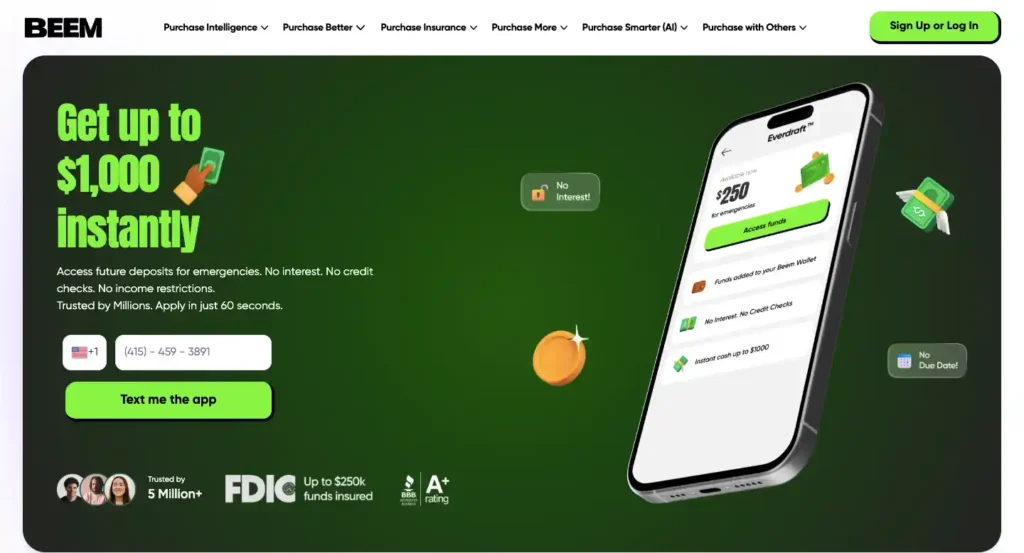
Everdraft charges no interest on cash advances of up to $1,000. During a period of income disruption, the last thing an affected household needs is a financial product that compounds the problem with interest charges.
Beem’s zero-interest model means that the advance you receive is exactly the amount you repay, with no additional cost attached to the time between receiving the advance and repaying it when your income resumes.
No Mandatory Fees
There are no mandatory fees associated with accessing or repaying an Everdraft advance. The only optional cost is an instant transfer fee for users who choose expedited fund delivery. For users who can wait one to three business days for standard delivery, the advance is completely free of charge. This cost structure is the opposite of payday lending and fundamentally different from high-interest credit alternatives.
Repayment Aligned With Income Resume
Everdraft repayment is designed to align with the user’s incoming deposits. When your federal paycheck is restored, your benefit payment resumes, or your contractor income restarts, that deposit automatically triggers the repayment process.
There is no rigid repayment deadline that falls before your income resumes, which means the advance genuinely bridges the gap rather than creating a new repayment deadline during the disruption period.
Practical Steps for Using Beem During a Shutdown
Here is a straightforward action plan for federal employees, benefit recipients, and contractors facing income disruption.
Step 1: Download Beem and Apply Early
Do not wait until your account balance reaches zero before applying for Everdraft. The approval process is fast, typically completing within minutes, but setting up your account before a cash flow crisis arrives gives you immediate access to funds the moment you need them.
Download the Beem app, complete identity verification, and connect your primary bank account as soon as you become aware of an impending income disruption.
Step 2: Connect Your Primary Income Account
Connect the bank account where your federal paycheck, benefit payment, or contractor income is normally deposited. Beem’s approval system analyzes your income patterns and account activity to determine eligibility.
An account with a clear history of regular government income deposits is the strongest possible input for the approval process.
Step 3: Request Only What You Need
Everdraft™ advances are repaid when your next deposit arrives. Request the amount you actually need to cover essential expenses rather than the maximum available limit. Keeping the advance amount aligned with your actual gap makes repayment straightforward when income resumes and avoids overextending during an already stressful period.
Step 4: Prioritize Essential Expenses First
Use the advance to cover Tier 1 essential expenses first, starting with housing, utilities, groceries, and minimum debt payments. Discretionary spending can be deferred. Essential expenses cannot be avoided, and the consequences of missing them are significantly more costly than the advance itself.
Step 5: Communicate With Creditors in Parallel
An Everdraft advance buys you time. Use that time productively by contacting creditors, landlords, and service providers to inform them of your situation and request any available hardship accommodations.
Many creditors have formal programs for government employees and benefit recipients affected by shutdowns, but those programs require you to ask for them.
People Also Read: How Beem Pass Works
Beem vs. Other Financial Options During a Government Shutdown
| Option | Cost | Speed | Credit Check | Repayment Flexibility |
| Beem Everdraft | $0 mandatory fees, 0% interest | Minutes to approve, 1 to 3 days standard | No | Aligned with income deposits |
| Payday Loan | $15 to $30 per $100 borrowed | Same day | Sometimes | Fixed, typically next payday |
| Credit Card Cash Advance | 3% to 5% fee plus 25%+ APR | Immediate | Existing card required | Minimum monthly payment |
| Personal Loan | Varies, often 10% to 36% APR | Days to weeks | Yes, hard inquiry | Fixed monthly installments |
| Bank Overdraft | $25 to $35 per transaction | Automatic | No | Immediate repayment required |
| Federal Employee Union Loan | Low to zero interest | Varies | Sometimes | Structured repayment plan |
How BudgetGPT Helps You Manage Through a Shutdown
Managing a constrained, unpredictable budget during a government shutdown is exactly the scenario that Beem’s BudgetGPT was built to support. When income is disrupted, and every dollar counts more than usual, real-time visibility into your spending is no longer a luxury. It is a necessity.
BudgetGPT tracks your spending patterns in real time, helps you identify which expenses can be reduced or deferred, and gives you a clear picture of how long your available funds will last at your current spending rate. During a shutdown, this kind of visibility helps you make deliberate, informed spending decisions rather than reactive ones driven by anxiety about an uncertain timeline.
Using BudgetGPT alongside Everdraft during a shutdown gives you both the financial resource and the financial awareness to navigate the disruption period as effectively as possible, stretching available funds further and making better decisions about where and when to use the advance.
Final Thoughts
A government shutdown or benefit delay is not a financial problem of your making, but it becomes your financial problem to solve. The bills, the rent, the groceries, and the minimum payments do not pause while political negotiations play out in Washington. What you need in those moments is fast, fair, and genuinely affordable access to funds that cover the gap without making the situation worse when normal income resumes.
Beem’s Everdraft is built for exactly that scenario. Zero interest, no mandatory fees, no credit check, and repayment aligned with your actual income cycle make it one of the most practical financial tools available to the millions of Americans whose financial stability is periodically disrupted by events entirely outside their control. You did not choose the disruption. You do have a choice about how you navigate it.
People Also Ask
1. Can federal employees use Beem Everdraft during a government shutdown?
Yes. Federal employees affected by a government shutdown can apply for Beem Everdraft regardless of their employment status during the shutdown. Beem evaluates eligibility based on bank account activity and income history, not current employment status.
2. Does Beem charge interest on advances taken during a government shutdown?
No. Beem’s Everdraft charges zero interest on cash advances of up to $1,000, regardless of the circumstances under which the advance is taken. There are no mandatory fees and no penalty rates. The only optional cost is an instant transfer fee for expedited delivery, which is disclosed clearly before confirmation.
3. How quickly can I access Everdraft funds during a government shutdown?
Most users receive an approval decision within minutes of connecting their bank account. Standard fund delivery takes one to three business days. Users who choose the optional instant transfer can receive funds significantly faster. Applying early, before your balance reaches zero, ensures funds are available when you need them most.
4. What happens to my Everdraft repayment if the shutdown lasts longer than expected?
Incoming deposits trigger an everdraft repayment to your connected bank account. If the shutdown extends and your income has not yet resumed, repayment does not occur until a qualifying deposit arrives. This alignment with actual income timing means Everdraft genuinely bridges the gap rather than creating a fixed repayment deadline during an ongoing disruption.
5. Can government contractors use Beem if they are not guaranteed back pay?
Yes. Beem evaluates eligibility based on historical account activity and income patterns rather than current employment status or guaranteed future income. Contractors with a history of regular deposits from government contract work can qualify for Everdraft based on that history.