


Table of Contents
Cleo talks to you like a friend who happens to know your bank balance. Dave gives you a checking account, a debit card, and side hustle listings alongside cash advances. Both have millions of users. Both charge for their services.
Both cap cash advances at $500 or below. And both leave you searching for a second option the moment your emergency exceeds what they are willing to lend.
The cleo vs dave comparison is not just about which app is cheaper or faster. It is about two completely different philosophies of what a cash advance app should be. Cleo built a personality-driven AI assistant that roasts your spending habits.
Dave built a financial ecosystem with banking at the center. Understanding what each app actually does well, and where each one falls short, is the only way to decide which one belongs on your phone.
Cash Advance Limits: The Number That Matters Most
Cleo’s Salary Advance
Cleo offers a “Salary Advance” of up to $250. The Cleo Plus subscription ($5.99/month) unlocks higher limit building, and Cleo Builder ($14.99/month) adds credit building. Starting limits for new users are often $20 to $100, building based on activity and spending patterns.
The cleo cash advance ceiling is the primary limitation. $250 covers a utility bill or a prescription refill. It does not cover a $400 rent shortfall, a $600 car repair, or a $500 medical copay.
Dave’s ExtraCash
Dave offers ExtraCash advances up to $500. The $1/month subscription provides access. Starting limits are $25 to $75, building based on direct deposit activity and account behavior. Users who set up Dave Spending (checking account) with direct deposit unlock higher limits faster.
The dave cash advance limit is double Cleo’s, but $500 still falls short for car repairs averaging $600 to $800 or rent shortfalls exceeding $500. The dave vs cleo comparison on limits gives Dave a clear edge, though both share the same structural problem: a ceiling too low for many real emergencies.

Fees: What You Actually Pay
Cleo’s Pricing
Cleo uses a tiered model. Free tier offers limited advance access. Cleo Plus at $5.99/month ($71.88/year) unlocks better advances and cashback. Cleo Builder at $14.99/month ($179.88/year) adds credit building. Express delivery adds fees per advance. A Cleo Builder user taking two express advances monthly can spend $220 to $280/year for access to advances that max at $250.
Dave’s Pricing
Dave charges $1/month ($12/year). Express delivery fees add $1.99 to $5.99 per transaction. Dave historically used a tipping model but has moved toward the subscription-plus-express structure. A moderate user taking one express advance per month pays approximately $60 to $84/year.
The cleo vs dave fees comparison favors Dave significantly on cost. Dave’s $12 annual subscription is one-sixth of Cleo Plus and one-fifteenth of Cleo Builder. Even with express fees, Dave is cheaper at every usage level. The dave vs cleo pricing gap is one of the widest in any cash advance app comparison.
The AI: Cleo’s Defining Feature
Cleo connects to your bank account and uses an AI chatbot to analyze spending, track bills, and identify forgotten subscriptions through a conversational interface. The AI has a personality: “hype” mode (encouraging) or “roast” mode (brutally honest). Users can text questions like “can I afford to eat out tonight” and get instant answers. The engagement model works. Users who interact regularly report better spending awareness.
What Cleo’s AI does not do: actively find deals on future purchases, compare prices before you buy, or match you with income opportunities. It is a smart mirror for spending, not a tool that changes the inputs. If your problem is under-earning or a timing gap, spending insights do not solve the structural issue.
Banking: Dave’s Defining Feature
Dave offers a full checking account (Dave Spending) with a Mastercard debit card, no minimum balance, no overdraft fees, and early direct deposit (up to 2 days early). By moving direct deposit to Dave, you get faster ExtraCash access and higher advance limits.
The tradeoff: your banking relationship is now inside the cash advance app, creating dependency. The dave cash advance experience is optimized for users who commit to the ecosystem. If you are comparing cleo vs dave and willing to switch banks, Dave rewards that commitment.
Credit Building
Cleo Builder ($14.99/month, $179.88/year) includes credit building through a Credit Builder Card that reports to bureaus.
Users on the free tier or Cleo Plus do not get it. Dave does not offer credit building at all. For users who want credit building included without a premium paywall, neither Cleo nor Dave delivers.
Where Both Apps Fall Short
The cleo vs dave comparison reveals individual strengths but also shared weaknesses.
Both cap below $1,000. Cleo maxes at $250. Dave maxes at $500. Neither covers a $700 car repair or $900 rent-plus-utility shortfall in a single advance.
Neither offers AI tools beyond budgeting: no price comparison, no cashback discovery, no income opportunity matching. And both charge express delivery fees on top of subscriptions, making the total annual cost unpredictable.
The Third Option Neither App Wants You to Consider
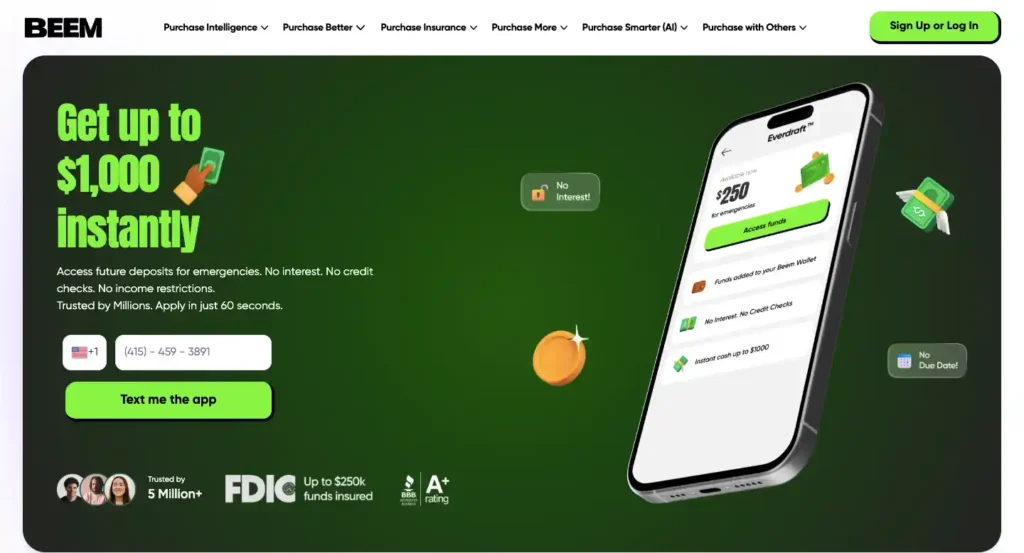
Beem did not build a chatbot personality or a checking account. It built a $1,000 cash advance ceiling with AI tools that attack root causes.
Everdraft™ Cash Advance provides up to $1,000 at zero interest: four times Cleo’s limit, double Dave’s. The membership includes BudgetGPT, DealsGPT (cashback), PriceGPT (price comparison), JobsGPT (income matching), and credit building without a premium tier. No bank switch required.
Quick Comparison Table
| Feature | Cleo | Dave | Beem |
| Max advance | $250 | $500 (ExtraCash) | $1,000 (Everdraft™) |
| Interest | 0% | 0% | 0% |
| Monthly cost | Free / $5.99 / $14.99 | $1 | Membership fee |
| Express delivery | Fee | Fee ($1.99-$5.99) | Fee (same-day) |
| Banking | No | Yes (Dave Spending) | No |
| AI chatbot | Yes (personality-driven) | No | AI tools (BudgetGPT, DealsGPT, PriceGPT, JobsGPT) |
| Credit building | $14.99/month tier only | No | Included |
| Bank switch needed | No | Encouraged for better limits | No |
FAQ: Cleo vs Dave
1. Which app has a higher cash advance limit?
Dave offers up to $500 (ExtraCash). Cleo offers up to $250 (Salary Advance). Beem offers up to $1,000 (Everdraft™ Cash Advance). For emergencies exceeding $500, neither Cleo nor Dave covers the full amount.
2. Which app is cheaper?
Dave at $1/month is significantly cheaper than Cleo Plus ($5.99) or Cleo Builder ($14.99). With express fees included, Dave costs $60 to $84/year for moderate use. Cleo costs $120 to $280/year depending on tier. Beem’s membership with a $1,000 limit delivers the best cost-per-dollar-of-advance-capacity.
3. Does Cleo or Dave build credit?
Cleo offers credit building only on the $14.99/month Builder tier ($179.88/year). Dave does not offer credit building. Beem includes credit building in the standard membership at no premium.
4. Can I use Cleo, Dave, and Beem together?
Yes. Some users keep Dave for banking (checking account, debit card, early direct deposit), Cleo for spending insights (AI chatbot), and Beem for larger advances (up to $1,000) and credit building. The three apps serve different functions and do not conflict.
Final Thoughts
The cleo vs dave debate comes down to what you value. Cleo is better if you want an AI assistant that roasts your spending and helps you stay aware of where your money goes. Dave is better if you want a full checking account with a debit card and the cheapest subscription in the cash advance market.
Neither is better if your emergency exceeds $500. Neither includes credit building without a premium paywall or total absence. Neither offers AI tools that actively reduce spending or find income beyond basic budgeting insights.
Beem fills every gap both apps leave open: $1,000 advance ceiling, AI tools that go beyond spending analysis into price comparison and income matching, and credit building included without a $14.99/month premium tier.
The best cash advance app is not always the one with the most personality or the cheapest subscription. It is the one that covers your actual emergency and builds your financial future at the same time.