

Table of Contents
Gig workers cannot negotiate pay directly with platforms the way traditional employees negotiate with managers. Still, they can take deliberate actions that effectively increase their earnings per mile during a gas price spike. Strategic order acceptance, zone selection, tip optimization, multi-apping, and aggressive use of platform incentives all function as a self-directed pay increase, no platform approval required.
Gig platforms do not raise your base pay because gas prices rise. Uber, DoorDash, and Instacart set pay through algorithms. Some have introduced temporary fuel surcharges during severe spikes, but these responses are inconsistent, temporary, and rarely sufficient to offset a significant cost increase fully.
What gig workers do have is something more useful than a negotiation: control over which orders they accept, when they work, where they work, and how many platforms they run simultaneously. Those levers, applied strategically, are the functional equivalent of a pay increase, whether or not the platform’s base rate ever moves.
Why Gas Prices Hit Gig Workers Harder Than Anyone Else
A salaried employee absorbs rising gas costs as a commute expense. A gig driver absorbs them as a business operating cost that scales with every mile driven. The order that paid $6.50 and covered five miles last month still pays $6.50 today, even though the fuel cost of those five miles has increased by 15 to 20 percent. The driver’s effective hourly rate falls with no visible change to the pay displayed on screen.
The platform will not notify you when your effective earnings decline. The adjustment has to come from you.
What Platforms Have Done: The Honest Assessment
Uber, Lyft, DoorDash, and Instacart have all introduced temporary fuel surcharges during severe price spikes. During the 2022 surge, Uber added $0.45 to $0.55 per trip. The problem is these surcharges are temporary, activated at the platform’s discretion, and calibrated to offset only a portion of the actual cost increase. They disappear when prices moderate, even if prices remain well above pre-spike levels.
No major platform has introduced a permanent, automatic pay adjustment tied to real-time gas prices. That would require treating drivers more like employees, which conflicts directly with the independent contractor model the entire industry is built on. Expecting that response is not a viable strategy. Building your own is.
Read: 5 Best Cash Advance Apps for Freelancers and Gig Workers in 2026
Strategy One: Raise Your Minimum Earnings-Per-Mile Threshold
Use the IRS standard mileage rate of $0.70 per mile as your vehicle cost baseline. Any order paying less than $0.70 per mile costs you money before accounting for your time. During a gas spike, your real break-even point rises above that figure.
The practical threshold most gig drivers apply during high gas prices is between $1.00 and $1.50 per mile, including tip. Before accepting any order, divide the total offered pay by the estimated total miles, including pickup and return to the zone. Below your threshold, decline. The orders you do accept will generate significantly higher net earnings per hour.
Strategy Two: Work Smarter Zones, Not Harder Hours
Urban and dense suburban restaurant clusters produce delivery distances of 1 to 2 miles, resulting in dramatically higher earnings-to-mile ratios than residential areas, which cover 5 to 6 miles per order. Review your platform’s heat map before each shift and position yourself where the average delivery distance is shortest relative to the average pay.
Driving five miles to reach a sparse zone and another six for delivery adds up to eleven miles for one order. Waiting in a dense zone typically produces a three-mile order at comparable pay. Patience in the right zone is a fuel-saving strategy that compounds across every shift.
Strategy Three: Optimize for Tips Actively
Timeliness, verifying order accuracy before leaving the restaurant, and courteous delivery notes consistently produce above-average tips, none of which cost extra time or effort. A driver who raises their average tip by $1.50 per order through deliberate service quality adds $30 across a 20-order shift, even with the same miles driven.
Higher-value sit-down restaurant orders and grocery delivery through Instacart consistently produce higher tips than fast-food orders. Prioritizing these categories during high-gas-price periods is earnings optimization, not preference.
Strategy Four: Multi-App Simultaneously
Multi-apping fills dead time between orders on one platform with earning activity on another, generating more revenue per hour from the same miles. Accept a second order only when the first is complete or nearly so. Carrying two active orders in opposite directions creates compounding delays that cost more than the extra income is worth.
DoorDash and Uber Eats are the most effective pairing in most markets. Instacart pairs well with either, filling gaps between restaurant clusters with longer, higher-paying grocery orders.
Strategy Five: Leverage Platform Incentives Aggressively
The fuel cost of each delivery does not change with surge pricing. An order costing $1.50 in fuel that pays $6.50 at base pays $9.50 during a $3.00 surge. Your net earnings increase by $3.00 while your fuel cost stays constant. Concentrate hours during DoorDash Peak Pay and Uber Eats surge windows rather than distributing shifts evenly across the week.
DoorDash Quests pay a lump bonus for completing a set number of deliveries within a window. A $25 bonus for 15 deliveries adds $1.67 in effective pay across every one of those orders. Plan your shifts around completing these thresholds rather than treating them as a byproduct of however many orders arrive.
Strategy Six: Know When to Stop
One of the most financially disciplined decisions a gig driver can make during a gas spike is establishing a personal threshold below which continued driving is not worth it. If your average earnings per mile drop below $1.00 for a sustained period, late-night low-density hours or slow midweek afternoons may cost more in fuel than they earn in income. Stopping is not defeat. It is the calculation working correctly.
Read: Financial Planning for Freelancers and Gig Workers
How Beem Supports Gig Workers Through Fuel Cost Pressure
Everdraft™: The Bridge Between Shifts
Rising gas prices do not wait for your earnings strategy to take effect. The gap between when your fuel costs spike and when your optimized strategy starts producing higher net earnings is real, and it often lands in the same week.
Beem’s Everdraft™ provides cash advances of up to $1,000 with no interest charged and no credit check required, covering that gap without the cost of payday lending or the slow burn of credit card interest.
For gig workers without access to employer benefits, paid leave, or traditional financial safety nets, Everdraft™ is a zero-cost bridge that keeps the lights on while their earnings strategy catches up.
BudgetGPT: Track Whether Your Strategy Is Working
BudgetGPT is Beem’s AI-powered budgeting tool that analyzes your income and spending patterns to surface insights about your financial picture. For gig workers implementing a new earnings optimization strategy during a gas spike, BudgetGPT makes it visible whether the strategy is actually improving your net monthly income or whether further adjustments are needed.
PriceGPT: Cut the Fuel Cost That Remains
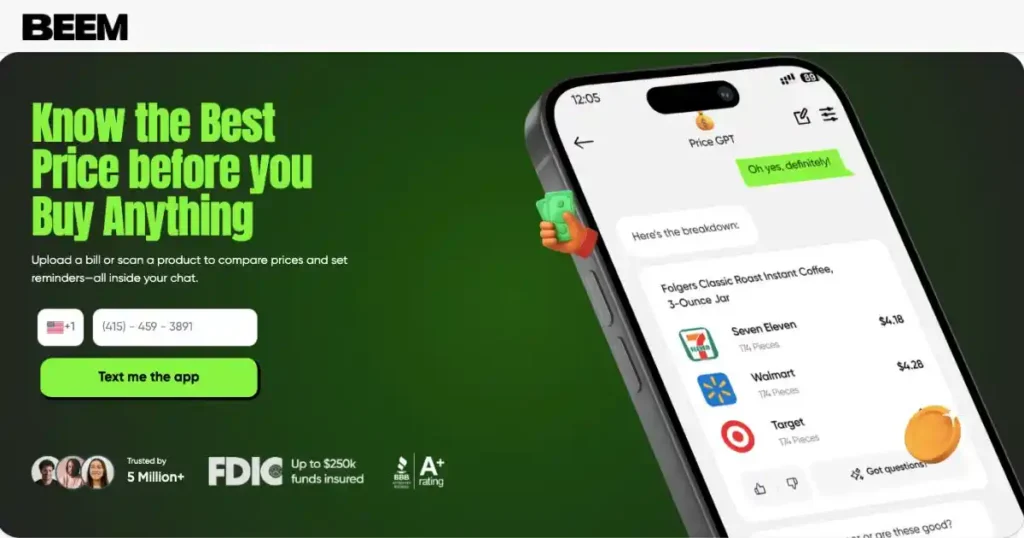
Even the most optimized gig earnings strategy still requires filling your tank. Beem’s PriceGPT identifies better prices on everyday purchases, including fuel, reducing the per-gallon cost of every fill-up and compounding with every earnings optimization decision you make behind the wheel.
Conclusion
Gig workers cannot walk into their platform’s office and ask for a raise. But they control more of their earnings than most realize, and during a gas price spike, those controls matter more than ever.
Raising your earnings-per-mile threshold, working high-density zones, optimizing for tips, multi-apping to eliminate dead miles, leveraging platform incentives aggressively, and knowing when the math no longer supports continued driving are six strategies that collectively function as a self-directed pay increase, no platform approval required.
The platforms may eventually respond to severe gas price spikes with temporary surcharges. Some will and some will not. Building a strategy that does not depend on that response puts you in a stronger position regardless of what any platform decides. Beem’s Everdraft™ bridges the gap while that strategy takes effect, and PriceGPT reduces the fuel cost that drives the problem in the first place. Download the app now!
People Also Ask: Can Gig Workers Negotiate Higher Pay When Gas Prices Rise?
1. Can gig workers negotiate higher pay when gas prices rise?
Not through direct platform negotiation, since pay is set algorithmically. However, gig workers can effectively increase earnings per mile by raising their acceptance threshold, working high-density short-distance zones, optimizing for tips, multi-apping to eliminate dead miles, and concentrating hours in surge and incentive windows. These strategies function as self-directed pay increases that require no platform involvement.
2. Do delivery platforms increase pay when gas prices spike?
Some platforms, including Uber, Lyft, and DoorDash,h have introduced temporary per-order fuel surcharges during severe spikes, typically $0.35 to $0.55 per order. These are temporary, activated at the platform’s discretion, and offset only a portion of the actual fuel cost increase. No major platform has introduced a permanent automatic fuel adjustment tied to real-time gas prices.
3. What is the minimum earnings per mile a gig driver should accept during high gas prices?
Between $1.00 and $1.50 per mile,l e including tip. Below $1.00 per mile, the order is unlikely to produce a meaningful hourly return after vehicle costs at elevated fuel prices. Use the IRS standard mileage rate of $0.70 per mile as your cost baseline and set your acceptance threshold above that figure by enough to generate a positive return on your time.
4. Does multi-apping help during a gas price spike?
Yes. Multi-apping fills dead miles between orders with earning activity on a second platform, generating more revenue per hour from the same miles driven. During high-gas-price periods, any strategy that reduces unpaid miles improves your effective earnings per gallon. DoorDash and Uber Eats are the most commonly paired combination in most US markets.
5. What should a gig worker do when gas prices make a shift unprofitable?
Raise your acceptance threshold, move to a high-density zone, and check for active platform incentives. If earnings per mile remain below $1.00 despite adjustments, reducing hours or stopping for the day is a financially rational response. If a genuine income gap appears, Beem’s Everdraft™ offers advances up to $1,000 with no interest and no credit check required.