

Table of Contents
Income verification used to mean one thing: hand over pay stubs, wait for someone to review them, and hope nothing gets stuck.
Fintech apps changed that. Today, income verification can happen in seconds, often without paperwork, by verifying income through payroll connections, bank transaction history, or uploaded documents. That’s good for speed and convenience, but it also creates confusion for users: what exactly is being verified, how does it work, and does it mean you need a “perfect” paycheck to qualify?
This blog breaks down the digital income verification process in simple terms, including how fintechs verify income, how bank account verification apps work, what cash advance income requirements typically look like, and how Beem can say “no income restrictions” while still running eligibility checks responsibly.
What Income Verification Actually Means
Income verification is the process of confirming that money is coming in, how much, how often, and from what sources. In fintech apps, it’s commonly used to:
- Confirm you can support a product safely (underwriting and risk controls)
- Reduce fraud and account abuse
- Match your account setup to the right features and limits
Digital income verification is often done by connecting to data sources like banks and payroll providers to confirm income electronically instead of relying only on paper documents.
Income Verification vs Employment Verification
These are often mixed up:
- Income verification confirms the money you receive.
- Employment verification confirms who you work for and your job status.
Some fintech apps need both. Others only need income signals (especially if they’re evaluating cash flow rather than offering a traditional loan).
Income Verification vs Bank Account Verification
Bank account verification apps typically validate that a bank account is real and belongs to you (often using micro-deposits or an account-linking flow). Income verification can use that same bank connection, but it goes further: it looks at the deposits and income patterns over time.
Why Fintech Apps Verify Income
To Prevent “Bad Fit” Approvals
A well-designed fintech app tries to avoid setting you up for failure. Income verification helps products stay aligned with reality: if your cash flow is inconsistent, the product should behave differently than it would for someone with steady deposits.
To Reduce Fraud
Cash advance and money movement products are frequent fraud targets. Verifying income and cash flow helps confirm the account is active and behaving like a real personal finance account, not a synthetic account used for abuse.
To Set Limits That Match Your Cash Flow
Even apps that don’t do credit checks still have to set an amount that is safe and sustainable. That’s one reason you see “up to” limits across the industry, and why the maximum is rarely a starting point.
People Also Read: Understanding Encryption in Financial Apps
The Digital Income Verification Process, Step By Step
Most fintech apps follow some version of this workflow:
Step 1: Consent
The user agrees to allow access to certain income data sources. Digital income verification is consent-based, which is why you’ll see a permissions step before the connection happens.
Step 2: Authorization
You connect a source of truth, typically one of these:
- A bank account
- A payroll provider
- A document upload (pay stub, benefit statement, etc.)
Plaid, for example, describes income verification methods through payroll, bank data, or document uploads.
Step 3: Data Retrieval and Normalization
The system pulls income-relevant data and converts it into a consistent format: pay dates, net income, gross income (where available), employer, deposit frequency, and income streams.
Step 4: Income Pattern Detection
For bank-based verification, systems commonly identify recurring deposits and classify income streams. Plaid’s Bank Income documentation describes retrieving net income information from a connected bank account and supporting both irregular/gig income and W-2 income.
Step 5: Decisioning
The app uses this verified data to:
- Approve or decline access
- Set an eligible amount or limit
- Determine what features the user can access
That’s the “digital income verification process” in its simplest form.
How Fintech Verifies Income: The Three Main Methods
Payroll-Based Income Verification
This method connects to your payroll provider (or to payroll networks) to verify employment and income details.
Plaid’s Payroll Income documentation describes verifying employment details and gross income information from a user-connected payroll account.
Best for:
- Traditional W-2 workers
- Applicants who want fast verification without bank history review
Tradeoff:
- Doesn’t always capture gig income well unless the system supports it
- May exclude people paid outside standard payroll rails
Bank-Based Income Verification
This method connects to your bank account and verifies income through deposits and transaction history.
Plaid’s Bank Income documentation describes retrieving net income info and supporting irregular/gig income streams from bank transactions.
Best for:
- People with mixed income sources (gig, freelance, benefits)
- Anyone whose income shows up consistently in bank deposits
Tradeoff:
- Requires enough bank history to detect patterns
- Users may feel uncomfortable sharing transaction-level data without clarity
Document-Based Income Verification
This method asks the user to upload documents like pay stubs, bank statements, benefit letters, or tax documents. Plaid also describes “Document Income” as part of its suite, where documents are used for verification.
Best for:
- Users without supported payroll or bank connections
- Edge cases (new job, irregular deposits, self-employed)
Tradeoff:
- Slower and more manual
- Higher friction and higher risk of document mismatch
Cash Advance Income Requirements: Why Some Apps Ask, And What’s Actually Happening
Cash advance apps vary widely, but most fall into two models:
Earned Wage Access Model
Some apps are essentially “access your earned wages early,” which typically requires employment verification or consistent payroll cycles.
Cash Flow Model
Other apps evaluate deposits and cash flow, which can include payroll, gig income, or benefits deposits.
Either way, the phrase “income verification” can show up even when the app isn’t judging your job title or your salary. Often it’s simply verifying that deposits exist and that the account activity supports safe access.
Where Beem Fits: “No Income Restrictions” Without Skipping Responsibility
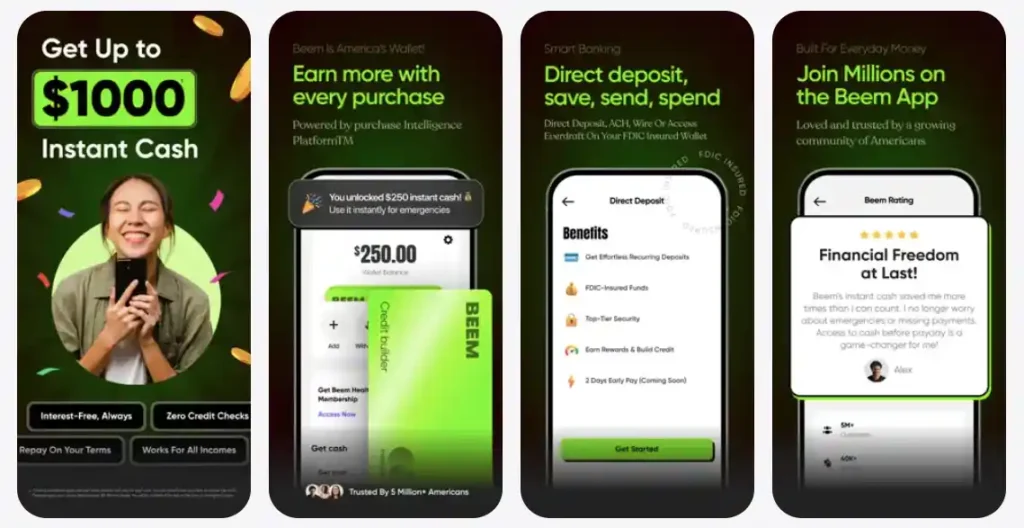
At Beem, we say “no income restrictions” because we don’t require a minimum monthly income or a minimum direct deposit amount to access Everdraft™, and we don’t limit you based on having a traditional paycheck.
People Also Read: Why Beem Has No Income Restrictions
What “No Income Restrictions” Means At Beem
At Beem, “no income restrictions” means we do not require a minimum monthly direct deposit to access Everdraft™, and your income can come from gig work, freelance clients, part-time employment, or other sources.
What It Does Not Mean
“No income restrictions” does not mean “no eligibility criteria.” Everdraft eligibility and limits can change over time based on account activity, and our Google Play listing discloses that Everdraft™ availability depends on eligibility criteria, including cash flow and income verification.
In plain terms, we don’t block you for not meeting a minimum income threshold, but we still verify enough financial behavior to offer the product responsibly.
How BEEM Evaluates Eligibility For Everdraft™
Beem’s Help Center lists requirements to be eligible for Everdraft™, including:
- Connect a supported U.S. checking account
- Be on an eligible subscription plan
- Have a verified debit card linked to the primary bank account
- Have no pending dues
…and notes eligibility and limits can change based on account activity.
That’s the difference between “income restrictions” and “income verification” in practice.
Why Income Verification Fails (Even When You’re Actually Getting Paid)
Most people assume income verification fails because they “don’t make enough.” In fintech, failures are often more mechanical than personal. The system isn’t judging your worth. It’s trying to detect patterns with enough confidence to approve access safely.
Here are the most common real-world reasons verification fails or returns a low confidence result:
- Your deposits don’t look consistent yet. If you recently switched jobs, started freelancing, or changed pay schedules, the system may not have enough history to confidently label your deposits as income.
- Your income isn’t deposited into the linked account. If you get paid to a different bank, a prepaid account, a business account, or a platform wallet, the linked checking account may not show the income signals the app expects.
- Your income is “lumpy.” Gig and freelance pay often comes in irregular amounts and irregular timing. Some systems can detect it, but it can still take time to build a reliable baseline.
- Your deposit labels are unclear. Income detection often relies on deposit descriptions. If the deposit description doesn’t clearly represent payroll or recurring income, it can reduce confidence even if the money is real.
- The account is too new or too inactive. A newly opened account with limited transaction behavior can make verification difficult because there’s not enough activity to validate ongoing cash flow.
- You have frequent returns, chargebacks, or overdraft events. These can trigger risk rules in some products because they signal instability or repayment risk.
How To Improve Your Approval Odds Without “Gaming The System”
A lot of articles tell users to “hack” income verification. That’s bad advice. Fintech systems are designed to detect real, sustainable patterns, and trying to manipulate them can backfire.
What actually works is straightforward and honest:
- Use your primary checking account. The account where your income consistently lands is the account that can verify income most clearly.
- Let deposits build history. If you just started a new job or changed income sources, give it time. Many systems become more confident after multiple deposit cycles.
- Avoid mixing personal and business income in one account if possible. When deposits are a blend of reimbursements, transfers, client payments, and payroll, the signal becomes noisier.
- Keep your account stable during verification. Frequent bank switching, new accounts, or constant changes in linked accounts can slow the process because the system has to reassess.
- If a payroll option exists and you’re W-2, use it. Payroll-based verification can sometimes be more direct for traditional employment income.
Bank Account Verification Apps: What You’re Usually Approving When You Link A Bank
When you link a bank inside a fintech app, you’re typically enabling:
- Ownership validation (it’s your account)
- Connectivity (the app can read balances/transactions or confirm deposits)
- Data needed for features like cash flow analysis or transfer eligibility
This is not always a “credit check.” It’s usually a data authorization. The best apps make it clear what they access and why.
People Also Read: How the Beem Cash Advance Works
What Users Assume vs What’s Actually True
| What People Think | What’s Usually True In Fintech Apps | What This Means For You |
| “Income verification means pay stubs.” | It can be payroll, bank deposits, or documents. | You might not need paperwork at all. |
| “If I’m gig/self-employed, I can’t qualify.” | Many systems can verify income via bank deposits, including irregular income. | Your income type isn’t always a blocker anymore. |
| “No income restrictions means no verification.” | Apps can avoid minimum thresholds but still verify cash flow and account activity. | You can be included without being unverified. |
| “Bank linking means the app sees everything forever.” | Access depends on the authorization scope and provider. | You should understand what data is used and why. |
What You Should Look For Before You Approve Income Verification
Clarity On What Data Is Being Used
A trustworthy app should tell you whether it’s using:
- Payroll data
- Bank deposit history
- Document uploads
and what it’s trying to confirm (income amount, frequency, eligibility, etc.).
A Clear Reason For Verification
Good reason: “to determine eligibility and limits safely.”
Bad reason: “because we can.”
A Path For Edge Cases
If your income is new, irregular, or seasonal, the app should offer a way to proceed (or explain why it can’t) without leaving you guessing.
Final Thoughts
Income verification in fintech apps isn’t just paperwork moved online. It’s a shift toward verifying income through payroll connections, bank deposit history, and digital consent flows.
For users, the win is speed and inclusion, especially for gig workers, freelancers, and people with non-traditional income. The risk is confusion when apps don’t explain what they’re verifying and why.
On the Beem app, “no income restrictions” is about inclusion: we don’t require minimum income thresholds or a traditional paycheck to access Everdraft™. But we still believe verification and eligibility checks matter, because trust in a money product comes from clarity, safety, and responsible access.
FAQs on Income Verification in Fintech Apps
1. What Is Income Verification In Fintech Apps?
Income verification is how fintech apps confirm your income using electronic sources like bank deposits, payroll providers, or documents, often to set eligibility and limits.
2. How Do Fintech Apps Verify Income Without Pay Stubs?
Many use bank-based income verification by analyzing deposit patterns and identifying income streams from a connected checking account, which can support W-2 and irregular/gig income.
3. Are Bank Account Verification Apps The Same As Income Verification?
Not exactly. Bank verification confirms the account and can enable data access; income verification uses that data (or payroll/docs) to confirm income and cash flow patterns.
4. What Are Typical Cash Advance Income Requirements?
They vary. Some models focus on employment/payroll patterns, while others focus on deposits and cash flow. The key is whether the product needs a minimum threshold or simply needs verified cash flow signals.
5. How Can Beem Have No Income Restrictions If There’s Income Verification?
Because “no income restrictions” refers to not requiring a minimum income or minimum direct deposit amount and not excluding people based on income source, while verification can still be used to confirm cash flow and eligibility responsibly.