
You sold a couch on Facebook Marketplace. The buyer paid through Venmo. The money is sitting in your Venmo balance and you need it in your bank account to cover rent tonight.
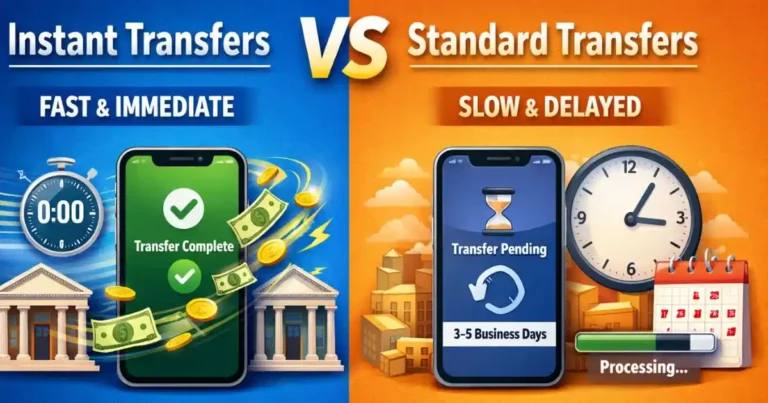
You tap “Transfer to Bank” and the app gives you two options: instant transfer for a small fee, or standard transfer for free. One arrives in 30 seconds. The other arrives in one to three business days.
That choice, instant transfer vs standard transfer, follows you across nearly every financial app in 2026. Venmo, Cash App, PayPal, Zelle, cash advance apps, gig payment platforms, digital banks.
They all ask the same question: do you want your money now or later? And they all charge differently depending on your answer.
It seems like a simple decision. Pay a little, get it fast. Wait a bit, keep it free. But the mechanics behind each transfer type, the fees that accumulate over dozens of transactions per year, and the scenarios where paying for speed actually saves you money make the instant transfer vs standard transfer question more nuanced than it appears.
Understanding the difference saves you money every single time you move funds.
How Standard Transfers Work
A standard transfer moves money from one account to another through the ACH (Automated Clearing House) network, the infrastructure backbone of the American banking system.
ACH has been processing electronic payments since the 1970s and now handles over 30 billion transactions per year, including direct deposits, payroll, bill payments, tax refunds, and account-to-account transfers.
Here is what actually happens when you initiate a standard transfer. Your app or bank submits the transfer request to the ACH network.
ACH does not process transactions individually in real time. Instead, it batches your request together with millions of other transactions and processes them in scheduled windows throughout the business day.
The receiving bank then verifies the incoming funds and posts them to your account. The entire cycle takes one to three business days.
That “business days” qualifier is where people get tripped up. ACH does not process on weekends or federal holidays.
A standard transfer initiated at 8 PM on Friday will not begin processing until Monday morning and may not arrive in your account until Tuesday or Wednesday. What looked like a “one to three day” wait is actually a five-day wait because Saturday and Sunday do not count.
The advantage of standard transfers is cost: they are almost always free. No per-transaction fee, no percentage-based charge, no minimum transfer amount. When timing is not urgent, a standard transfer is the cheapest way to move money between accounts. Period.
Standard transfer speed by platform (typical 2026 timeframes):
- Venmo to bank: 1-3 business days
- Cash App to bank: 1-3 business days
- PayPal to bank: 1-3 business days (sometimes up to 5)
- Cash advance app to bank: 1-3 business days
- Bank-to-bank ACH: 1-3 business days
- Gig platform payouts (DoorDash, Uber): 1-3 business days for standard deposit
How Instant Transfers Work
An instant transfer bypasses the ACH batching system entirely and moves money in real time or near-real time, typically within 30 seconds to 30 minutes. Instant transfers use completely different payment rails than standard transfers, which is why they cost more and arrive faster.
The two primary networks powering instant transfers in 2026 are:
Debit card networks (Visa Direct, Mastercard Send). Most app-based instant transfers push funds directly to your linked debit card rather than to your bank account number. The money routes through Visa or Mastercard’s existing debit infrastructure, which operates 24 hours a day, 7 days a week, 365 days a year, including weekends and holidays.
This is how Venmo, Cash App, PayPal, and most cash advance apps deliver instant transfers. Because the transfer goes to your debit card, the funds land in whatever bank account is tied to that card.
RTP (Real-Time Payments) and FedNow. The RTP network, run by The Clearing House, and FedNow, launched by the Federal Reserve in July 2023, process bank-to-bank payments in real time around the clock.
These networks are expanding rapidly in 2026, and a growing number of banks and fintech apps are integrating them as alternatives to debit-card-based instant transfers.
RTP and FedNow deliver funds in seconds directly to your bank account without routing through a card network, which means they work even if you do not have a debit card linked.
The tradeoff for this speed is cost. Most platforms charge an instant transfer fee that is either a flat rate or a percentage of the transfer amount.
Instant transfer fees by platform (typical 2026 rates):
- Venmo: 1.75% of transfer (minimum $0.25, maximum $25)
- Cash App: 0.5% to 1.75%
- PayPal: 1.75% (minimum $0.25, maximum $25)
- Cash advance apps: $0 to $5.99 per express delivery (varies by app)
- Zelle: Free at most participating banks
- Digital banks (Chime, Current): Often free for internal transfers
Zelle deserves a special callout. Because Zelle is owned by a consortium of major U.S. banks and uses the banks’ own internal infrastructure, person-to-person Zelle transfers are both instant and free at most participating institutions.
However, Zelle is designed for sending money to other people, not for transferring your own funds between your own accounts at different banks. It solves a different problem than the instant transfer vs standard transfer question most people are asking.
Instant Transfer vs Standard Transfer: Side-by-Side Comparison
| Feature | Standard Transfer | Instant Transfer |
| Speed | 1-3 business days | 30 seconds to 30 minutes |
| Cost | Free | $0.25 to $25 (varies by platform and amount) |
| Network | ACH (batched processing) | Visa Direct, Mastercard Send, RTP, FedNow |
| Weekend/Holiday Processing | No (delays likely) | Yes (24/7/365) |
| Availability | Universal (all banks and apps) | Requires compatible debit card or participating bank |
| Daily Transfer Limits | Varies ($1,000 to $25,000+) | Often lower than standard limits |
| Best For | Non-urgent transfers, large amounts, routine bills | Emergencies, time-sensitive payments, weekend needs |
| Risk of Delay | Moderate (weekends, holidays, bank processing) | Very low (real-time processing) |
The comparison table reveals the fundamental tradeoff in the instant transfer vs standard transfer decision: you are paying a fee to eliminate time risk.
Standard transfers are free but unpredictable (one day? three days? five if there is a holiday?).
Instant transfers cost money but remove the uncertainty entirely. Whether that certainty is worth the fee depends entirely on what is waiting on the other end of the transfer.
When Standard Transfers Make Sense
Standard transfers are the right choice more often than most people assume. The zero cost and universal compatibility make them the smart default for any transfer where timing is flexible.
Routine bill payments. If rent is due on the first and you initiate the transfer on the 27th, a standard transfer arrives with days to spare. Paying an instant transfer fee for a payment that is not due for 72 hours is throwing money away.
Paycheck and gig deposits. Most employers, gig platforms, and cash advance apps offer free standard delivery. Unless your bank offers free early direct deposit, the standard timeline works perfectly for predictable, recurring income. Setting up standard delivery as your default across all platforms keeps transfer costs at zero for every routine deposit.
Savings contributions. Moving money from checking to savings, between investment accounts, or between banks for organizational purposes almost never requires instant speed. A standard transfer saves the fee on every transaction. Over a year of weekly $200 savings contributions, choosing standard over instant saves $180 or more in fees at 1.75% per transfer.
Large transfers. This is where the math gets decisive. Instant transfer fees are often percentage-based. On a $5,000 transfer at 1.75%, the instant fee is $87.50. On the same transfer, standard ACH costs $0. On $10,000, the instant fee could reach $175. The larger the amount, the more expensive instant becomes relative to standard. For any transfer above $1,000 where timing is not critical, standard is the financially rational choice every time.
Planned cash advance requests. If you know a bill is coming next week and request a cash advance today, standard delivery (free, 1-3 business days) gets the funds to your account in time without costing extra.
Beem’s Everdraft™ provides cash advances up to $1,000, and choosing standard delivery on planned advances keeps the total cost at just the Beem membership with zero delivery surcharges.
When Instant Transfers Are Worth the Fee
Despite the cost, there are real scenarios where paying the instant transfer fee is not just convenient but financially smart. The rule is simple: an instant transfer is worth the fee whenever the cost of waiting exceeds the fee itself.
Avoiding overdraft fees. Your checking balance is $12. A $200 automatic payment is hitting tonight. You have $500 in your Venmo balance from a weekend gig. An instant transfer costs $3.50 (1.75% of $200). Your bank’s overdraft fee: $35. Paying $3.50 to avoid $35 saves you $31.50. This is the single most common scenario where the instant transfer vs standard transfer math decisively favors instant. Every dollar spent on the fee prevents ten dollars in penalties.
Catching a payment deadline. Late fees on credit cards ($29 to $40), utilities ($10 to $25), and rent (often 5% of monthly rent, which on $1,500 rent means a $75 late fee) far exceed most instant transfer fees. If a same-day transfer prevents a $40 late fee, paying $2 to $5 for instant delivery is not an expense. It is a net savings of $35.
Weekend and holiday emergencies. Standard ACH does not process on weekends or federal holidays. If you need funds in your bank account on a Saturday to cover a car tow, a medical copay, or an emergency purchase, an instant transfer is your only option. Waiting until Monday or Tuesday is simply not feasible when the problem is happening right now.
Cash advance express delivery for genuine emergencies. Most cash advance apps offer two speeds: free standard (1-3 business days) or paid express (same day).
If you need the advance to fix your car today so you can drive to work tomorrow, the $1.99 to $5.99 express fee is a small investment to protect a day’s income.
Beem’s Everdraft™ offers same-day delivery options on advances up to $1,000, giving users the flexibility to choose express when the situation demands it and standard when it does not.
Time-sensitive opportunities. Occasionally, speed has upside rather than just downside prevention. A limited-time deal, a security deposit on an apartment, or a marketplace purchase that will not last until Monday are all situations where an instant transfer creates value beyond avoiding fees.
The Hidden Math: When Instant Transfer Fees Quietly Drain Your Account
One instant transfer fee is negligible. Fifty per year is not. This is where the instant transfer vs standard transfer decision has its biggest long-term financial impact, and most people never notice because each individual fee is small enough to ignore.
Consider a gig worker who receives payments through Venmo or Cash App and transfers earnings to their bank account twice per week. If they use instant transfer every time at an average fee of $2.50 per transfer, that is $260 per year in transfer fees.
Switching to standard transfers for routine moves and reserving instant only for genuine emergencies could cut that annual cost to $50 or less, saving over $200 per year.
Cash advance apps present the same calculation. If you take two advances per month and pay $3.99 for express delivery each time, that is $95.88 per year in delivery fees.
Using free standard delivery when the advance is not urgently needed (say, eight months out of twelve) and express only for the four months where timing is genuinely tight drops the annual cost to under $32.
That is $64 saved by making the standard-vs-instant decision consciously rather than defaulting to fast every time.
The principle applies universally: instant transfer is a tool, not a default setting. Treat speed as a premium you purchase when the situation justifies it, and default to free standard transfers for everything else. This one habit is one of the quietest ways to stop leaking money in the fintech era.
Beem’s financial toolkit helps here beyond just the advance itself. BudgetGPT tracks upcoming bills and expenses so you can plan advances and transfers days ahead, reducing the number of times you need to pay for speed.
DealsGPT surfaces cashback opportunities that offset costs.
PriceGPT prevents overspending that creates the cash flow gaps leading to emergency transfers in the first place. When you spend less and plan better, fewer transfers need to be instant.
How Cash Advance Apps Handle the Instant vs Standard Decision
Cash advance apps put the instant transfer vs standard transfer choice at the center of every single transaction. When you request an advance, most apps present two paths:
Standard delivery (free). Your advance arrives in 1-3 business days via ACH. No additional cost beyond whatever subscription or membership fee the app charges. Best for planned advances where you anticipate an expense coming later in the week and want to have funds ready.
Express or instant delivery (paid). Your advance arrives the same day or within hours. Fees range from $0 to $5.99 depending on the app and delivery method. Best for genuine emergencies where waiting is not an option.
Beem offers both delivery speeds for Everdraft™ advances up to $1,000 with zero interest. For users who plan ahead, standard delivery keeps the total cost at the Beem membership alone.
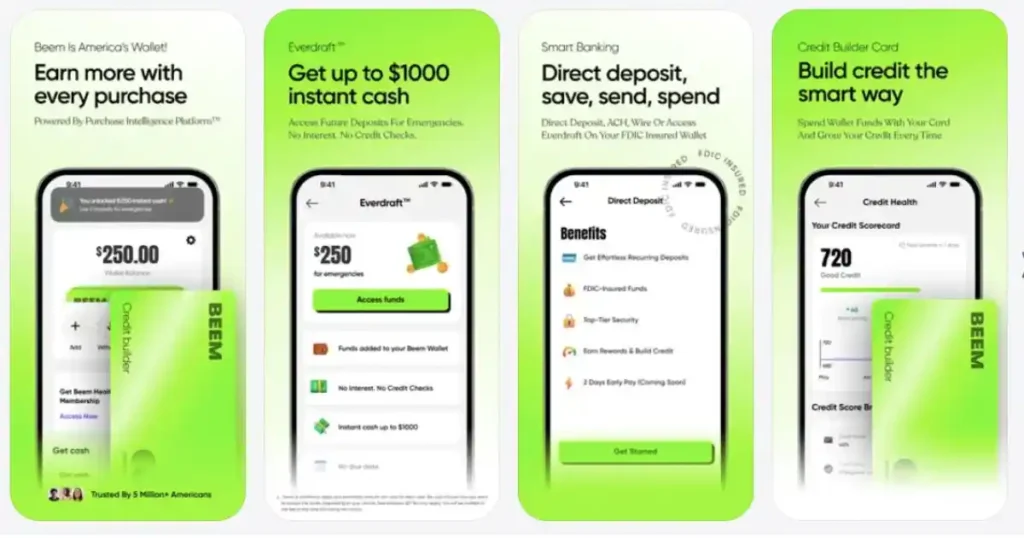
For users facing an urgent bill, a car breakdown, or a medical expense, same-day delivery gets the money moving immediately without the predatory fees that payday lenders or credit card cash advances would charge.
The key insight: having both options available on a per-advance basis means you control the cost. You are not locked into always paying for speed or always waiting three days. Each advance is its own decision, and the right choice depends on what is happening that specific week.
Over a year, a user who defaults to standard delivery and switches to express only when genuinely necessary saves significantly compared to someone who hits “instant” every time out of habit.
The Future: Is the Standard Transfer Going Away?
Short answer: no. But it is getting faster, and the gap between instant and standard is shrinking.
The expansion of FedNow, the Federal Reserve’s real-time payment network launched in July 2023, is gradually shifting the baseline speed of all bank transfers.
As more banks and credit unions integrate FedNow (over 900 institutions had joined by early 2025, with thousands more expected by 2027), “standard” transfers that currently take 1-3 business days may drop to same-day or next-day as the default processing speed.
Some banks are already ahead of this curve. Several digital banks and credit unions now offer same-day ACH processing at no additional cost, effectively making their “standard” transfer faster than many platforms’ paid instant option from a few years ago.
When standard transfers become same-day by default, the instant transfer fee becomes much harder to justify. Why pay 1.75% for a 30-second transfer when the free option arrives in four hours? This competitive pressure is already pushing some platforms to reduce or eliminate instant transfer fees entirely. Zelle’s free instant transfers are an early example of where the entire market is heading.
For consumers, the trend is entirely positive. The speed gap between instant and standard is narrowing while the cost difference remains significant.
Within a few years, the instant transfer vs standard transfer question may become irrelevant for most routine transactions, with near-instant becoming the free default and premium fees reserved only for truly immediate, seconds-matter situations.
Until then, the smartest approach remains the same: default to standard, switch to instant when the math justifies it, and use tools like Beem’s BudgetGPT and Everdraft™ to plan your finances well enough that emergencies requiring instant speed become rare rather than routine.
Frequently Asked Questions About Instant Transfers vs Standard Transfers
What is the difference between an instant transfer and a standard transfer?
A standard transfer uses the ACH network, takes 1-3 business days, and is typically free. An instant transfer uses debit card networks (Visa Direct, Mastercard Send) or real-time payment rails (RTP, FedNow), arrives in 30 seconds to 30 minutes, and costs $0.25 to $25 depending on the platform and amount. The core tradeoff in the instant transfer vs standard transfer decision is speed versus cost.
How much does an instant transfer cost?
Instant transfer fees vary by platform. Venmo and PayPal charge 1.75% (minimum $0.25, maximum $25). Cash App charges 0.5% to 1.75%. Cash advance apps charge $0 to $5.99 for express delivery. Zelle is free at most participating banks. On a $500 transfer, typical instant fees range from $2.50 to $8.75 depending on the platform.
Is an instant transfer worth the fee?
An instant transfer is worth the fee when the cost of waiting exceeds the cost of the fee. Paying $3.50 for an instant transfer to avoid a $35 overdraft fee saves $31.50. Paying $2 for same-day delivery to avoid a $40 late payment saves $38. For routine, non-urgent transfers where timing is flexible, standard transfers are always the cheaper choice.
Do instant transfers work on weekends and holidays?
Yes. Instant transfers process 24/7/365, including weekends and federal holidays. Standard ACH transfers do not process on weekends or holidays, which can add two to four days to delivery times for transfers initiated on Friday evenings or before holiday weekends. This around-the-clock availability is one of the biggest practical advantages of instant transfers.
How long does a standard transfer take?
A standard ACH transfer takes 1-3 business days under normal conditions. However, transfers initiated on Friday evenings, weekends, or before federal holidays can take up to five calendar days because ACH does not process on non-business days. Some banks and fintech platforms are beginning to offer same-day ACH, which reduces standard transfer times but is not yet universal.
How do cash advance apps handle instant vs standard delivery?
Most cash advance apps offer both options on every advance. Standard delivery (free, 1-3 business days via ACH) and express delivery ($0 to $5.99, same day or within hours). Beem’s Everdraft™ lets users choose per advance: free standard for planned expenses or same-day delivery for emergencies. Defaulting to standard and using express only when necessary keeps annual delivery costs minimal.
Will standard transfers eventually become instant by default?
The trend is moving in that direction. FedNow and expanding RTP adoption are gradually reducing standard transfer times. Over 900 financial institutions had joined FedNow by early 2025, with thousands more expected.
As real-time infrastructure scales, the speed gap between instant and standard will narrow, potentially making instant transfer fees difficult for platforms to justify within the next few years.
Disclaimer: Transfer speeds, fees, and platform features are subject to change. Always verify current terms with your bank or app provider. This article is for informational purposes only and does not constitute financial advice. Beem is not a bank. Banking services are provided by FDIC-insured partner institutions.