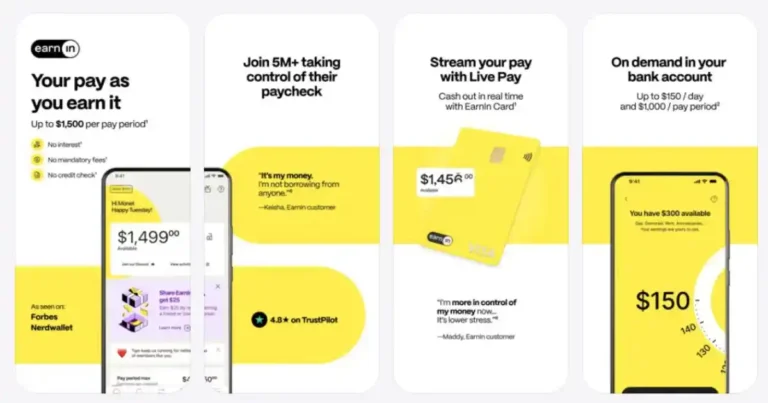

EarnIn is one of the most popular earned wage access apps in the U.S., but not everyone qualifies. To use EarnIn’s Cash Out feature, you need a verifiable employer, consistent direct deposits, and a bank account that meets specific criteria.
This means millions of Americans, including gig workers, freelancers, self-employed individuals, and those paid in cash or by paper check, may not be eligible.
This article breaks down exactly what EarnIn requires, who gets left behind, and what alternatives exist for workers who fall outside EarnIn’s model.
What Are EarnIn’s Income Requirements?
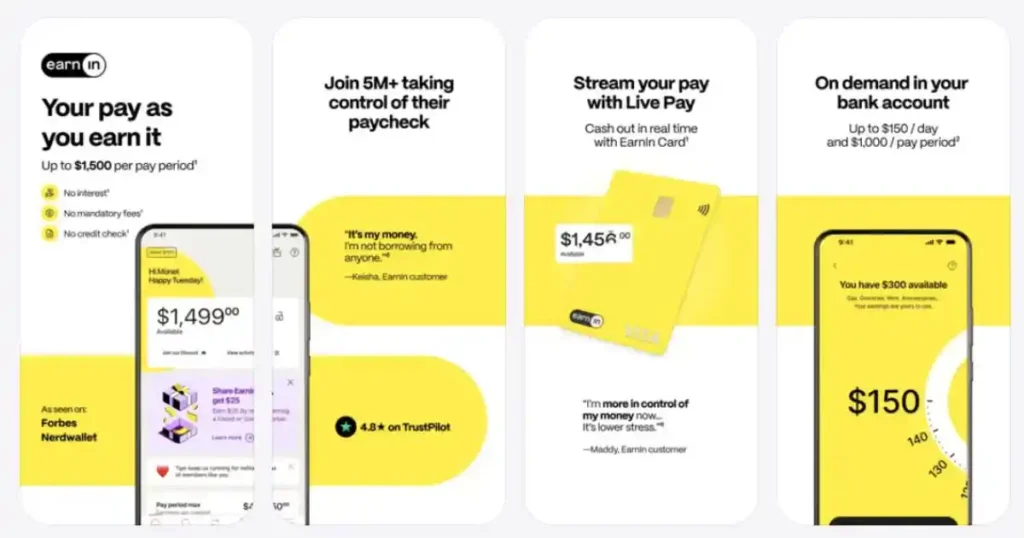
EarnIn requires users to have a verified source of regular income that can be tracked and confirmed through the app. Unlike traditional lenders, EarnIn does not run a credit check or evaluate your credit score.
However, the app does have specific income and employment verification requirements that determine whether you can access funds.
At its core, EarnIn needs to confirm two things: that you are actively earning money and that your paycheck is being deposited into a linked bank account on a predictable schedule. If the app cannot verify both of these conditions, you will not be able to use the Cash Out feature.
This verification-first approach works well for traditional employees with steady schedules and digital timekeeping. But it creates a significant barrier for anyone whose income does not follow a conventional pattern.
How Does EarnIn Verify Your Income?
EarnIn uses multiple methods to confirm that you have earned wages available for early access. The verification process typically involves the following steps:
Step 1: Link Your Bank Account
You must connect a checking account that receives regular direct deposits from your employer. EarnIn reviews your deposit history to confirm a consistent paycheck schedule. Prepaid cards, savings accounts, and accounts without direct deposit are generally not supported.
Step 2: Verify Your Employment
EarnIn needs to confirm where you work and how many hours you have logged. The app does this through one or more of the following methods:
- Electronic timekeeping integration: If your employer uses a digital timekeeping system (such as Kronos, ADP, or similar platforms), EarnIn can pull your hours directly.
- GPS location verification: EarnIn may use your phone’s location data to confirm you are physically present at your workplace during scheduled hours.
- Pay stub or work email verification: In some cases, you may need to upload a recent pay stub or verify your employment through a work email address.
Step 3: Establish a Pay Cycle Pattern
EarnIn analyzes your deposit history to identify your pay cycle (weekly, biweekly, or semi-monthly). The app uses this pattern to calculate how much of your earned wages are available for early access at any given point in your pay period.
If any of these steps cannot be completed, such as if your employer does not use digital timekeeping, if you do not receive direct deposit, or if your income is irregular, EarnIn may limit or deny access to the Cash Out feature.
Who Qualifies for EarnIn?
Based on the requirements above, the users who are most likely to qualify for EarnIn include:
Traditional W-2 employees with a fixed schedule and consistent direct deposits. If you work for a mid-size or large company that uses electronic timekeeping, you are the ideal EarnIn user.
Hourly or shift workers whose hours are tracked digitally. Retail, hospitality, healthcare, and warehouse workers often fit this profile, provided their employer’s system integrates with EarnIn.
Salaried employees with predictable biweekly or semi-monthly paychecks deposited via direct deposit into a supported checking account.
In short, EarnIn works best for people with stable, verifiable, employer-dependent income.
Who Gets Left Behind by EarnIn’s Requirements?
This is where EarnIn’s model reveals its limitations. A significant portion of the American workforce does not fit neatly into the traditional employer-employee structure that EarnIn relies on. Here are the groups most likely to be excluded:
Gig Workers and Independent Contractors
If you drive for Uber, deliver for DoorDash, freelance on Upwork, or work through any gig platform, you are technically self-employed.
EarnIn’s system is built around employer verification, which means it cannot track your earnings the same way it tracks a W-2 employee’s hours. Even if you earn a steady income through gig work, EarnIn may not be able to verify it.
According to the Bureau of Labor Statistics, over 57 million Americans participate in freelance or gig work. That is a massive segment of the workforce that earned wage access apps like EarnIn were not designed to serve.
Freelancers and Self-Employed Professionals
Graphic designers, writers, consultants, photographers, tutors, and other freelancers often earn well but receive payments irregularly and from multiple clients.
EarnIn’s requirement for a single, consistent direct deposit from one employer makes it impractical for this group.
Workers Paid by Paper Check or Cash
Many small businesses, particularly in industries like construction, food service, agriculture, and domestic work, still pay employees by paper check or cash.
Without a direct deposit trail, EarnIn cannot verify income or establish a pay cycle, effectively excluding these workers from the platform.
Workers With Irregular or Variable Schedules
Even some W-2 employees get left behind. If your hours vary significantly from week to week, or if your employer does not use a digital timekeeping system, EarnIn may not be able to accurately calculate your earned wages.
This is common for part-time workers, seasonal employees, and those working multiple jobs.
People Without a Traditional Checking Account
EarnIn requires a linked checking account with direct deposit. According to the FDIC’s most recent survey, approximately 4.5% of U.S. households (roughly 5.9 million households) are unbanked, meaning they do not have a checking or savings account at an insured institution.
An additional 14.1% are underbanked, relying on alternative financial services. For these Americans, EarnIn is simply not an option.
How Many Americans Does EarnIn’s Model Exclude?
When you add up the numbers, the scale of exclusion becomes clear:
| Group | Estimated Size |
| Gig workers and freelancers | 57+ million |
| Workers paid by cash or paper check | 10+ million (estimated) |
| Unbanked households | ~5.9 million households |
| Underbanked households | ~18.7 million households |
| Part-time/variable-schedule workers | 26+ million |
While there is overlap between these groups, the picture is unmistakable: tens of millions of working Americans fall outside the eligibility window of employer-dependent earned wage access apps like EarnIn.
What Are the Alternatives for Workers Who Don’t Qualify for EarnIn?
If you do not meet EarnIn’s income requirements, you still have options. Several fintech platforms have built cash advance and financial wellness tools that do not depend on employer verification.
Beem

Beem offers Everdraft, a cash advance feature that provides up to $1,000 with no interest and no credit check. The key difference from EarnIn is that Beem does not require employer verification.
Approval is based on your income history, not your employer’s timekeeping system. This makes Beem accessible to gig workers, freelancers, self-employed professionals, and anyone with a non-traditional income structure.
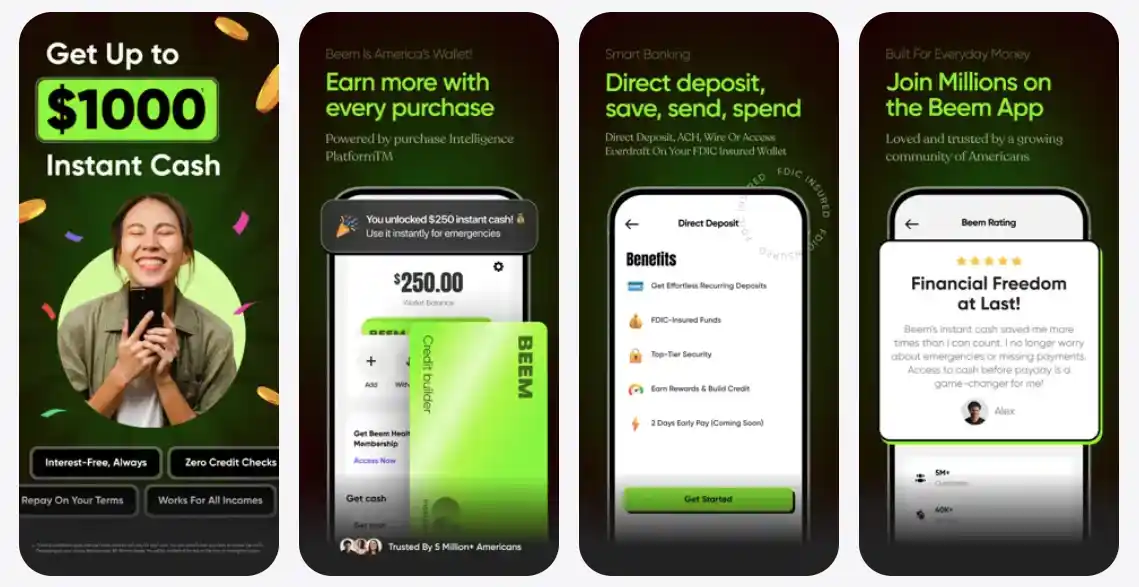
Beyond cash advances, Beem provides a full suite of financial tools that are especially valuable for workers with irregular income:
- BudgetGPT analyzes your spending patterns and provides AI-powered budgeting recommendations tailored to your cash flow.
- PriceGPT helps you compare prices before making purchases, stretching every dollar further.
- DealsGPT surfaces cashback offers and discounts across thousands of brands.
- Credit building tools help you improve your credit score over time, even without traditional credit products.
- Beem Pass lets you share access with family or friends, which is useful for households managing shared or irregular finances.
All of Beem’s financial services are FDIC-backed, giving users the same deposit insurance protection offered by traditional banks.
Other EarnIn Alternatives Worth Considering
- Dave: Offers cash advances up to $500 without employer verification, though it charges a monthly subscription fee and optional express fees.
- Brigit: Provides up to $250 in advances with automatic repayment. Requires a connected bank account with regular deposits but does not require employer integration.
- Current: A mobile banking platform with early direct deposit (up to two days early) and overdraft protection, though advance limits are lower.
Each of these alternatives has its own trade-offs in terms of limits, fees, and features. But the common thread is that none of them require the employer verification that EarnIn depends on.
Why Employer-Dependent Models Are Falling Behind
The American workforce is changing. The traditional model of one employer, one paycheck, and one schedule no longer describes the financial reality of millions of workers. The rise of the gig economy, remote work, freelancing, and portfolio careers means that income increasingly comes from multiple sources on unpredictable timelines.
Earned wage access apps like EarnIn were designed for a workforce that looks increasingly different from the one that exists today. While EarnIn serves its core audience well (traditional employees with direct deposit and digital timekeeping), its model leaves behind the fastest-growing segments of the labor market.
Fintech platforms that decouple cash advance access from employer verification, like Beem, are better positioned to serve the modern workforce. By evaluating income history rather than requiring employer participation, these apps can reach gig workers, freelancers, small business owners, and anyone else whose financial life does not fit into a 9-to-5 box.
The Consumer Financial Protection Bureau (CFPB) has also signaled increased scrutiny of earned wage access products, particularly around how tips and fees are disclosed. As regulatory attention grows, the distinction between employer-dependent and employer-independent models will become even more important for consumers evaluating their options.
How to Decide if EarnIn Is Right for You
Before downloading EarnIn, ask yourself these questions:
- Do I receive regular direct deposits from a single employer? If yes, you are likely eligible. If not, EarnIn may not work for you.
- Does my employer use electronic timekeeping? If your workplace tracks hours digitally, EarnIn can verify your earnings more easily. If your employer uses paper timesheets or does not track hours at all, verification may fail.
- Is my income consistent and predictable? EarnIn works best when it can identify a clear pay cycle. Highly variable income makes it difficult for the app to calculate available funds.
- Do I need more than $150 per day? EarnIn caps daily Cash Out at $150 (or up to $1,000 per pay period with the standard plan, and potentially more with the EarnIn Card). If your needs exceed these limits, a platform with higher advance ceilings may be a better fit.
If you answered “no” to any of these questions, you may want to explore alternatives that do not depend on employer verification.
FAQ: EarnIn Income Requirements
What income do you need to use EarnIn?
EarnIn does not set a minimum income amount, but you need a verifiable source of regular earnings. This means having an employer whose hours can be tracked through electronic timekeeping, GPS verification, or pay stubs, along with consistent direct deposits into a linked checking account.
Does EarnIn require direct deposit?
Yes. EarnIn requires your paycheck to be deposited via direct deposit into a linked checking account. Paper checks, cash payments, and prepaid card deposits are not supported. The app uses your deposit history to verify your pay cycle and calculate available funds.
What is the best EarnIn alternative for freelancers?
Beem is one of the strongest alternatives for freelancers and gig workers. Everdraft offers cash advances up to $1,000 with no employer verification, no interest, and no credit check. Beem also includes AI budgeting tools (BudgetGPT), cashback rewards, credit building, and FDIC-backed security, making it a comprehensive financial platform for non-traditional workers.
How much can you cash out with EarnIn?
EarnIn allows up to $150 per day and up to $1,000 per pay period through the standard Cash Out feature. Users with the EarnIn Card (Live Pay) may access higher limits of up to approximately $1,500 per pay period, though additional eligibility requirements apply.
Is EarnIn safe to use?
EarnIn uses encryption and standard security protocols to protect user data. However, EarnIn’s core service is not FDIC-backed. The app’s voluntary tip model has also drawn attention from consumer advocacy groups and the CFPB regarding fee transparency. Users should review the latest terms and disclosures before using the app.
Disclaimer: This article is for informational purposes only and does not constitute financial advice. Eligibility requirements, cash advance limits, and terms may vary and are subject to change. Always review the latest terms on each app’s official website before making financial decisions. Data on gig workers, unbanked households, and workforce statistics are sourced from the Bureau of Labor Statistics and the FDIC.