

Table of Contents
If you’ve ever seen “FDIC insured” in a fintech app and felt a wave of relief, that reaction makes sense. FDIC insurance is one of the strongest consumer protections in U.S. finance.
But fintech has changed how people bank. Today, you can open an “account” through an app that isn’t a bank, move money through a digital wallet, and access multiple financial products in one place. That convenience can also create confusion: what exactly is insured, who provides the insurance, and what does it protect you from?
This guide is the plain-English answer, written for real fintech users who want to verify the truth rather than rely on slogans.
What FDIC Insurance Is (The Clean Definition)
FDIC deposit insurance protects insured deposits if an FDIC-insured bank fails. Coverage is automatic for deposit accounts held at an FDIC-insured bank, up to the standard limits.
The standard insurance amount is $250,000 per depositor, per FDIC-insured bank, per ownership category. That’s the core definition. Everything else is details and edge cases.
What FDIC Insurance Covers (And Why That’s Good News)
FDIC insurance generally covers common deposit products like checking and savings accounts, money market deposit accounts, and CDs.
If an FDIC-insured bank fails, the FDIC’s job is to protect insured depositors, often by transferring deposits to another institution or making insured funds available quickly (the FDIC explains this in its FAQs and consumer materials).
What FDIC Insurance Does Not Cover (The Part People Miss)
FDIC insurance is not a blanket “everything is safe” promise. It does not cover:
- Stocks, bonds, mutual funds, and similar investments
- Crypto assets
- Losses caused by market movement
- Most non-deposit products marketed inside apps
Also important: FDIC insurance is triggered by bank failure, not by every kind of loss scenario. If a non-bank fintech company has an operational outage or business failure, FDIC insurance isn’t automatically what makes you whole unless your funds are truly held as insured deposits at an FDIC-insured bank and the coverage conditions are met.
People Also Read: The Complete Cash Advance App Checklist
The Most Common FDIC Mistake: Thinking It’s “Per Account”
People hear “$250,000 FDIC insurance” and assume they get $250,000 per account.
FDIC’s rule is more specific: $250,000 per depositor, per insured bank, per ownership category.
That means:
- If you have multiple accounts at the same bank in the same ownership category, the FDIC adds them together.
- You can qualify for more coverage at one bank if the deposits are in different ownership categories (FDIC lists the ownership categories and explains how they work).
A Simple Example (No Fine Print Required)
You have $200,000 in checking and $100,000 in savings at the same FDIC-insured bank, both single ownership accounts. That’s $300,000 total in the same category at the same bank, so $50,000 would be uninsured. That’s why the bank matters, not the app’s branding.
Why Fintech Makes This Confusing: Pass-Through Insurance
Many fintech apps aren’t banks, but they work with partner banks to provide deposit products. In those setups, FDIC insurance can still apply through pass-through coverage.
Here’s the honest version:
Pass-through coverage can protect each end user (the beneficial owner) if ownership, disclosure, and recordkeeping requirements are met. If those requirements aren’t met, the deposits may be insured as belonging to the named account holder on the bank’s records, and coverage can be aggregated in a way users don’t expect.
This is why “FDIC insured” should always come with:
- the name of the bank,
- clarity that it’s a deposit product,
- and clarity about how deposits are held.
The One-Minute FDIC Insurance Test For Any Fintech App
If you only take one thing from this blog, take this.
Step 1: Find The Bank Name
A trustworthy app should name the bank that provides the deposit product.
Step 2: Confirm The Bank Is FDIC-Insured
Use FDIC resources (FDIC calls out tools like its consumer resources and bank lookup guidance).
Step 3: Confirm You’re Looking At A Deposit Product
Checking/savings/CDs are deposits. Many other products inside apps are not.
Step 4: Check For “Pass-Through” Clarity If It’s A Fintech Structure
If the app uses pooled/custodial structures, pass-through coverage depends on recordkeeping/disclosure rules.
If any of these steps feel impossible, treat “FDIC insured” as unverified until it’s clear.
People Also Read: Beem Everdraft Explained
A Consumer Table That Makes FDIC Practical
| What You’re Trying To Protect | FDIC Helps If… | FDIC Does Not Help If… |
| Cash in checking/savings | It’s held as a deposit at an FDIC-insured bank within limits | It’s not a deposit product, or is held outside FDIC coverage rules |
| Large balances | You understand per-bank aggregation and ownership categories | You assume “per account” and exceed limits at one bank |
| Funds held via fintech partner bank | Pass-through requirements are met (ownership, disclosure, recordkeeping) | Requirements aren’t met, so coverage aggregates under another account holder |
| Crypto/investments | Not applicable | FDIC does not insure crypto or securities |
Why Regulators Are Getting Stricter About “FDIC” Language
As fintech expanded, “FDIC insured” started showing up next to products that aren’t deposits, or in ways that could confuse consumers. The FDIC has been updating guidance and rules around official signs and advertising requirements, misrepresentation of insured status, and the use of the FDIC’s name/logo (Part 328).
There’s also continuing rule activity and updates around how non-deposit products should be labeled in digital channels to prevent consumer confusion.
For fintech users, this direction is positive: it pushes the market toward clearer separation between insured deposits and non-deposit products.
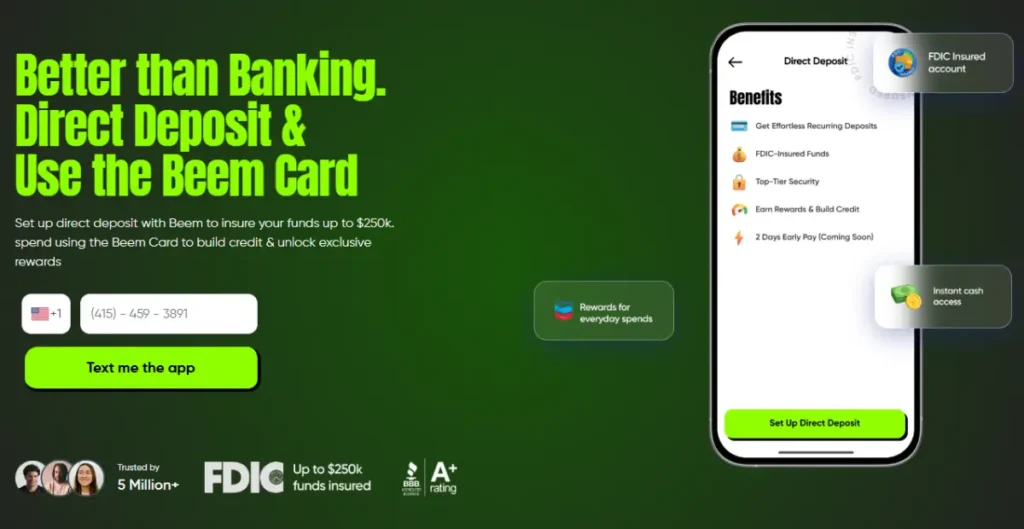
What FDIC Insurance Means Inside BEEM (Our Clear, Verifiable Disclosure)
BEEM is a financial technology company, not a bank. When we offer a deposit product, we do it through regulated partners.
On our Direct Deposit page, we state clearly:
- The deposit product is provided by Cross River Bank, Member FDIC
- The deposit product is FDIC-insured up to $250,000 through Cross River Bank
- Upwardli is the program manager of the Beem Card, not an FDIC-insured bank
- A line of credit is not a deposit product
That separation is intentional. “FDIC insured” is too important to be vague. When the product is a deposit product, we name the bank and the coverage. When it’s not, we say that too.
The 10 Most Common FDIC Myths (And The Correct Truth)
Myth 1: “FDIC Insurance Protects Me If The App Goes Out Of Business”
Reality: FDIC insurance is designed to protect insured deposits if an FDIC-insured bank fails, not if a non-bank app or fintech company fails. The protection is tied to the bank and the deposit account, not the app brand.
Myth 2: “FDIC Insurance Covers Fraud, Scams, Or Unauthorized Transfers”
Reality: FDIC deposit insurance is about bank failure and insured deposit balances, not a universal guarantee against fraud, theft, or scams. Those risks are addressed through security controls, account monitoring, and dispute processes, not FDIC insurance.
Myth 3: “If It Says ‘FDIC Insured,’ The App Itself Is FDIC-Insured”
Reality: Only banks (FDIC-insured depository institutions) are FDIC-insured. Fintech apps often provide deposit products through a partner bank; FDIC coverage depends on where the money is held and how it’s titled and recorded.
Myth 4: “FDIC Covers Crypto Or Investment Balances”
Reality: FDIC insurance covers deposit products (checking, savings, money market deposit accounts, CDs). It does not cover investments like stocks, bonds, mutual funds, and it does not insure crypto assets.
Myth 5: “I Get $250,000 Of Coverage Per Account”
Reality: The standard limit is $250,000 per depositor, per FDIC-insured bank, per ownership category, not per account. Multiple accounts you own in the same category at the same bank are generally added together.
Myth 6: “Opening Multiple Accounts In The Same Bank Increases Coverage”
Reality: Not if they’re in the same ownership category at the same bank. FDIC aggregates deposits owned by the same depositor in the same ownership capacity at the same insured bank.
Myth 7: “Using Multiple Fintech Apps Always Increases My FDIC Coverage”
Reality: If multiple apps use the same partner bank for deposit accounts, your deposits may still be aggregated under that bank for FDIC limit purposes (because the rule is per depositor per insured bank).
Myth 8: “Anything Labeled ‘Wallet Balance’ Is FDIC-Insured”
Reality: “Wallet” is a product label, not an FDIC category. FDIC insurance applies when your money is held as an insured deposit at an FDIC-insured bank within coverage limits, and the account structure must support proper ownership/recordkeeping.
Myth 9: “Prepaid Cards Are Always FDIC-Insured”
Reality: It depends on whether the funds behind the card are actually held as insured deposits at an FDIC-insured bank and whether recordkeeping supports the beneficial owners. The safer mindset is: prepaid card coverage is structure-dependent, not guaranteed by the card itself.
Myth 10: “FDIC Insurance Covers ‘Everything In The App’ If A Partner Bank Is Named”
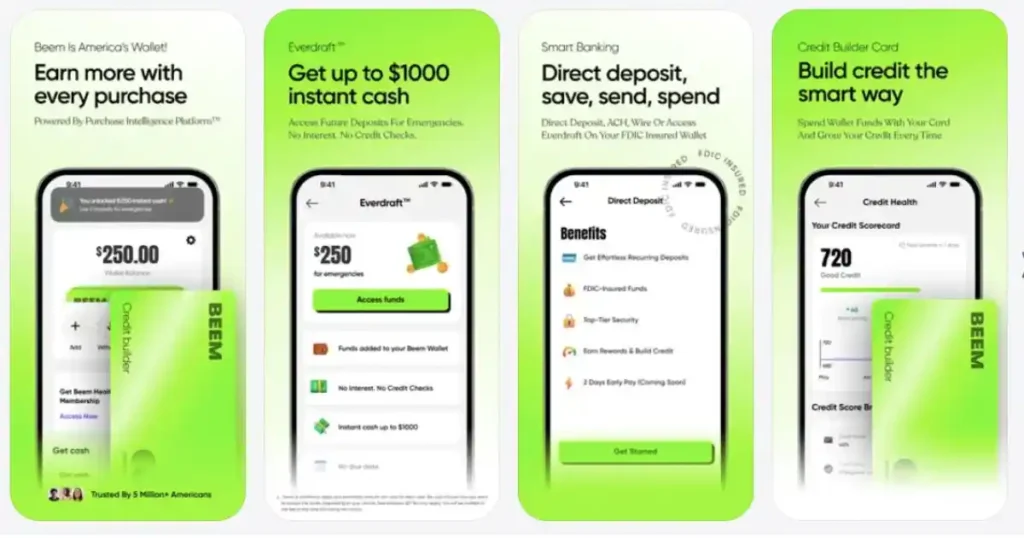
Reality: FDIC coverage is product-specific. Deposit accounts can be insured; non-deposit products are not. A clear fintech disclosure should separate deposit products from non-deposit products. (Beem does this explicitly: deposit product via Cross River Bank, Member FDIC; line of credit is not a deposit product; Upwardli is a program manager, not an FDIC-insured bank.)
People Also Read: How Cash Advance Apps Protect Your Banking Data
Conclusion
FDIC insurance is real protection, but it’s not magic. It protects insured deposits if an FDIC-insured bank fails, up to $250,000 per depositor, per bank, per ownership category.
For fintech users, the trust move is simple: verify the bank, verify the product is a deposit, and understand how coverage applies in partner-bank structures. If an app makes those answers easy to find, that’s a strong sign it’s treating FDIC insurance with the seriousness it deserves.
On the Beem app, that’s our standard: name the bank, name the coverage limit, and clearly separate deposit products from non-deposit products, so “FDIC insured” stays a fact you can confirm, not a phrase you have to interpret.
What People Also Ask About FDIC Insurance
1. Is FDIC Insurance The Same As “Bank-Level Security”?
No. FDIC insurance protects insured deposits if an FDIC-insured bank fails. Security (like biometrics, encryption, fraud monitoring, and account recovery controls) helps protect against scams and account takeover, a different category of risk.
2. How Can I Check If A Bank Is FDIC-Insured?
Use the FDIC’s BankFind Suite. Search the bank name to confirm it’s an FDIC-insured institution and view its details. This is the fastest way to verify “Member FDIC” claims without relying on marketing.
3. Do I Need To Apply For FDIC Insurance?
No. FDIC insurance is generally automatic for eligible deposits held at an FDIC-insured bank, up to coverage limits. You don’t enroll; you verify that your money is actually held as insured deposits at an insured bank.
4. What If I Have More Than $250,000?
FDIC coverage is $250,000 per depositor, per FDIC-insured bank, per ownership category. If you have more than $250,000, you can reduce risk by spreading deposits across different FDIC-insured banks or using different ownership categories when appropriate. The FDIC’s consumer guidance explains coverage limits and ownership categories clearly.
5. Does FDIC Cover Prepaid Cards Or Wallet Balances?
Sometimes, but only when the underlying funds are actually held as insured deposits at an FDIC-insured bank and the structure supports proper ownership and recordkeeping (pass-through coverage where applicable). In fintech, “wallet” and “prepaid” labels aren’t enough; the insured bank and deposit structure are what determine coverage.