


Table of Contents
Overdraft fees are one of the most avoidable financial costs in a household budget, and both EarnIn and Beem have built tools specifically designed to eliminate them. The question is not whether these platforms help with overdraft prevention. Both do. The question is which approach fits your financial life better, covering your actual spending needs, your income structure, your eligibility profile, and the broader financial management support you need alongside the overdraft prevention function itself.
EarnIn’s Balance Shield is a well-known feature with a specific design philosophy built around earned wage access. Beem’s overdraft prevention approach is built around a broader financial toolkit that addresses the same underlying problem through multiple simultaneous strategies. Understanding the practical differences between these approaches, in terms of how they work, what they cost and who they are accessible to gives you the information needed to make a genuinely informed choice.
Understanding EarnIn Balance Shield
What is EarnIn?
EarnIn is a financial app built around the earned wage access model. The core premise is that users should be able to access wages they have already earned before their scheduled payday rather than waiting for the pay cycle to complete. EarnIn connects to the user’s employer and bank account, tracks hours worked and wages earned, and allows users to access a portion of those earned wages in advance.
How Balance Shield Works
Balance Shield is EarnIn’s automated overdraft prevention feature. Users set a minimum balance threshold, typically between $100 and $400, and when their bank account balance drops below that threshold, EarnIn automatically sends a cash advance to bring the balance back above the set level. The advance draws from the user’s earned but unpaid wages, and repayment occurs automatically on the next payday.
EarnIn Balance Shield Key Details
Balance Shield advances are capped at $100 per day with a maximum of $750 per pay period, subject to EarnIn’s Max eligibility criteria. The service operates on a tip-based model, meaning there is no mandatory fee but EarnIn encourages voluntary tips on each transaction. Cash advances through EarnIn are based on verified earned wages, which means eligibility is tied to employment status and the ability to verify income through EarnIn’s employer or timekeeping connection system.
Who EarnIn Balance Shield Is Designed For
Balance Shield is designed for traditionally employed W-2 workers with consistent, verifiable wages from an employer that EarnIn can connect to. Users must have a regular pay schedule, direct deposit, and earnings that EarnIn can verify through its employment verification system. This design works well for users whose financial profile matches that description but creates eligibility barriers for others.
People Also Read: EarnIn Income Requirements: Who Gets Left Behind?
Understanding Beem’s Overdraft Prevention Approach
What is Beem?
Beem is a comprehensive digital money platform offering a full suite of financial tools including Everdraft instant cash advances, AI-powered budgeting and spending tools, credit building, smart money transfers, and rewards. Beem’s approach to overdraft prevention is not a single feature but a combination of proactive tools that address the low-balance risk from multiple angles simultaneously.
How Beem Prevents Overdrafts
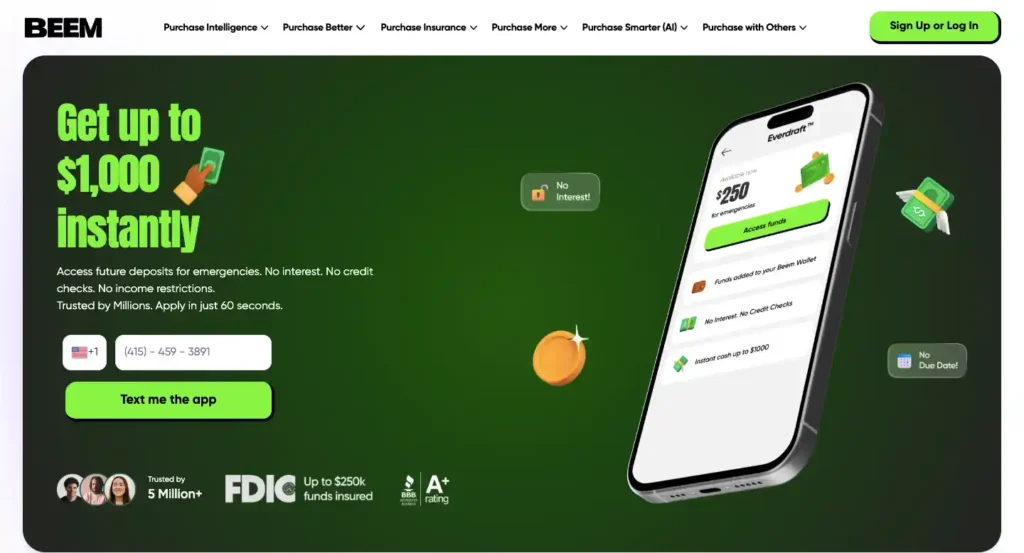
Beem’s overdraft prevention strategy operates on two levels. The first is proactive financial awareness through BudgetGPT, which tracks spending in real time and identifies low-balance risk before it triggers an overdraft event. The second is immediate access to Everdraft advances when a gap is identified, giving users a zero-interest, zero-mandatory-fee cash advance of up to $1,000 to cover the shortfall before a transaction is declined or an overdraft fee is charged.
Beem Everdraft Key Details
Everdraft provides cash advances of up to $1,000 for eligible users with no interest, no mandatory fees, and no credit check. Eligibility is based on income patterns, bank account activity, and financial behavior rather than employment verification or earned wage calculation. Advances are delivered via standard transfer in one to three business days or via optional instant transfer. Repayment aligns with incoming deposits rather than a fixed payday schedule.
Who Beem Is Designed For
Beem is designed for a broad range of users including salaried employees, freelancers, gig workers, contractors, benefit recipients, and anyone with a regular pattern of income deposits into a US bank account. The behavior-based eligibility model makes Beem accessible to users who do not fit the traditional W-2 employment profile that EarnIn’s wage verification system requires.
Head-to-Head Comparison: EarnIn Balance Shield vs Beem
| Feature | EarnIn Balance Shield | Beem Everdraft |
| Maximum advance amount | $100 per day, $750 per pay period | Up to $1,000 per advance |
| Mandatory fees | None (tip encouraged) | None |
| Interest charged | None | None |
| Credit check | No | No |
| Eligibility basis | Verified earned wages, W-2 employment | Income patterns, bank account activity |
| Employment requirement | Yes, employer verification required | No |
| Eligible income types | W-2 wages only | Employment, freelance, gig, benefits |
| Automation | Automatic when balance drops below threshold | User-initiated with BudgetGPT alerts |
| Advance delivery | Instant to EarnIn account | 1 to 3 days standard, instant optional |
| Repayment timing | Fixed next payday | Aligned with incoming deposits |
| Real-time budget tracking | Limited | Yes, BudgetGPT |
| Credit building | No | Yes |
| AI financial tools | No | Yes (BudgetGPT, PriceGPT, DealsGPT, JobsGPT) |
| FDIC-backed funds | Yes | Yes |
| Family or group access | No | Yes (Beem Pass) |
Where EarnIn Balance Shield Performs Well
Fully Automated Low-Balance Protection
Balance Shield’s strongest feature is its automation. Users set their threshold once and the system monitors their balance continuously, triggering an advance automatically without requiring any manual action. For users who prefer a set-and-forget approach to overdraft prevention, this automation is genuinely valuable and removes the need for active monitoring.
Earned Wage Basis Limits Overborrowing
Because Balance Shield advances are drawn from wages already earned, the product has a built-in ceiling that prevents users from accessing more than they have already generated through work. For users who are concerned about overborrowing or creating repayment obligations that exceed upcoming income, this earned wage basis provides a structural safeguard that is meaningfully different from an open credit facility.
Established Platform With Track Record
EarnIn has been operating in the earned wage access space for several years and has a large established user base. For users who prioritize platform longevity and familiarity, EarnIn’s track record is a relevant consideration alongside its specific feature set.
People Also Read: Beem vs EarnIn: Which Cash Advance App Serves More Americans?
Where Beem’s Approach Outperforms
Higher Advance Limits for Real-World Needs
A $100 per day advance cap does not cover the actual cost of the financial gaps that overdraft events typically represent. A grocery run, a utility bill, or a car repair all exceed that ceiling in today’s cost environment. Beem’s $1,000 Everdraft limit covers the realistic range of household financial gaps rather than providing a partial solution that still leaves the underlying problem unresolved.
Broader Eligibility for Non-Traditional Income Earners
Employer verification creates a hard eligibility barrier for freelancers, gig workers, contractors, and anyone whose income does not come from a traditional W-2 employer. In 2026, that barrier excludes a substantial and growing share of the workforce. Beem’s behavior-based eligibility model assesses bank account activity rather than employment structure, which means consistent access regardless of how income arrives or who it comes from.
Proactive Gap Prevention Rather Than Reactive Coverage
Reactive overdraft protection responds after the balance drops. BudgetGPT identifies the spending trajectory that will create a low-balance situation before it arrives, giving users time to adjust behavior or request an advance before a bill fails or an overdraft fee is charged. Prevention is meaningfully superior to coverage because it eliminates the cost rather than cushioning it.
A Complete Financial Toolkit, Not Just One Feature
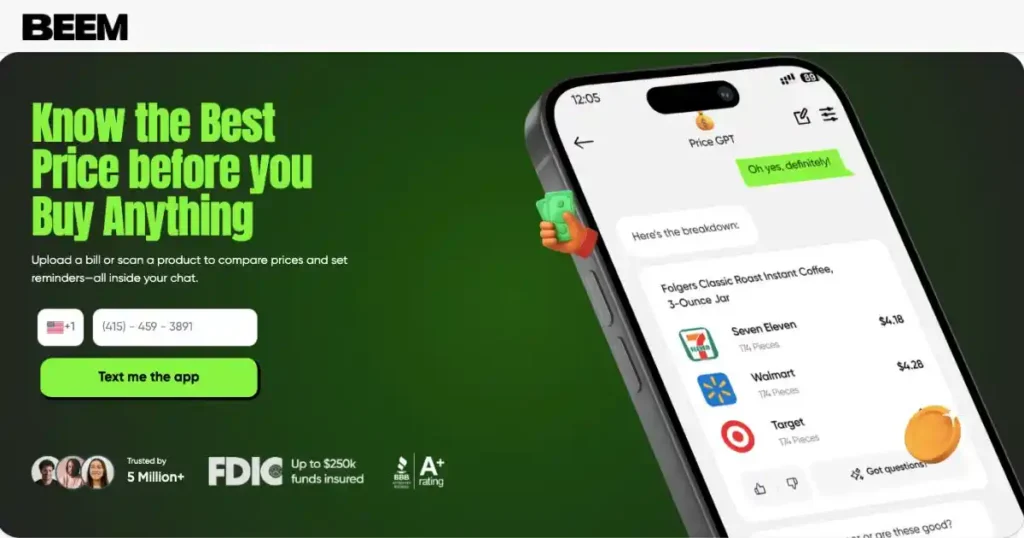
Beem pairs Everdraft with BudgetGPT, PriceGPT, DealsGPT, JobsGPT, credit building tools, and Beem Pass for shared family access. For users who want more than overdraft coverage, Beem delivers a comprehensive financial toolkit without requiring a separate app for each function.
Cost Analysis: What Each Platform Actually Costs
EarnIn Balance Shield Cost Structure
EarnIn operates on a voluntary tip model. There is no mandatory fee for Balance Shield advances, but EarnIn’s interface encourages tips on each transaction, typically suggesting amounts between $1 and $14 per advance. Users who consistently tip on every advance can accumulate meaningful costs over time, even if each individual tip feels minor. Lightning Speed delivery, EarnIn’s instant transfer option, is available for an additional fee. The effective cost of consistent EarnIn use depends significantly on tipping behavior.
Beem Cost Structure
Beem’s Everdraft charges zero interest and zero mandatory fees. The only optional cost is an instant transfer fee for users who choose expedited delivery rather than standard one to three business day delivery. There is no encouraged tipping, no subscription fee required for core Everdraft access, and no hidden costs that appear after transactions are confirmed. The total mandatory cost of using Everdraft for overdraft prevention is zero.
The Long-Term Cost Difference
For a user who experiences four overdraft-risk events per month, the annual cost comparison is straightforward. EarnIn at $4 average tip per advance equals $192 per year in voluntary costs. Beem at zero mandatory fees equals $0 per year in mandatory costs. Over two years, the difference is $384, assuming consistent EarnIn tip behavior at a modest average amount. For users who tip at the higher suggested amounts, the cost difference is proportionally larger.
People Also Ask: Gerald vs Dave vs EarnIn vs Brigit vs Beem: Best Cash Advance Comparison for 2026
Which Platform Is Right for You
Choose EarnIn Balance Shield If
You are a traditional W-2 employee with a consistent, verifiable paycheck from an employer in EarnIn’s network. You prefer fully automated overdraft protection that requires no active monitoring or manual advance requests. Your typical overdraft risk events involve relatively small amounts within EarnIn’s daily advance limit. You are comfortable with the tip-based cost model and prefer the earned wage access framing over a cash advance model.
Choose Beem If
Your income comes from freelance work, gig platforms, contract employment, benefits, or any source that does not fit the W-2 employer verification model. You need advance limits that cover real household financial gaps rather than just small balance shortfalls. You want proactive spending visibility through BudgetGPT rather than reactive balance monitoring. You are looking for a comprehensive financial platform that provides budgeting, credit building, and income discovery alongside overdraft prevention. You prefer a zero mandatory fee model with no encouraged tipping behavior.
Final Thoughts
EarnIn Balance Shield and Beem both address the real, costly problem of overdraft events. EarnIn does well for the specific user profile it was designed for: a traditional W-2 employee with verifiable wages, a consistent pay schedule, and overdraft risk events that fall within a $100 daily advance limit. Within that profile, Balance Shield’s automation is a genuine strength.
Beem serves a broader population with higher advance limits, zero mandatory fees, behavior-based eligibility that works across all income types, and a financial toolkit that goes significantly beyond overdraft prevention to address the underlying financial patterns that create low-balance risk in the first place. For users whose income does not fit the traditional employment mold, whose financial gaps exceed $100, or who want more than a single overdraft feature from their financial platform, Beem is the more complete and more accessible choice.
People Also Ask: EarnIn Balance Shield vs Beem
1. What is the main difference between EarnIn Balance Shield and Beem Everdraft?
EarnIn Balance Shield is an automated overdraft prevention feature for W-2 employees, capped at $100 per day and based on verified earned wages. Beem Everdraft is a zero-interest cash advance of up to $1,000 available to users across all income types, with no employer verification required and proactive BudgetGPT monitoring alongside the advance capability.
2. Does EarnIn Balance Shield work for gig workers and freelancers?
No. EarnIn’s Balance Shield requires employer verification and is designed for traditional W-2 employees with verifiable earned wages. Freelancers, gig workers, contractors, and benefit recipients generally do not qualify. Beem’s behavior-based approval process works with any consistent income deposit pattern, making it the more accessible option for non-traditional income earners.
3. Which app has lower fees for overdraft prevention?
Beem charges zero mandatory fees on Everdraft advances. EarnIn operates on a voluntary tip model with no mandatory fee but consistent interface prompts encouraging tips of $1 to $14 per advance. For users committed to zero mandatory cost overdraft prevention, Beem’s model is structurally more transparent, with no encouraged payment beyond the optional instant transfer fee for expedited delivery.
4. Can Beem replace EarnIn for overdraft protection?
For most users, yes. Beem’s combination of BudgetGPT for proactive low-balance monitoring and Everdraft for zero-interest advance access covers the same core overdraft prevention function as Balance Shield while adding higher advance limits, broader eligibility, and a comprehensive financial toolkit. Users who specifically value EarnIn’s automated threshold-based triggering may prefer that automation, but Beem’s proactive BudgetGPT alerts provide comparable advance warning.
5. Which platform is better for building long-term financial health?
Beem provides significantly more long-term financial health support. Credit building, BudgetGPT, PriceGPT, DealsGPT, and JobsGPT collectively address spending habits, borrowing costs, income opportunities, and credit profile improvement. EarnIn’s primary focus is earned wage access and overdraft prevention without the broader financial wellness toolkit that turns short-term stability into long-term financial progress.