

Table of Contents
The cash advance app market in 2026 is crowded. There are dozens of platforms competing for the same user, each claiming to be faster, more generous, and more transparent than the last. For someone standing at the beginning of that selection process, the noise is genuinely difficult to cut through.
This article cuts through it. Not by bashing competitors or making claims that cannot be substantiated, but by doing something more useful: explaining exactly what a standard cash advance product looks like structurally, what Beem’s Everdraft™ looks like structurally, and where the genuine differences live in terms that matter to a real person managing a real financial gap.
The comparison is honest in both directions. Standard cash advance apps have made meaningful progress since the payday loan era. Everdraft™ is not operating in a vacuum. But the differences between how Everdraft™ is built and how most standard cash advance products are built are real, specific, and consequential for the users who rely on these products in genuine financial need.
What a Standard Cash Advance App Looks Like in 2026
The Cost Structure
Most standard cash advance apps generate revenue through three mechanisms: monthly subscription fees, express delivery fees, and voluntary tip prompts. Subscriptions range from $1 to $9.99 per month, charged regardless of whether an advance is taken. A user who takes one advance every six weeks but pays a $9.99 monthly subscription spends roughly $60 per year in subscription costs to access a product they use eight or nine times annually.
Express delivery fees are the more insidious cost. Standard delivery on most apps takes one to three business days, which is functionally useless for actual emergencies. Instant delivery costs $1.99 to $8.99 per transaction. On a $100 advance, a $7.99 express fee is an 8% transaction cost before accounting for the subscription. Tip prompts compound the issue further, with pre-selected amounts that require active effort to remove. Research on choice architecture consistently shows that pre-selected defaults are accepted by a majority of users, making the optional tip functionally non-optional for many of them.
Advance Limits and Income Verification
Standard apps typically offer advances between $20 and $500, with new users starting much lower. Reaching the upper limit often requires months of usage history, paid subscription maintenance, and direct deposit connectivity. Some platforms cap advances at $100 to $200 regardless of the user’s actual income level.
What Everdraft™ Looks Like Across the Same Dimensions
With the standard baseline established, here is how Everdraft™ compares across each dimension.
Cost Structure: Genuinely Zero
Everdraft carries no interest on advances. This is not a promotional period or a conditional offer. It is the permanent structure of the product. The amount received is the amount repaid, with no interest calculation, no APR, and no finance charges of any kind.
There are no express delivery fees, no tip prompts engineered to extract additional revenue at the moment of greatest financial vulnerability, and no subscription costs buried in the pricing structure. For a user who requests six advances per year at $200 each, the difference between a platform with a $9.99 monthly subscription and a $5.99 express fee per transaction and a platform with zero fees is approximately $156 per year in direct savings. For someone managing a tight financial margin, $156 is a number that matters.
Advance Limits and Income Verification
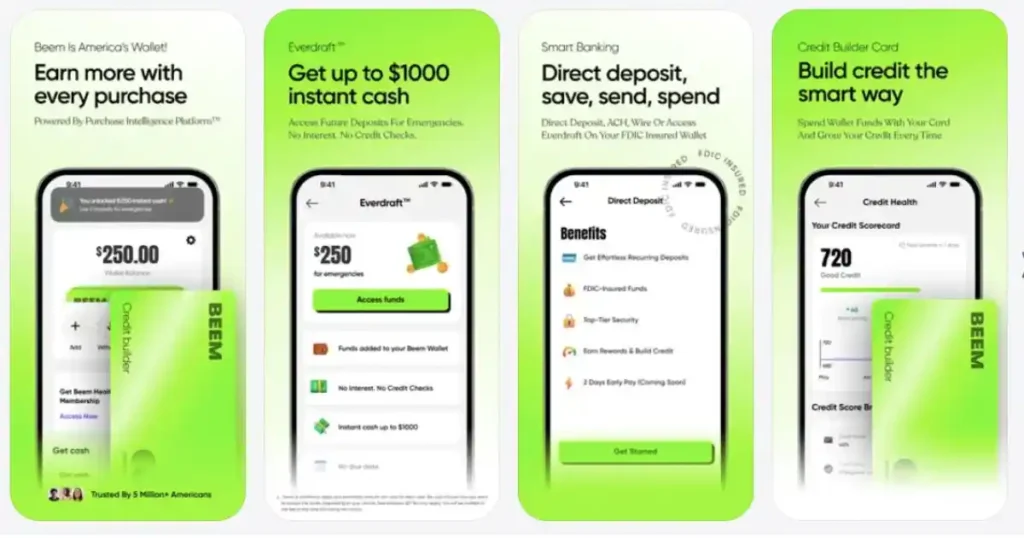
Everdraft offers advances up to $1,000 with no interest and no credit check, calibrated to the individual user’s verified income and account history. This limit is among the highest available in the no-interest cash advance market, and it is calibrated to the actual size of the problems variable income earners face rather than to the supplemental role an employer-paycheck-as-baseline product imagined for itself.
Eligibility is assessed through an AI-driven system that builds a probabilistic income model from the full pattern of account activity rather than pattern-matching against a biweekly direct deposit template. Tipped workers who deposit cash consistently, freelancers with variable project income, seasonal workers with concentrated earning periods, and gig workers with multiple income streams can all produce readable income signals for Beem’s verification system in ways that most standard rule-based systems cannot accommodate. This flexibility is not a marginal improvement. For the workers who fall outside the direct deposit template, it is the difference between access and exclusion.

The Five Dimensions Where the Differences Are Most Consequential
Moving beyond the structural overview, here are the five specific dimensions where the difference between Everdraft™ and standard cash advance products matters most for real users in real financial situations.
What the Advance Actually Costs
A standard cash advance with a monthly subscription, an express fee, and an accepted tip prompt costs the user a meaningful percentage of the advance amount per transaction. For small advances, this percentage can be surprisingly high. A $50 advance with a prorated $9.99 monthly fee and a $3.99 express fee costs approximately $14 in access costs on a $50 advance, which is a 28% transaction cost regardless of how it is labeled.
Everdraft costs zero in interest and zero in hidden fees. The comparison for identical advance amounts produces a direct, measurable financial difference in the user’s pocket after repayment. This dimension is the most immediately legible difference for a user evaluating their options. What does this actually cost me? For Everdraft, the answer is nothing beyond the advance amount itself.
How Income Type Affects Access
Standard cash advance apps built around direct deposit income verification systematically exclude a significant portion of the American workforce. Tipped workers, cash-income workers, seasonal workers, gig workers with variable income, self-employed individuals, and creators with royalty income are all imperfectly served or entirely excluded by systems designed around salaried employment.
Everdraft’s AI-driven verification is built to accommodate the full spectrum of how Americans actually earn, not just the most convenient subset. This is not a technical distinction without human consequences. For the workers who fall outside the direct deposit template, it is the difference between receiving help during a financial crisis and being turned away by an eligibility screen that cannot read their income.
What Happens Between Advance Requests
Open a standard cash advance app between advance requests and there is typically little to engage with. Your current balance. Your advance history. Perhaps a credit score display. The app has nothing to offer during the periods when you are not in financial distress. This single-function design means the platform does nothing to address the underlying conditions that make advances necessary in the first place.
Open Beem between advance requests and the platform is actively working on your financial situation. BudgetGPT is showing your cash flow trajectory for the next three weeks. DealsGPT has identified savings opportunities on your planned grocery run. JobsGPT has surfaced income opportunities that match your skills and availability. Your credit score is being actively developed through platform activity. The platform is working for you continuously, not just during moments of crisis.
The Trajectory the Platform Creates
Standard cash advance platforms create flat trajectories by design. The user requests an advance when needed, repays it, and their financial situation returns to the same state it was in before the advance. The platform does nothing to change the underlying conditions. The cycle continues indefinitely because the tool only addresses symptoms.
Beem creates an upward trajectory for users who engage with its tools. BudgetGPT improves spending awareness. DealsGPT and cashback reduce effective spending costs. JobsGPT increases income. Credit building develops financial access. The financial situation of an active Beem user in month twelve looks meaningfully different from month one, not because Beem gave them money but because the platform gave them tools that produced compounding improvements over time. A standard cash advance app provides a bridge over the gap. Beem provides a bridge and simultaneously works on filling the gap so fewer bridges are needed.
What Expanded Access Looks Like Over Time
Most standard cash advance apps have a fixed ceiling. A user with a perfect two-year repayment record may have a modestly higher limit than a new user, but the improvement is incremental and the ceiling is low. The platform keeps users in the advance tier indefinitely because that is the only tier the platform has.
Everdraft within Beem’s Full Access Mode offers up to $1,000, and Beem Boost creates a clear path to that limit through demonstrated responsible usage. More significantly, Full Access Mode also unlocks access to Beem’s personal loan products, offering up to $100,000 for qualifying users. The trajectory from a first Everdraft advance to personal loan eligibility is a trajectory from financial instability to mainstream financial access. No standard cash advance app offers this progression.
Where Standard Apps Still Have Advantages Worth Acknowledging
An honest comparison acknowledges the areas where standard apps have genuine advantages. Some have longer track records and larger user bases, which means more publicly available user reviews and more established customer service infrastructure. For users who weight peer review volume heavily in their decision-making, this established presence is a real consideration.
Some standard apps also offer advances to users whose account history is thinner than Beem’s verification system requires for meaningful eligibility, by accepting lower verification confidence in exchange for offering smaller advance amounts. For a brand-new user with minimal bank account history who needs $50 immediately, some standard apps may produce faster initial access to that specific small amount than Beem’s verification process accommodates. These are real advantages in specific contexts. They do not change the overall comparison picture, but acknowledging them is part of the honest assessment this article is built on.
The Question That Frames the Choice
When evaluating Everdraft against standard cash advance options, the most clarifying question is not which app delivers money fastest or which app has the most users. The clarifying question is this: do you want a tool that addresses your financial emergency, or a platform that addresses your financial emergency and simultaneously works on making future emergencies less likely?
Standard cash advance apps answer the first question adequately in many cases. Everdraft within the Beem platform answers both questions, and it answers the second one in a way that no standard app currently matches. For users looking for a short-term fix, any number of products may serve. For users looking for a financial partner that takes their long-term trajectory as seriously as their immediate cash need, Beem’s architecture is in a different category.
Conclusion
The cash advance market has come a long way from the payday loan storefronts of the 1990s. Standard cash advance apps represent genuine progress: lower costs, faster delivery, and more accessible eligibility than the predatory products they replaced. That progress deserves acknowledgment.
But progress relative to a harmful baseline is not the same as building the best possible tool. Everdraft™ is built against a different standard than payday loan replacement. It is built to serve the full financial reality of its users, which means no interest, no hidden fees, AI-driven verification that accommodates non-traditional income, advance limits that reflect real emergency costs, and a surrounding ecosystem of financial tools that work on the underlying conditions rather than just the immediate symptoms.
Frequently Asked Questions (FAQ)
What is the main difference between Beem Everdraft and standard cash advance apps?
The primary differences are cost structure, advance limits, income verification flexibility, and platform depth. Everdraft charges no interest and no hidden fees on advances up to $1,000. Most standard apps charge monthly subscriptions, express delivery fees, and use tip prompts that add significant per-transaction costs.
Does Beem Everdraft really charge no interest?
Yes. Everdraft is structurally a no-interest product. The amount advanced is the amount repaid, with no interest calculation, no APR, and no finance charges. This is not a promotional rate or a conditional offer. It is the permanent cost structure of the product, and all fees associated with Beem’s platform are disclosed transparently before any advance is requested.
How does Everdraft handle income types that standard apps reject?
Everdraft uses AI-driven income verification that builds a probabilistic income model from the full pattern of account deposit activity rather than requiring biweekly payroll direct deposits. This approach accommodates tipped workers, cash-income earners, seasonal workers, freelancers, and gig workers, provided their income deposits into the connected account consistently enough to produce a readable pattern.
Are there situations where a standard cash advance app might be a better choice?
Yes. Users who need a very small advance immediately and whose account history is too thin for Beem’s verification system to produce meaningful eligibility may find faster initial access on some standard platforms that accept lower verification confidence. Users who place high weight on peer review volume may also prefer platforms with larger established user bases. These are legitimate context-specific advantages that do not change the overall structural comparison.
How does the broader Beem platform change the value proposition?
It transforms the value proposition from emergency financial access to ongoing financial empowerment. BudgetGPT, DealsGPT, JobsGPT, Smart Money Transfers, credit building, tax tools, and personal loan access collectively address the underlying financial conditions that make advances necessary, not just the immediate symptom of a cash gap. Standard single-function apps provide emergency access.